English




Sintered Stone Countertops: Pros, Cons, Cost, Finishes and Applications
Quick Answer
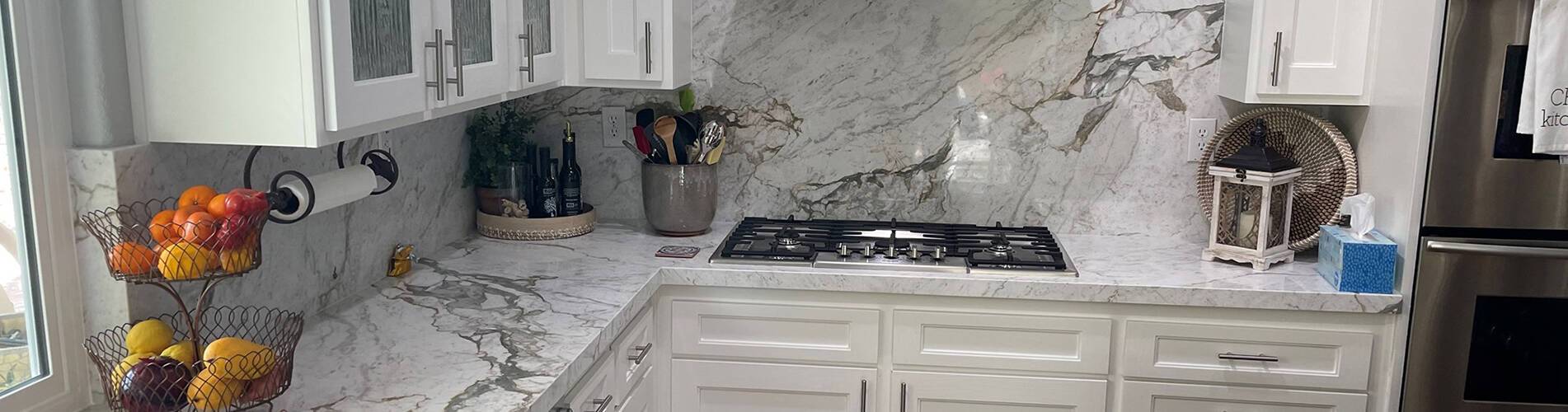
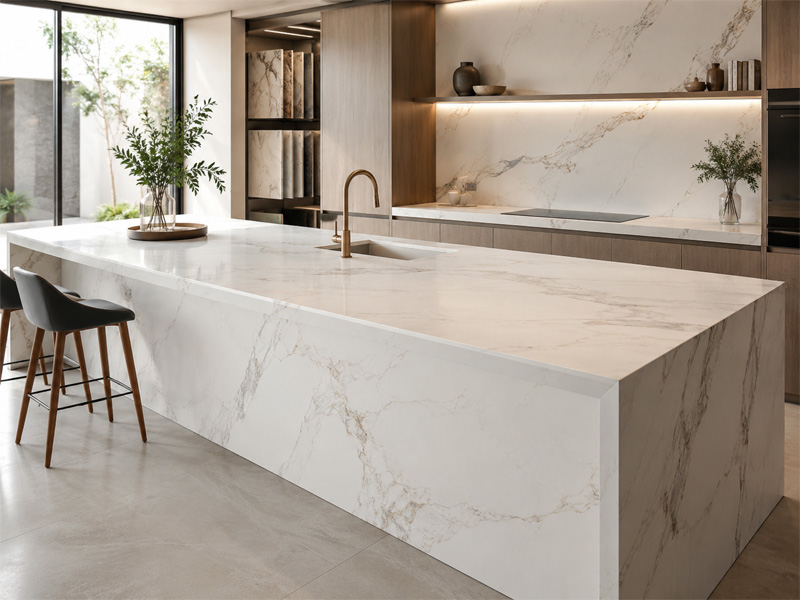
Sintered stone countertops are widely used in modern kitchens, bathroom vanities, kitchen islands, commercial counters, outdoor bars and custom furniture surfaces. They offer the visual appeal of natural stone with the performance advantages of an engineered mineral-based slab.
Many buyers compare sintered stone countertops with quartz countertops, marble countertops, granite countertops, porcelain countertops and Dekton alternatives because these materials can be used in similar spaces. However, countertop performance is not decided by appearance alone. Thickness, finish, edge design, cutouts, installation quality, project environment and supplier capability all affect the final result.
This guide explains where sintered stone countertops are used, which finishes are suitable for different applications, what affects cost, and how B2B buyers can choose the right countertop solution for residential, commercial and export projects.
Sintered stone countertops are durable work surfaces used for kitchens, islands, bathrooms, commercial counters, bars and furniture tops. Sintered stone is produced from mineral-based raw materials that are compressed and fired at very high temperatures, giving the surface strong resistance to heat, stains, moisture and daily wear.
The material background is explained in what is sintered stone, including composition, production process and basic material characteristics. After confirming the material direction, buyers can compare sintered stone slabs by size, thickness, color and finish before choosing a countertop surface.
Sintered stone is selected for countertops because it combines surface performance, design flexibility and large-format visual continuity. These advantages matter most when the selected slab, finish, support structure and fabrication method match the project requirements.
Heat resistance makes sintered stone suitable for kitchen countertops, restaurant counters, commercial food areas and outdoor islands where heat exposure may occur.
However, heat resistance should not be treated as unlimited heat protection. Long-term performance still depends on slab thickness, support structure, edge design, installation quality and supplier recommendations, especially in high-use commercial environments.
Sintered stone has a dense, low-porosity surface that helps resist common stains from food, beverages, oil, sauces, cosmetics and daily use.
This makes it suitable for:
Projects with higher hygiene requirements may need antibacterial or stain-resistant surface options. These functions should be confirmed by the specific product series and relevant test documentation, rather than assumed for every sintered stone product.
Low water absorption is important for countertops used in kitchens, bathrooms, laundry rooms, humid regions and wet commercial spaces. It helps reduce staining, moisture penetration and maintenance difficulty.
Moisture-resistant sintered stone countertops are especially useful for:
Humid-region and export projects may require specific water absorption data or moisture-resistance documentation.
Heavy-use countertop applications require more attention to slab thickness and structural support. Commercial kitchens, outdoor islands, laboratory worktops and technical counters may need stronger load-bearing performance than standard residential countertops.
Thicker slabs such as 12mm or above may be selected when bending strength, impact resistance, load-bearing performance and project-specific documentation are required.
The right thickness should be selected together with the countertop span, support structure, cutouts, edge design, overhang and installation method.
Large-format sintered stone slabs can reduce visible seams and create a cleaner countertop surface. This is especially valuable for islands, waterfall edges, reception counters and commercial feature surfaces.
Large-format sintered stone countertops are especially suitable for:
Bookmatched patterns, mitered edges and continuous veining can create a more architectural countertop appearance.
Different countertop projects require different slab structures, thicknesses, finishes and functional properties. Instead of choosing only by color, buyers should match the countertop type with the application, expected load, fabrication method and project documentation.
| Countertop Type | Key Features | Best For |
|---|---|---|
| Heavy-duty countertops | Thicker slabs, stronger bending performance and better support for demanding use | Commercial kitchens, outdoor islands, laboratory worktops |
| Lightweight composite countertops | Thin sintered stone laminated with lightweight backing | Floating bars, custom furniture, curved islands |
| Antibacterial and stain-resistant countertops | Functional surface treatment for hygiene and easier cleaning | Restaurants, food service areas, healthcare-related counters |
| Outdoor and weather-resistant countertops | UV resistance, anti-slip surface and freeze-thaw resistance depending on product | Outdoor kitchens, terraces, poolside bars |
| Moisture-resistant countertops | Very low water absorption for humid climates and wet areas | Bathrooms, laundry rooms, Southeast Asian projects |
B2B projects may also require technical documentation, test reports, export packaging and market-specific compliance support.
Surface finish affects appearance, cleaning, touch, glare, slip resistance and suitability for different spaces. The right finish should match the lighting environment, cleaning conditions and usage intensity.
A polished finish has a high-gloss, reflective surface. It is commonly selected for modern kitchens, dining counters, commercial tables and luxury residential interiors.
Polished sintered stone countertops are usually easy to wipe clean, making them suitable for daily kitchen use and commercial dining spaces. In strong lighting conditions, buyers should evaluate glare and avoid using the same finish in areas where slip resistance is required.
Best for:
A soft matte or satin finish has lower gloss than a polished surface. It reduces strong reflections while keeping a refined appearance.
This finish works well for high-end residential islands, hotel bars, minimalist kitchens and projects where lower glare and easier fingerprint control are important.
Best for:
A matte finish has a low-gloss surface and a more restrained visual effect. It works well in bathrooms, outdoor kitchens, wet areas and modern interiors.
Some matte surfaces may offer better anti-slip potential than polished finishes, depending on the surface structure. However, dark matte surfaces may show water marks, dust or fingerprints more easily than lighter finishes.
Best for:
A textured finish has a tactile surface structure. It can improve grip and slip resistance, making it useful for outdoor bars, commercial counters, wet areas and project spaces where surface contact and safety are important.
Textured surfaces are not always ideal for heavy-oil kitchen areas. Oil, sauce and residue may be harder to remove from deep textures than from polished or soft matte surfaces, so cleaning requirements should be evaluated before selection.
Best for:
Project-based orders may require functional surfaces such as antibacterial performance, slip resistance, UV resistance, freeze-thaw resistance or moisture resistance.
Functional finish options may include:
These functions should be confirmed by the specific product series and relevant test documentation. They should not be assumed as standard for every sintered stone countertop.
The best sintered stone application depends on how the selected slab handles heat, stains, moisture, load, cutouts, edge processing and installation.
Kitchen countertops require heat resistance, stain resistance, easy cleaning and reliable cutout processing for sinks, cooktops and faucets.
Residential kitchens often use soft matte, polished and marble-look designs. Commercial kitchens or high-use food areas should prioritize thicker slabs, easy-clean finishes, antibacterial options and project-specific documentation.
A marble-look kitchen with continuous veining across islands, worktops and backsplashes needs a slab with consistent pattern direction, such as the Dekton Calacatta Gold sintered stone worktop.
Large-format sintered stone slabs are especially suitable for kitchen islands because they reduce seams and create a continuous surface.
Waterfall islands require more than a matching color. Mitered edges, vein matching, seam planning and support structure all affect the final result.
When planning a kitchen island, buyers should consider:
Countertop-to-wall combinations work better when the surface, pattern and finish are planned together. Typhoon Crystal sintered stone wall panels can help create a continuous look from worktop to backsplash or feature wall.
Bathroom vanity tops require low water absorption, easy cleaning and stable appearance in humid spaces.
Hotel, apartment and humid-climate projects should focus on moisture resistance, finish selection, backsplash integration and edge protection. Soft matte and matte finishes are often suitable because they reduce glare and create a calm bathroom appearance.
Commercial countertops are used in restaurants, hotels, offices, retail stores, shopping malls and public interiors. In these spaces, cleaning performance, edge durability, maintenance and documentation are often more important than appearance alone.
Common commercial applications include:
Heavy-duty slabs, antibacterial surfaces, stain-resistant finishes and project-specific documentation may be required depending on the use environment.
Outdoor kitchens, terraces, villa bars and poolside counters require more careful product selection than indoor countertops.
Outdoor countertop applications should be checked for:
Not every sintered stone product is automatically suitable for outdoor use. Outdoor projects should be evaluated according to product specifications and local climate conditions.
Sintered stone can also be used for furniture tops, floating bars, dining tables, coffee tables and custom commercial surfaces. Furniture manufacturers, hotel suppliers and distributors often need surface consistency across different product formats.
Bulk furniture programs can use wholesale sintered stone table tops for dining tables, coffee tables and commercial table projects.
Countertop thickness affects appearance, strength, edge design, weight, cost and installation requirements. Different applications may require different slab structures.
| Structure | Typical Thickness / Feature | Suitable Uses |
|---|---|---|
| Thin lightweight countertop panels | 3–8mm with composite backing | Furniture tops, floating bars, curved islands |
| Standard countertop slabs | Around 12mm or above depending on application | Kitchen countertops, islands, commercial counters |
| Heavy-duty countertop slabs | Higher strength and load-bearing performance | Restaurant kitchens, outdoor islands, laboratory worktops |
Thin lightweight composite structures are useful for furniture, suspended designs, curved forms and projects where lower weight is important. Standard and heavy-duty slabs are more suitable for kitchens, islands, commercial counters and other work surfaces that require stronger support.
Thicker slabs such as 12mm or above may be selected when load-bearing performance, bending strength and commercial-use documentation are required.
The right thickness should always be selected together with the support structure, edge profile, cutout design and installation method.
Sintered stone countertops perform best when the slab, edge design, cutouts, support system and installation method are planned together.
Common edge options include:
Common cutouts include:
Fabrication quality is critical because edges, corners, openings and unsupported areas are more vulnerable than the center of the slab. Poor fabrication can cause chipping, cracking or installation problems.
Important fabrication considerations include:
Large-format slabs require careful handling during loading, unloading, cutting, transportation and installation. The material itself can be strong, but improper processing can reduce final countertop performance.
Sintered stone countertop cost should not be judged by slab price alone. Fabrication, edge processing, cutouts, installation, packaging and documentation can significantly affect the final project cost.
| Cost Factor | Why It Matters |
|---|---|
| Slab size | Larger slabs increase material, handling and transportation requirements |
| Thickness | Thicker or reinforced structures may cost more |
| Surface finish | Polished, matte, textured and functional finishes vary in cost |
| Edge profile | Mitered edges, built-up edges and waterfall edges require more fabrication |
| Cutouts | Sink, cooktop and faucet openings increase processing complexity |
| Installation | Professional handling and installation are required |
| Export packaging | Large-format slabs need stronger packaging and safer loading |
| Certification | Project-specific tests or documents may increase cost |
| Customization | Curved forms, bookmatch, special sizes and furniture panels may add cost |
For a simple residential kitchen, cost may be mainly affected by slab size, thickness, finish and cutouts. Commercial or export projects may also involve technical reports, packaging, destination market requirements and supplier capability.
Price research should focus on the full countertop specification, not only the slab category. Buyers need project drawings, slab requirements and quantity details before requesting a formal quotation.
Many buyers compare sintered stone countertops with quartz, marble, granite, porcelain and Dekton. These materials may be used in similar spaces, but their composition, maintenance, heat resistance, appearance and fabrication requirements are different.
| Material | Compared with Sintered Stone Countertops | Better For |
|---|---|---|
| Quartz | Quartz has a mature countertop market, but heat resistance and outdoor suitability may require careful comparison | Standard indoor kitchens and bathroom vanities |
| Marble | Marble offers natural luxury veining, but it usually requires more sealing and maintenance | Natural stone preference and luxury decoration |
| Granite | Granite is durable and natural, but color consistency and sealing requirements vary | Traditional countertop projects |
| Porcelain | Porcelain and sintered stone may be similar in production logic, but thickness, structure and fabrication options can differ | Walls, floors, lightweight surfaces and selected countertops |
| Dekton | Dekton is a branded ultra-compact surface often compared with sintered stone in high-end projects | Premium countertops, outdoor surfaces and branded specifications |
Material comparison should start from the project risk: heat exposure, sealing needs, outdoor use, fabrication difficulty, brand specification or maintenance requirements.
Porcelain-related projects should compare sintered stone vs porcelain before choosing slabs for countertops. Specifications that mention Dekton or ultra-compact surfaces may also require a review of sintered stone as a Dekton alternative.
For export and B2B projects, countertop selection should also consider destination market, climate, regulation, building habits and customer preferences.
| Target Market | Recommended Focus | Why It Matters |
|---|---|---|
| North America | 12mm or above, commercial safety requirements, outdoor suitability | Suitable for kitchens, commercial counters and outdoor islands |
| Europe | Lightweight or eco-oriented options, recycled content and EPD-related documentation when required | Fits sustainability and lightweight design preferences |
| Middle East | UV resistance, weather resistance and decorative luxury finishes | Suitable for outdoor bars, villas, hotels and high-sunlight areas |
| Southeast Asia | Moisture resistance, very low water absorption and easy-clean finishes | Suitable for humid kitchens, bathrooms and commercial interiors |
Depending on the project and destination market, buyers may need documentation related to slip resistance, UV resistance, freeze-thaw performance, recycled content, food contact, moisture resistance or local safety standards.
A countertop used in a North American restaurant, a European residential project, a Middle Eastern outdoor bar and a Southeast Asian apartment kitchen may require different slab structures, finishes and supporting documents.
Export-oriented buyers should evaluate whether the supplier can support samples, technical data, packaging guidance and project-based recommendations.
Like any countertop material, sintered stone has both advantages and considerations. This section summarizes the main decision points for buyers who need a quick comparison.
Heat resistance
Suitable for kitchens, cooking areas and commercial counters where heat exposure may occur.
Stain resistance
Helps resist common stains from oil, sauces, coffee, wine, cosmetics and daily use.
Low water absorption
Useful for kitchens, bathrooms, laundry rooms and humid environments.
Large-format appearance
Reduces seams and supports continuous designs for islands, backsplashes and commercial counters.
Wide design options
Available in marble-look, granite-look, concrete-look, stone-look, solid color, terrazzo and metallic effects.
Multiple finishes
Polished, soft matte, matte, textured and functional finishes can be selected according to application.
Indoor and selected outdoor use
Suitable for selected outdoor kitchens, terraces and commercial exterior-related projects when the product and installation system are appropriate.
B2B customization potential
Different thicknesses, finishes, structures and functional surfaces can support project-based customization.
Professional fabrication is required
Cutting, edging, sink openings and installation should be handled by experienced fabricators.
Edges may chip if poorly processed
Improper edge finishing, transportation or impact can cause chipping, especially at exposed corners.
Large slabs need careful handling
Packaging, loading, unloading, cutting and installation must be planned carefully.
Textured surfaces may require more cleaning effort
Deep textures can hold oil or residue more easily than smooth finishes.
Dark matte finishes may show marks
Water marks, fingerprints or dust may be more visible on some dark matte surfaces.
Cost varies by project
Thickness, finish, slab size, edge design, cutouts, certification and installation all affect price.
Not every supplier can support complex processing
Curved countertops, lightweight composite structures, bookmatch, mitered edges and export packaging require stronger supplier capability.
Choosing the right sintered stone countertop should start with the application, not only the color.
A kitchen island, restaurant counter, bathroom vanity, outdoor bar and laboratory worktop have different requirements.
Ask first:
Use thin lightweight composite panels for furniture, floating bars and curved designs. Use standard or heavy-duty slabs for kitchens, commercial counters and outdoor islands where stronger structure is needed.
Choose polished surfaces for easy cleaning and bright interiors. Choose soft matte for lower glare and refined residential spaces. Choose matte for bathrooms and modern designs. Choose textured surfaces for outdoor or wet environments where grip matters.
Before confirming the slab, check whether the project needs:
A qualified supplier should be able to provide slab size, thickness, finish, packaging information, samples, technical data, project photos, customization support and export experience.
For B2B buyers, supplier capability is as important as the slab itself. Choose a sintered stone supplier that can support product selection, fabrication advice, documentation and project-based recommendations.
Yes. They are suitable for kitchens because they offer heat resistance, stain resistance, low water absorption and easy cleaning. Kitchen layouts, edge details, backsplash combinations and island applications should be confirmed before fabrication.
Yes. Sintered stone has strong heat resistance for normal kitchen and commercial countertop use, but slab thickness, support structure, installation and daily use still affect long-term performance.
Sintered stone has a dense, low-porosity surface, so it resists many common stains from food, oil, coffee, wine and cosmetics. Daily cleaning is usually simple with water, mild detergent and a soft cloth.
Sintered stone may offer advantages in heat resistance, low water absorption and selected outdoor applications. Quartz remains widely used for indoor kitchens, so the better choice depends on project needs, budget, design and installation conditions.
Selected sintered stone products can be used outdoors, but buyers should confirm UV resistance, weather resistance, freeze-thaw performance, installation system and supplier recommendations before using them for outdoor kitchens, terraces or exterior counters.
The best thickness depends on application, span, support, cutouts and load requirements. Lightweight composite panels may use 3–8mm sintered stone with backing, while standard or heavy-duty countertops often use thicker slabs such as 12mm or above.
Polished and soft matte finishes are common for kitchens because they are easy to clean and suitable for modern interiors. Matte finishes can also work well, while textured finishes should be used carefully in heavy-oil cooking areas.
Textured surfaces provide better grip and a stronger tactile effect, but they may require more cleaning effort than smooth surfaces. They are usually more suitable for outdoor bars, wet areas and decorative commercial counters than heavy-oil kitchen worktops.
Cost depends on slab size, thickness, surface finish, edge profile, cutouts, installation, packaging, certification and customization. Accurate pricing requires drawings, slab specifications, finish requirements and quantity.
Yes. Large-format sintered stone slabs are suitable for waterfall islands. Mitered edges, vein matching, seam planning and professional installation are important for achieving a clean and continuous result.
Sintered stone is durable, but edges and corners can chip if they are poorly processed, transported incorrectly or hit by strong impact. Proper edge design, corner radius, packaging and professional installation help reduce this risk.
Buyers who are ready to compare colors, thicknesses and finishes can review slab options and prepare project drawings, required size, thickness, finish and application details. A supplier can then recommend suitable countertop options for residential, commercial and export projects.
Sintered stone countertops should be selected by application first, then matched with thickness, finish, edge design, cutouts, support structure and supplier capability.
For residential kitchens, appearance, cleaning and daily performance may be the main priorities. Commercial and export projects should also confirm load-bearing performance, antibacterial options, anti-slip requirements, UV resistance, freeze-thaw resistance, moisture resistance, packaging and project documentation.
After confirming the application, thickness, finish, fabrication needs and project documentation, buyers can request a countertop quote to discuss samples, catalog and project specifications.
Contact us for sintered stone countertop samples, slab options, thickness recommendations, fabrication advice, packaging advice and export quotation support.
Categories
New Blog
 ROOM 205,NO.45, MIDDLE HAIJING ROAD,XIAMEN,AREA OF PILOT FREE TRADE ZONE(FUJIAN)OF CHINA
For inquiries about our products or pricelist, please leave to us and we will be in touch within 24 hours.



© Copyright: 2026 XIAMEN EXCELLENT STONE CO.,LTD. All Rights Reserved.

IPv6 network supported