English




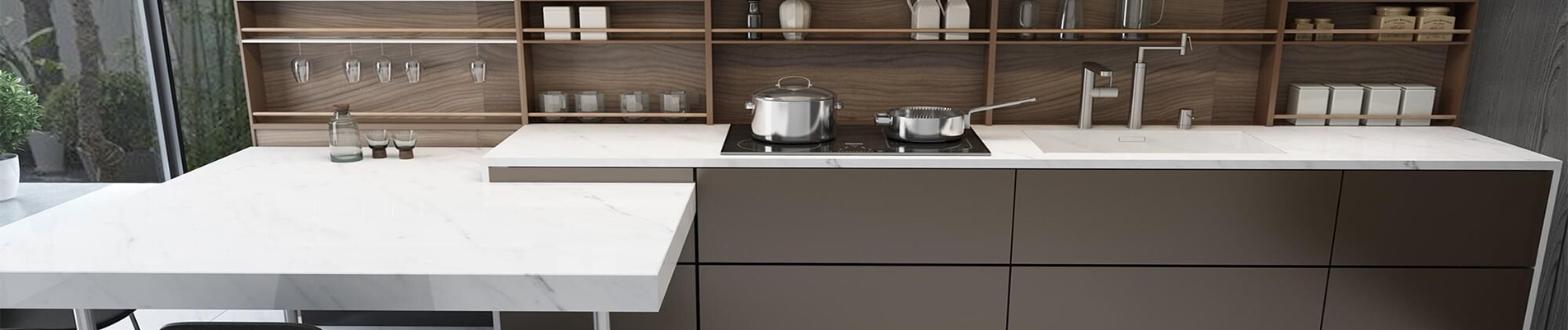

Technical Data Sheet Tema Grey Granite Ghana G603 / Ghana Salt & Pepper Granite for pavers, cobblestones, curbstones, steps, coping, slabs, and cut-to-size stone. 1. Product Identification Item Description Product Name Tema Grey Granite Alternative Names Ghana G603 / Ghana Salt & Pepper Granite Material Type Natural Granite Color Grey, salt-and-pepper Origin Ghana Loading Port Tema Port, Ghana Supplier Excellent Stone 2. Physical & Mechanical Properties Property Test Method Result Unit Apparent Density EN 1936 2680 kg/m³ Open Porosity EN 1936 0.52 % Water Absorption EN 13755 0.16 % Flexural Strength EN 12372 19.7 MPa Flexural Strength After Freeze-Thaw EN 12371 / EN 12372 18.0 MPa Abrasion Resistance, Polished EN 14157 14.2 mm Slip Resistance, Polished EN 14231 Dry 56 / Wet 16 SRV Compressive Strength EN 1926 166 MPa Compressive Strength After Freeze-Thaw EN 12371 / EN 1926 185 MPa Breaking Load at Dowel Hole EN 13364 2025 N Petrographic Description EN 12407 Medium-grained quartz monzonite / diorite — Note: Test values are based on available SGS report data. Natural stone may vary between blocks and production batches. 3. Material Description Grey salt-and-pepper granite Black, white, and light grey mineral grains Medium-grained natural stone texture Suitable for exterior paving, curbing, landscape, and architectural stone Polished finish appears darker Flamed or bush-hammered finish appears lighter 4. Product Forms & Common Sizes Product Form Common Sizes Metric Reference Finish Options Typical Use Granite Pavers 12" × 12" to 24" × 36" 305 × 305 mm to 610 × 914 mm Flamed / Thermal, Bush-hammered, Sawn Patio, walkway, garden path Thick Pavers 12" × 12", 12" × 24", 24" × 24" 305 × 305 mm, 305 × 610 mm, 610 × 610 mm Flamed, Bush-hammered Pedestrian paving, outdoor paving Thin Cobblestone Pavers Approx. 9" × 5" × 2.5" nominal 229 × 127 × 63 mm Flamed top, split sides, tumbled edges Patio, walkway, driveway border Standard Belgian-Block Style Cobblestone Approx. 9" × 5" × 5" nominal 229 × 127 × 127 mm Split, Tumbled, Flamed top Driveway edging, apron, heavy border Jumbo Cobblestone Approx. 10" × 7" × 4" nominal 254 × 178 × 102 mm Split, Tumbled Driveway, edging, landscape border Classic Cobblestone Approx. 12" × 6" × 3" nominal 305 × 152 × 76 mm Split, Tumbled, Flamed top Patio, walkway, edging Cube Cobblestone Approx. 4" × 4" × 4" nominal 102 × 102 × 102 mm Split, Tumbled Mosaic paving, garden edging Landscape Cobble Approx. 8" × 4" × 4" nominal 203 × 102 × 102 mm Split, Tumbled Landscape border, garden path Curbstone / Kerbstone 4"–8" wide, 9"–18" deep, 24"–10' long Custom sizes Flamed, Sawn, Split face Road curb, driveway edge, parking area Steps & Treads 7" thick, 3'–8' long Custom siz...
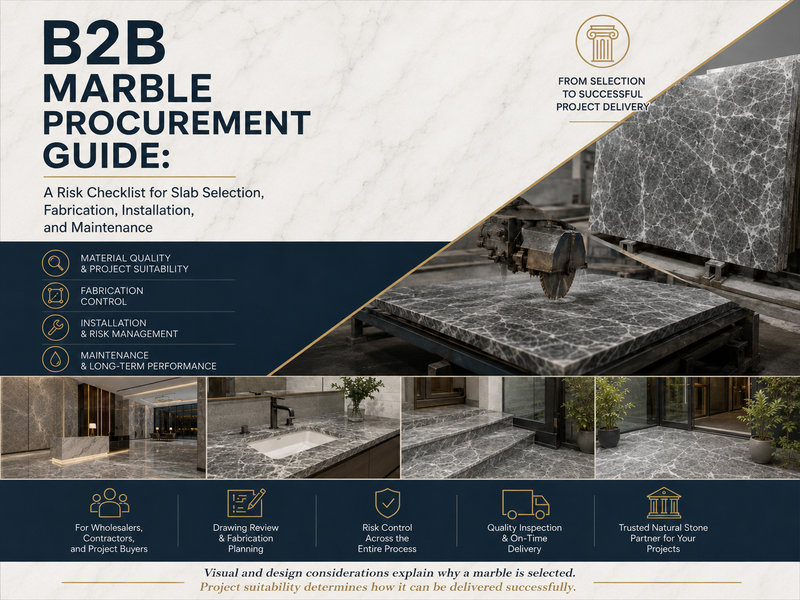
Introduction: Why Can the Same Premium Hermes Grey Marble Lead to Different Project Outcomes? The same Hermes Grey marble was used in two different projects. In one hotel flooring project, breakage occurred when the client cut slabs into tiles. In another project, the same material was used for entrance stone pieces and 70 vanity tops, and the order was delivered successfully. Neither project used “poor-quality stone.” The test reports were acceptable. So where did the difference come from? The answer is simple: the same premium natural marble can perform very differently under different fabrication methods, site conditions, and project control processes. This is one of the most underestimated issues in B2B marble procurement. As a supplier of natural stone and engineered stone, Excellent STONE works with natural marble projects under one basic principle: marble procurement starts with visual and design selection. Color, veining, origin, design intent, and client preference are usually the first reasons a marble is chosen. For stone wholesalers, contractors, and project buyers, the visual effect should remain a priority. However, once the visual direction is confirmed, a second level of evaluation is required: is this marble suitable for the specific fabrication method, installation condition, and maintenance expectation of the project? Design and visual appeal explain why a marble is selected. Project suitability determines whether it can be delivered successfully. This guide does not challenge the importance of visual selection. Instead, it is based on natural marble supply, fabrication coordination, and project delivery experience. Its goal is to help wholesalers, contractors, and project buyers identify key risks in cutting, drilling, layout, installation, and maintenance before the order moves too far into production. For a step-by-step material selection framework beyond this procurement white paper, read our Marble Slab Selection Guide for Commercial Projects. Excellent Stone processes marble columns precisely using advanced CNC bridge cutting and automated polishing technology. Who Is This Guide For? This guide is written for B2B readers involved in marble procurement and project delivery: Stone wholesalers: teams that need to evaluate batches, slab condition, and supply stability. Contractors: teams that need to confirm whether a marble is suitable for cut-outs, stairs, thresholds, vanity tops, flooring, or feature walls. Project buyers: buyers who need to balance budget, appearance, lead time, breakage risk, and maintenance expectations. Design implementation teams: teams that need to turn a design material into a product that can be fabricated, installed, and maintained. 1. Before Buying Marble, How Should Material Quality and Project Suitability Be Evaluated? Key Points Passing technical requirements does not automatically mean the marble is suitable for every project. Good slab appearance, consistent color, and acceptable...
1
pages ROOM 205,NO.45, MIDDLE HAIJING ROAD,XIAMEN,AREA OF PILOT FREE TRADE ZONE(FUJIAN)OF CHINA
For inquiries about our products or pricelist, please leave to us and we will be in touch within 24 hours.



© Copyright: 2026 XIAMEN EXCELLENT STONE CO.,LTD. All Rights Reserved.

IPv6 network supported