English








Introduction: From Design-Selected Marble to Project-Ready Marble
What makes a marble supplier valuable in a commercial project? It is not only the ability to provide attractive slabs, competitive prices, or fast shipment. A good supplier helps buyers avoid the wrong approval decision before the stone is cut, fabricated, shipped, or installed.
In construction, rework is rarely a small inconvenience. A 2026 ASCE summary of field rework research reported that actual precompletion rework averaged 0.38% of contract value, and the figure rose to 0.76% when postcompletion corrections were included, with some projects reaching 7.34%. Although this is not marble-specific data, it shows why accurate material review and early project communication matter before an order is approved.
Commercial marble selection often starts with design intent. A slab may be selected because it supports the atmosphere, visual language, and material character of a commercial space. But design approval is only the beginning. The next question is whether the same marble can perform under the project’s real application, fabrication, installation, and maintenance conditions.
This is where supplier experience matters. We do not approve of marble only because it looks good in slab form. We read the stone against the project: where it will be used, how it will be fabricated, what risks the application will amplify, and what must be adjusted before it becomes project-ready.
For a broader procurement framework, read our Marble Project Suitability White Paper.
Quick Answer: How to Choose the Right Marble for a Commercial Project
The right marble for a commercial project is not chosen by stone name alone. It should be reviewed by application area, slab condition, fabrication method, installation condition, and maintenance expectation.
A marble that works well for a feature wall may not work well for a stair tread, wet floor, or countertop with cut-outs. The goal is not only to select an attractive slab, but to protect the stone’s design value under real project conditions.
What Does “The Right Marble” Mean for a Commercial Project?
After the design intent is clear, the next step is to define what “right” means in project terms.
The right marble is not always the whitest stone, the strongest test report, or the most dramatic slab in the warehouse. For commercial projects, the right marble is decided by the project condition.
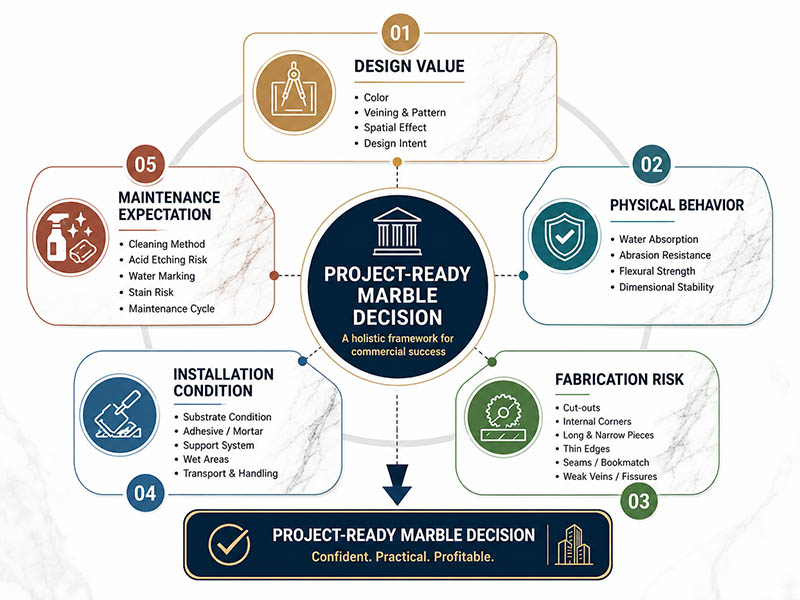
In this guide, “the right marble” means the marble whose design value, physical behavior, fabrication risk, installation condition, and maintenance expectation can work together under the project’s real use condition.
ASTM C503/C503M lists physical requirements for marble dimension stone, including absorption, compressive strength, abrasion resistance, and flexural strength. These data points matter, but they do not automatically approve a stone for every application.
In practice, we read technical data together with project conditions. Abrasion resistance matters more in flooring. Flexural behavior matters more for stairs and long pieces. Absorption becomes more important in wet areas and light-colored stones. A visually dramatic marble may work well for a feature wall but create risk in narrow structural pieces.
This is why project suitability is different from general material quality. Technical data and slab inspection confirm baseline performance, but final approval depends on application, fabrication method, slab condition, installation capability, and maintenance responsibility.
How to Inspect Marble Slab Quality Before Approval
For wholesalers and contractors, slab inspection is one of the first ways to reduce later claims, fabrication disputes, installation delays, and unexpected project costs.
The first review is practical and visible. We inspect slab appearance, color range, veining, thickness, finish consistency, repaired areas, visible cracks, and batch consistency.
A basic marble slab inspection should include:
- Overall slab appearance and color range
- Veining, movement, and batch consistency
- Thickness and finish consistency
- Visible cracks, natural lines, and repaired areas
- Surface consistency and filling condition
- Suitability for the intended cutting plan
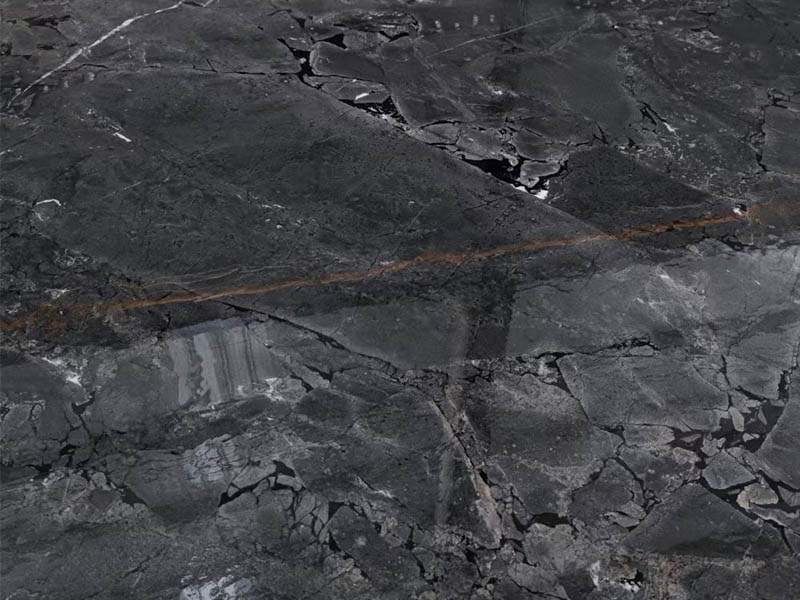
But slab appearance alone is not enough. A slab that looks clean and consistent may still create project risk if its properties do not match the application or fabrication method. At the same time, a natural line or repaired area does not automatically make a slab unusable. The key question is whether the feature creates risk in cut-outs, long narrow pieces, high-stress edges, or wet-area exposure.
The same logic applies to test reports. ASTM C1353 explains that abrasion resistance testing can rank stone performance, but laboratory abrasion data alone cannot predict actual wear performance in use.
Data helps us understand the stone. Project context tells us what that data means.
Application-Based Marble Review
Different application areas amplify different stone behaviors. Use this quick matrix to review the main risk and possible adjustment before approving marble for a commercial project.
Commercial FlooringMain Risk: Possible Adjustment: |
Countertops & Vanity TopsMain Risk: Possible Adjustment: |
Feature Walls & Large SlabsMain Risk: Possible Adjustment: |
Stairs, Thresholds & Long PiecesMain Risk: Possible Adjustment: |
Bathrooms & Wet AreasMain Risk: Possible Adjustment: |
Project Review FocusDecision Point: Goal: |
How to Choose Marble for Commercial Flooring
Commercial flooring should not be reviewed only by strength or thickness. Traffic responsibility is often the more useful starting point. A marble used in a hotel lobby traffic lane faces different pressure from the same marble used in borders, inlays, or decorative zones.
For a full flooring-specific decision path, read our How to Choose Marble for Commercial Flooring guide.
NSI’s Dimension Stone Design Manual discusses abrasion resistance, installation conditions, thresholds, stairs, and substrate flatness, which supports the point that marble flooring is not approved by stone name alone.
Best Marble for Countertops and Vanity Tops
Countertop selection often starts with slab movement, bookmatching potential, and edge design. But fabrication changes the way stone behaves. Sink cut-outs, inside corners, overhangs, seams, and edge profiles all concentrate stress.
The key review question is whether the stone’s veins, repaired areas, and slab integrity are compatible with the intended fabrication plan.
How to Choose Marble for Feature Walls and Large Slab Applications
Feature walls often use marble because of strong movement, bold veining, or brecciated structure. These visual qualities are not problems by themselves. They are often the reason the stone is selected.
The review point is whether the slab has enough integrity to perform as a large vertical panel. Backing, panel size, resin treatment, anchorage method, and handling sensitivity all become part of approval.
Marble for Stairs, Thresholds, and Long Pieces
Long pieces turn marble from a slab surface into a narrow structural component. The risk comes from the relationship between stone structure and piece geometry.
A weak line that is manageable in a wall panel may become a breaking path in a stair tread or threshold. This is why cutting direction, thickness, edge profile, reinforcement, and packaging must be reviewed together.
Marble in Bathrooms and Wet Areas
Wet-area suitability is not decided by absorption alone. Water, adhesive, filling condition, finish, drainage, and maintenance all act together.
Sealing may reduce staining risk, but it does not remove every wet-area risk. Marble maintenance also matters because calcite-based stone is sensitive to acidic cleaners.
What If the Marble You Choose Does Not Fully Match the Application?
A selected marble does not need to be rejected immediately when it does not fully match the application. The better question is: under what conditions can this marble still work, and what must change to make it project-ready?
When a selected marble does not fully match the application, the review should follow four steps:
- Identify the design value that should be preserved.
- Locate where the application concentrates risk.
- Decide whether the risk can be controlled by fabrication, installation, or maintenance planning.
- Adjust the stone position, detail, or material choice when the original plan creates unacceptable risk.
Commercial Flooring: When the Preferred Marble Is Not Ideal for Heavy Traffic
A client may prefer a marble for its visual effect, even when the stone is not ideal for heavy commercial traffic. The first decision is whether the stone must carry the main traffic load or mainly support the floor’s design language.
In main entrances, corridors, or lift lobbies, approval should include finish, abrasion behavior, slip performance, cleaning method, and maintenance cycle. Where the marble mainly serves a design role, it may remain in borders, inlays, low-wear areas, or controlled decorative zones. The main walking path may use a more traffic-resistant stone or another material while the selected marble preserves the project’s visual language.
This solution works because many flooring failures are not immediate breakage. They are long-term dulling, scratching, slip complaints, staining, cleaning difficulty, and maintenance disputes. For a deeper flooring decision framework, see our commercial marble flooring selection framework.
Countertops and Vanity Tops: Separating Fabrication Risk From Use-Mark Risk
A marble with beautiful movement may still include weak lines, repaired areas, higher absorption, or acid sensitivity. The review should separate structural risk from use-mark risk.
Weak areas near undermount sink cutouts, inside corners, thin strips, mitered edges, or overhangs become fabrication risks. The solution may be cutout adjustment, larger inside corner radius, local reinforcement, simplified edge profile, CNC cutting, CNC edge profiling, or finished-piece inspection.
Acid etching, oil marks, water marks, and cleaning sensitivity require more than fabrication control. They also require sealing boundaries, use expectations, and maintenance communication. NSI notes that true marble is based on calcite crystal, which is vulnerable to mild acids commonly found in kitchen and bar settings.
Feature Walls: Preserving Visual Impact While Controlling Panel Integrity
A dramatic marble selected for a feature wall should not be rejected simply because it is fabrication-sensitive. Strong veining, movement, and brecciated structure can be the design value. The key review point is whether that visual value also comes with slab integrity risk.
Open lines, repaired zones, mesh backing, resin treatment, or panel flatness concerns may require stronger slabs for the main visual area, controlled panel size, backing or reinforcement, mesh and resin compatibility checks, or composite panel or honeycomb backing for large slabs.
This solution works because a feature wall is both a visual surface and a large vertical stone system. The goal is not to weaken the design effect. The goal is to keep the large panel stable enough to deliver that design safely.
Stairs, Thresholds, and Long Pieces: Managing Weak-Line Direction
For stairs, thresholds, door frames, and long pieces, the first check is whether veins, natural lines, or fissures create a breaking path across the narrow direction.
Local and controllable risks may be addressed by changing cutting direction, shortening the piece, increasing thickness, simplifying the edge profile, adding backing or reinforcement, improving packaging, or confirming full and even site support.
This solution works because long pieces create bending and handling stress. The problem is not just that a stone is “fragile.” The problem is the relationship between the stone’s internal structure and the geometry of the finished piece.
Bathrooms and Wet Areas: Reading Water, Finish, Filling, and Maintenance Together
For light marble, dark polished marble, or travertine in a bathroom or shower area, absorption alone is not enough to approve the application. The main risk may come from water shadow, adhesive staining, open voids, filled or unfilled condition, finish slip behavior, cleaning chemicals, or maintenance expectation.
For porous stone or travertine, filling may be required. NSI’s travertine course treats travertine selection, fabrication, installation, maintenance, uses, and limitations together, which supports the idea that travertine is not evaluated simply by whether it can be used, but by how it is filled, installed, finished, and maintained.
For wet floors, finish may need to change. For light stone, adhesive and substrate staining must be controlled. For dark polished marble, water marks and cleaning marks should be expected and communicated. Sealing can reduce certain risks, but it should not be presented as a stain-proof or maintenance-free promise.
How We Turn a Design Choice Into a Project-Ready Marble Plan
Project-Ready Marble Plan
From Design Choice to Project-Ready Marble
A selected marble should be reviewed through design intent, application risk, slab condition, fabrication details, installation conditions, and maintenance expectations before final approval.
|
01 Confirm Design IntentPreserve the desired color, veining, movement, bookmatching effect, and design atmosphere. |
→ |
02 Review Application RiskCheck whether the marble will be used for flooring, countertops, walls, stairs, or wet areas. |
→ |
03 Inspect Slab ConditionReview color range, veining, thickness, finish consistency, cracks, repaired areas, and batch consistency. |
→ |
04 Check Fabrication DetailsEvaluate cut-outs, inside corners, long pieces, weak-line direction, edge profiles, and reinforcement needs. |
→ |
05 Approve, Adjust, or ReplaceAdjust the finish, cutting direction, reinforcement, panel size, or maintenance plan before final approval. |
When a client selects a marble, our role is not to approve it by appearance alone or reject it too quickly. We first identify the design value the client wants to preserve, then review what the application will amplify.
Flooring amplifies wear and maintenance. Countertops amplify cut-outs and local stress. Feature walls amplify large-panel integrity. Long pieces amplify weak-line direction. Wet areas amplify water, adhesive, filling, and cleaning behavior.
If the risk can be controlled, the answer may be finish adjustment, reinforcement, CAD review, fabrication control, packaging improvement, or maintenance planning. If the original plan creates unacceptable risk, we may recommend changing the stone position or selecting a visually similar but lower-risk material.
To turn a selected slab into a project-ready marble plan, contact us for application-based marble review.
Conclusion: Choosing the Right Marble Means Making a Project Decision
Choosing marble for a commercial project is not only choosing a slab or a visual style. It is deciding whether the stone’s design value can be protected under the project’s real application, fabrication, installation, and maintenance conditions.
The right marble is the one whose design value can be protected by the right project plan.
The next related question is: what is marble soundness, and why does it matter in stone projects? For that topic, read What Is Marble Soundness? Major Sound Marble Types and Their Value in Stone Projects, which helps stone contractors and wholesalers understand the world’s major sound marble types and how the right material choice can protect project margin.
FAQ: Commercial Marble Selection
What is the most important factor when choosing marble for a commercial project?
The most important factor is project suitability. The marble should match the application area, fabrication method, installation condition, size format, and maintenance expectation, not only the desired visual style.
Can a visually imperfect marble slab still be used?
Yes. A natural line, repaired area, or visible variation does not automatically make a slab unusable. The key question is whether that feature creates risk in the intended application, cutting plan, or installation condition.
Is ASTM test data enough to approve marble for a project?
No. ASTM test data helps confirm baseline material properties, but it does not approve a marble for every application. The data must be read together with project context.
Why can the same marble work on a wall but fail on a floor?
A wall and a floor amplify different stone behaviors. A feature wall emphasizes slab integrity and panel size, while commercial flooring emphasizes wear, slip performance, cleaning method, and maintenance cycle.
Should a selected marble be rejected if it does not fully match the application?
Not always. The better approach is to review whether the risk can be controlled by changing the finish, cutting direction, reinforcement, installation method, or maintenance plan.