English




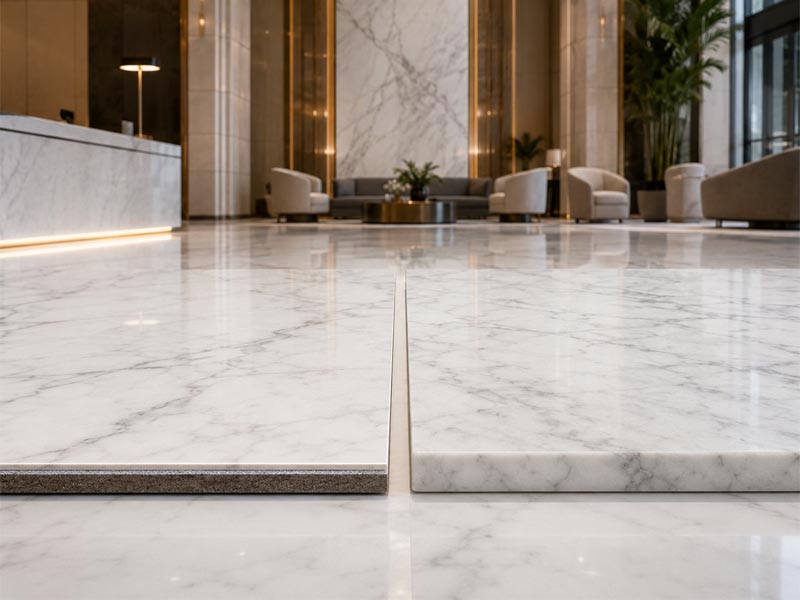
Thin marble panel beside solid marble flooring
Commercial marble flooring is not only a design decision. For project buyers, contractors, and stone wholesalers, it is also a decision about weight, cost, installation risk, maintenance depth, and long-term responsibility.
Thin marble panels are becoming more common in commercial interiors because many projects want the natural beauty of marble without the full weight, material consumption, and installation burden of traditional solid slabs. However, thin marble panels should not be treated as a universal replacement for solid marble flooring.
The right choice depends on the project area, traffic level, substrate condition, panel structure, marble type, installation method, and maintenance expectation. Before comparing thin panels and solid slabs, buyers should also review the broader flooring selection logic in our guide on how to choose marble for commercial flooring.
Commercial projects usually consider thin marble panels for three reasons: lower weight, better material yield, and easier use of expensive marble in controlled areas.
Traditional solid marble flooring is commonly around 20mm thick or above. A 20mm marble slab weighs about 50kg per square meter if calculated with an estimated marble density of 2.5g/cm³. A 15mm marble slab weighs about 37.5kg per square meter. This 12.5kg/m² difference may reduce handling pressure, especially in upper-floor interiors, renovation projects, and projects with tighter logistics conditions.
Thickness also affects stone consumption. In one sample calculation based on a 2.5mm saw blade allowance, one cubic meter of marble block may produce about:
| Slab thickness | Approx. slab yield per m³ |
|---|---|
| 18mm | 45.5 m² |
| 20mm | 41.7 m² |
| 25mm | 34.5 m² |
| 30mm | 29.4 m² |
This shows why thinner slabs can improve block yield. In many project estimates, thinner marble solutions may reduce raw stone pressure by around 15%–25%, and lighter shipping weight may reduce logistics pressure by around 20%–30%. These figures should be treated as project-based estimates, not fixed promises. The final cost still depends on marble type, cutting loss, backing material, adhesive system, edge treatment, installation labor, packaging, and transport distance.
Thin marble panels are valuable when a project wants to keep the visual value of natural marble while reducing weight and stone usage in controlled flooring zones.
A thin marble panel is not fake marble. Its visible surface is still natural marble, so it can keep real veining, mineral depth, color movement, polished reflection, and natural stone texture.
However, a thin marble panel is not judged only by the surface marble. Its performance depends on the full flooring system review, including:
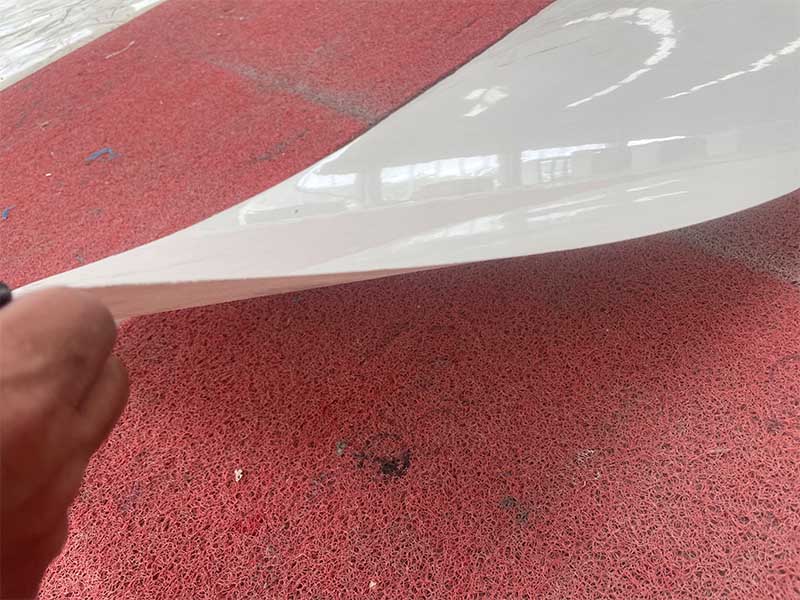
Close-up showing thin marble panel flexibility
In stone thickness classification, 20mm is often treated as a conventional slab thickness. Thin slabs are commonly discussed around 10–15mm, while ultra-thin stone may be below 8mm and is often used when projects have weight-reduction requirements or want to save material.
For commercial flooring, the important question is not only “How thick is the marble?” but also “Is the whole panel system suitable for flooring?”
A thin marble panel should be approved as a composite system, not as a traditional solid marble tile.
Solid marble flooring is still the better choice when the project needs stronger material continuity, deeper maintenance value, better edge processing, and longer service tolerance.
It is usually more suitable for:
The biggest advantage of solid marble is material depth. Marble flooring can often be polished and restored after years of use, but every grinding and polishing cycle removes a small amount of material. A very thin marble surface gives the owner less renovation depth. In some project maintenance plans, thin marble surfaces may be budgeted around a 5–8 year restoration review cycle, while thicker solid marble floors may support 10 years or more before major resurfacing under suitable traffic and cleaning conditions.
Solid marble also offers better tolerance for edge processing, on-site adjustment, and long-term wear. This does not mean solid marble has no risk. It is heavier, consumes more stone, costs more to transport, and may have higher cutting and handling loss, especially for large-format slabs or fragile marble types. In complicated large-size projects, processing loss can sometimes reach 25%–35% if the material is brittle, heavily veined, or difficult to lay out.
Even so, for areas with higher traffic, rolling loads, luggage movement, or frequent maintenance needs, solid marble flooring remains the more dependable option.
Thin marble panels make the most sense when visual value is more important than heavy load-bearing depth.
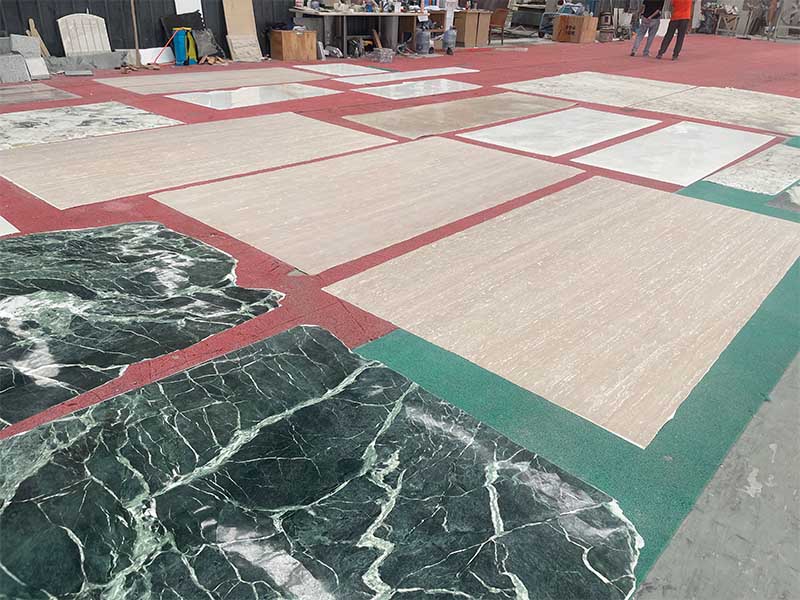
Thin marble panels laid out for project selection
They are better suited for controlled commercial areas such as:
| Application area | Suitability | Reason |
|---|---|---|
| Low-traffic decorative flooring zones | Suitable | Visual value is more important than heavy load-bearing |
| Showrooms | Suitable | Natural marble effect with lower material weight |
| Clubs and entertainment venues | Suitable with review | Strong visual demand, but traffic level must be checked |
| Renovation projects | Suitable with substrate review | Less demolition and lower structural load |
| Luxury feature areas | Suitable | Helps use expensive marble more flexibly |
| Wall-to-floor visual continuity zones | Suitable in controlled zones | Keeps the same marble design language |
| Main entrances and heavy rolling-load paths | Not recommended | Higher impact, wear, and claim risk |
Thin marble panels are useful when a project wants the beauty of natural stone but does not need the full structural depth of a traditional slab. They can help designers use rare marble, dramatic veining, or luxury stone effects in a more flexible way.
However, thin marble panels should be used carefully on floors. Thin slabs have lower resistance to compression and impact than thicker slabs. If the substrate is uneven, hollow, or poorly bonded, cracking and hollowing may appear. If the adhesive or cement color migrates through the stone, the surface appearance may also be affected. Overly thin stone can also increase the risk of warping, deformation, and installation-related failure.
For flooring use, thin panels need a professional installation system, full bonding, flat substrate, suitable adhesive, and proper six-side protection when required.
Thin marble panels can reduce material consumption and weight, but they also shift more responsibility to the backing, bonding, substrate, and installation system.
If you are planning a marble application project and need professional guidance on material selection, structural compatibility, or installation systems, feel free to contact our marble solution team for customized marble application comparison and design solutions.
| Factor | Thin marble panels | Solid marble flooring |
|---|---|---|
| Natural marble surface | Yes | Yes |
| Typical thickness | Around 10–15mm, or thinner with backing | Around 20mm or above |
| Approx. weight | 15mm marble is about 37.5kg/m² at 2.5g/cm³ density | 20mm marble is about 50kg/m² at 2.5g/cm³ density |
| Stone consumption | Lower | Higher |
| Estimated raw material saving | Often estimated around 15%–25%, depending on stone and cutting plan | Higher material consumption |
| Estimated logistics advantage | May reduce shipping pressure by around 20%–30% in some projects | Heavier shipping and handling |
| Cutting loss control | Thin panel projects should control breakage and cutting loss carefully, ideally below 10% | Large-format or fragile solid slab projects may face 25%–35% loss in difficult cases |
| Structural integrity | Depends on composite system | Stronger material continuity |
| Load-bearing ability | Must be reviewed by system | More predictable |
| Repair and polishing depth | Limited | Better |
| Edge processing | Needs careful protection | Easier to process deeply |
| Heavy traffic tolerance | Limited, requires strict review | Better, but still zone-dependent |
| Long-term maintenance | Shorter renovation depth | Better refinishing potential |
| Main risk | Backing, bonding, substrate, edge, hollowing, warping | Weight, slab soundness, cutting, installation, maintenance |
Lower stone consumption does not always mean lower total project cost. Backing material, adhesive system, fabrication accuracy, edge protection, substrate preparation, and installation control also affect the final project price.
A practical rule is simple: choose solid marble flooring when the project needs stronger material depth, long-term refinishing, edge processing, and higher traffic tolerance. Choose thin marble panels when the project needs natural marble appearance, lower weight, better material yield, and controlled decorative flooring use.
Thin marble panels can be safe in suitable commercial flooring zones, but only when they are approved as a complete flooring system. Buyers should check marble thickness, backing material, adhesive compatibility, substrate flatness, full bonding, impact resistance, edge protection, and whether the product is designed for flooring rather than only wall decoration. For installation-side risk, buyers should also review backing, bonding, and substrate risk before approval.
Yes, but their load-bearing ability depends on the full panel system, not only the marble surface. A 10–15mm marble slab or a thinner reinforced panel behaves differently from a conventional 20mm solid marble slab. The backing, adhesive layer, substrate, panel size, and expected traffic must be reviewed together.
No. If the visible surface is real natural marble, thin marble panels do not look fake. They are different from printed ceramic, artificial marble, or imitation stone. The surface can still show natural veins, mineral depth, color movement, and polished reflection.
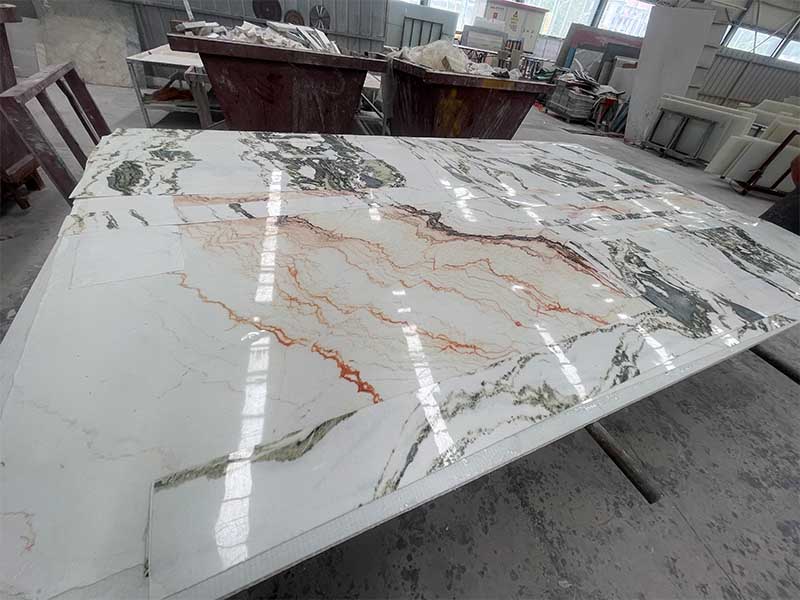
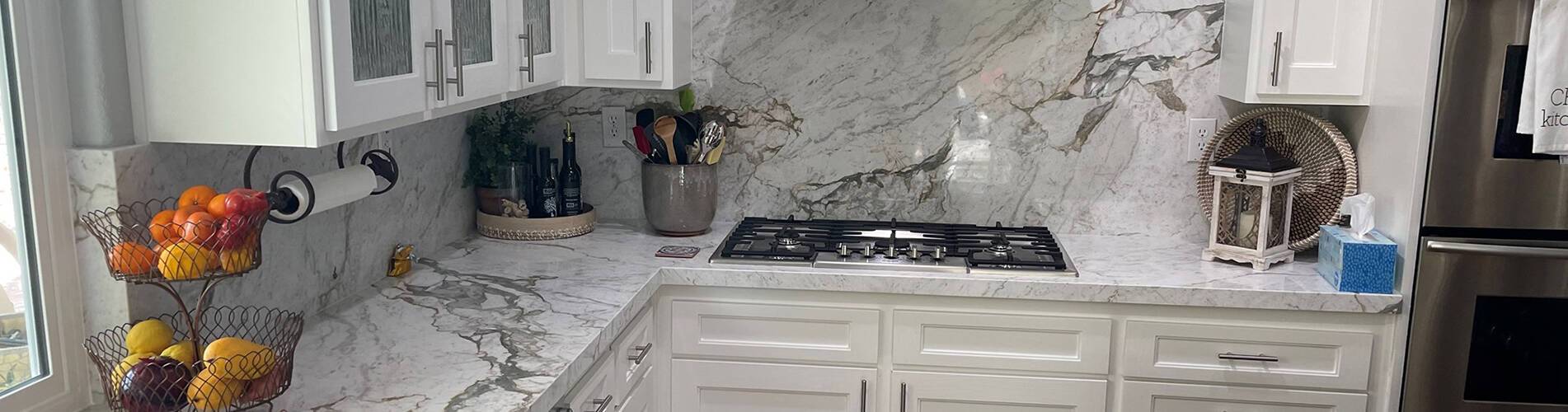
Large-format thin marble panel with natural veining
Yes. Since the visible surface is natural marble, thin marble panels can look highly realistic from the finished side. The main difference from solid marble is not appearance. The difference is structure, thickness, backing, repair depth, edge treatment, and flooring performance.
Thin marble slabs are often around 10–15mm. Ultra-thin stone may be below 8mm, usually with backing or reinforcement. Conventional solid marble flooring is commonly around 20mm or above. For commercial flooring, buyers should confirm both the marble surface thickness and the total panel thickness.
Thin marble panels are more suitable for low-traffic decorative flooring zones, showrooms, clubs, entertainment venues, renovation projects, luxury feature areas, wall-to-floor visual continuity, and weight-sensitive commercial interiors. They are not usually the first choice for shopping mall entrances, airport walkways, hospital corridors, heavy trolley routes, or other high-load main paths.
High-value decorative marble, rare luxury marble, strongly veined marble, and marble selected mainly for visual impact can be suitable for thin panels, especially when the project wants to reduce weight or improve material yield. However, brittle, highly fissured, or unstable marble needs stricter review because thin-panel performance depends heavily on backing, bonding, reinforcement, and fabrication control.
Thin marble panels are not a low-quality substitute for solid marble. They are a different solution for different project conditions. They are valuable when the project needs natural marble appearance, lower weight, easier handling, and better use of expensive stone in controlled areas. Solid marble flooring is still the better choice when the floor requires stronger material continuity, deeper maintenance, edge processing, and longer service tolerance.
For the broader decision process, return to the full commercial marble flooring selection framework.
Send us your project area, traffic level, preferred marble, installation substrate, panel size, finish requirement, and budget. We can help you decide whether solid marble flooring, thin marble composite panels, or another material solution is safer for your commercial project.
Categories
New Blog
 ROOM 205,NO.45, MIDDLE HAIJING ROAD,XIAMEN,AREA OF PILOT FREE TRADE ZONE(FUJIAN)OF CHINA
For inquiries about our products or pricelist, please leave to us and we will be in touch within 24 hours.



© Copyright: 2026 XIAMEN EXCELLENT STONE CO.,LTD. All Rights Reserved.

IPv6 network supported