English




Quick Answer
For the floors that carry the most people with the least upkeep, such as airport halls, shopping-centre walkways and building entrances, granite and quartzite are the best natural stones for a commercial project.
Marble is an equally good choice, especially where the floor is part of the space's image, as in a hotel lobby; travertine, limestone and sandstone work the same way in the right setting. The Burj Al Arab is floored in Statuario marble, and Apple's stores in pietra serena sandstone.
The best natural stone for a commercial project depends on where it goes. For the floors that take the heaviest traffic, such as airports, transit halls, shopping-centre walkways and building entrances, granite and quartzite are the best choice: they are the hardest natural stones and the easiest to maintain. Hotel lobbies have long been the place for marble, whose reflected light and veining make the arrival feel like an occasion, while travertine gives a warmer, matte floor that can run from a terrace straight into the lobby. Limestone and sandstone suit brand stores and contemporary interiors with their soft, unpolished surface. Exotic marbles, onyx and the more colourful quartzites go where the stone itself is the feature, on lobby walls and reception desks. Sintered stone, a manufactured material often compared with natural stone, fits projects that repeat the same design across many rooms or stores.
Every one of these stones answers two questions at once: how much traffic the floor can take, and what the space presents to the people who walk in. Granite and quartzite are the strongest on the first. Marble, travertine and limestone need more care, but they are chosen because the floor itself is part of how the whole space is presented.
We have supplied both Hermes Grey and Volakas for large hotel floors, for very different interiors. Hermes Grey is a deep grey that darkens and encloses a room, while Volakas is a white ground with grey veining that keeps it bright. See our Hermes Grey hotel project in Bhutan.
Contents
A commercial floor is used harder than a floor at home, and by people who never think about it. Hundreds or thousands of visitors a day walk the same routes, often straight in from the street with grit and rain on their shoes. Cleaning crews work to a schedule with whatever products the contract specifies. Luggage trolleys, delivery carts and cleaning machines roll across it. Whatever stone goes down has to cope with all of that for years.
That is why the usual checklist starts with wear resistance and moves on to water absorption, which decides how easily spills and dirty water stain the stone. Slip resistance follows, especially at entrances and anywhere the floor may be wet, and it depends as much on the surface finish as on the stone. Maintenance matters too: how often the floor needs sealing, regrinding or polishing, and whether the building has the staff and budget to do it.
Scale adds its own demands. A lobby or a run of corridors can take several hundred or several thousand square metres of one stone, and natural stone varies from block to block. On a large floor the colour and veining have to hold together across the whole area, which means the stone is selected and ordered as one lot, not topped up piece by piece. Cost comes in here too. The price of the stone itself is only part of it; fabrication, installation and years of upkeep all belong in the comparison.
Then there is the question every lobby, office entrance and shop is designed around: what the space should say to the people who walk in. A hotel wants guests to feel welcome, an office building wants to look established, a shop wants a look that belongs to its brand. The stone is one of the largest surfaces in the room, so it carries much of that impression, and that is what decides how much weight the other factors get.
Quartzite and granite are the most durable natural stones for commercial floors, and they hold up best at every stage of wear. A busy commercial floor wears in stages. Grit on shoes scratches the surface first. The steady passage of feet then grinds down the most-used routes. Spills soak into the pores, and acidic drinks or cleaners etch calcium-based stone.
Scratching is a matter of hardness. On the Mohs scale quartzite is about 7 and granite 6 to 7, while marble, travertine and limestone are about 3 to 4. Everyday grit carries quartz sand, which is harder than these softer stones, so they pick up fine scratches sooner.
Wear along walking routes is measured separately, as abrasion hardness (Ha), now usually tested to ASTM C1353. The ASTM standard for marble sets a minimum of 10, and recommends at least 12 for commercial floors, stairs and platforms with heavy foot traffic. Granite and quartzite sit well above these levels.
Staining and etching come next. Granite and quartzite absorb little water and are largely unaffected by acids. Travertine and limestone are more porous and need a penetrating sealer. Marble, travertine and limestone are all calcium-based, so lemon juice, wine or an acidic cleaner leaves a dull mark on them.
How all of this shows depends on the finish. On a polished floor, wear appears first as dull paths along the busiest routes; a honed, leathered or flamed surface hides it far longer. We come back to finishes further down.
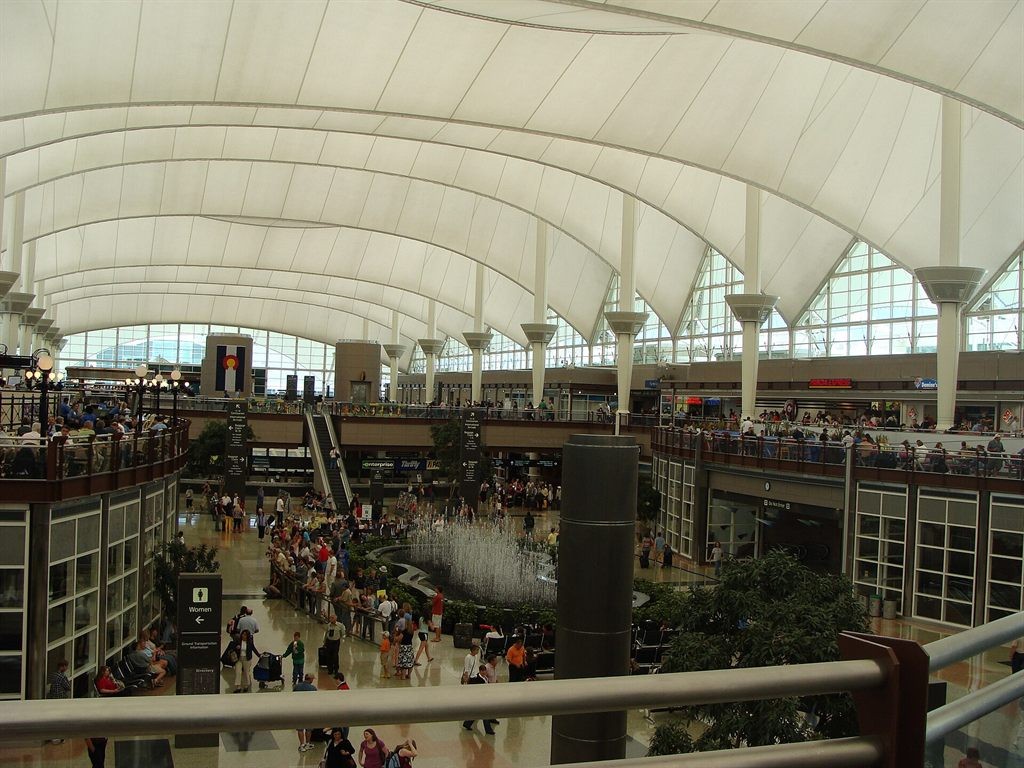
Taken together, the order for heavy-traffic floors runs from quartzite and granite, to marble in a honed finish, to filled and sealed travertine and limestone, with onyx kept to walls. Where a floor has to carry the most people with the least maintenance, such as an airport hall, a mall concourse or a building entrance, granite or quartzite is the right choice. Denver International, Toronto Pearson and Mumbai's Terminal 1A all have granite in their terminals.
Marble and the other softer stones are just as good a choice where the floor is part of the space's image, and many of the best-known commercial floors are in softer stone.
The Burj Al Arab in Dubai uses nearly 24,000 m² of Statuario marble on its floors and walls, including about 10,000 m² of marble flooring in its suites and lift lobbies.
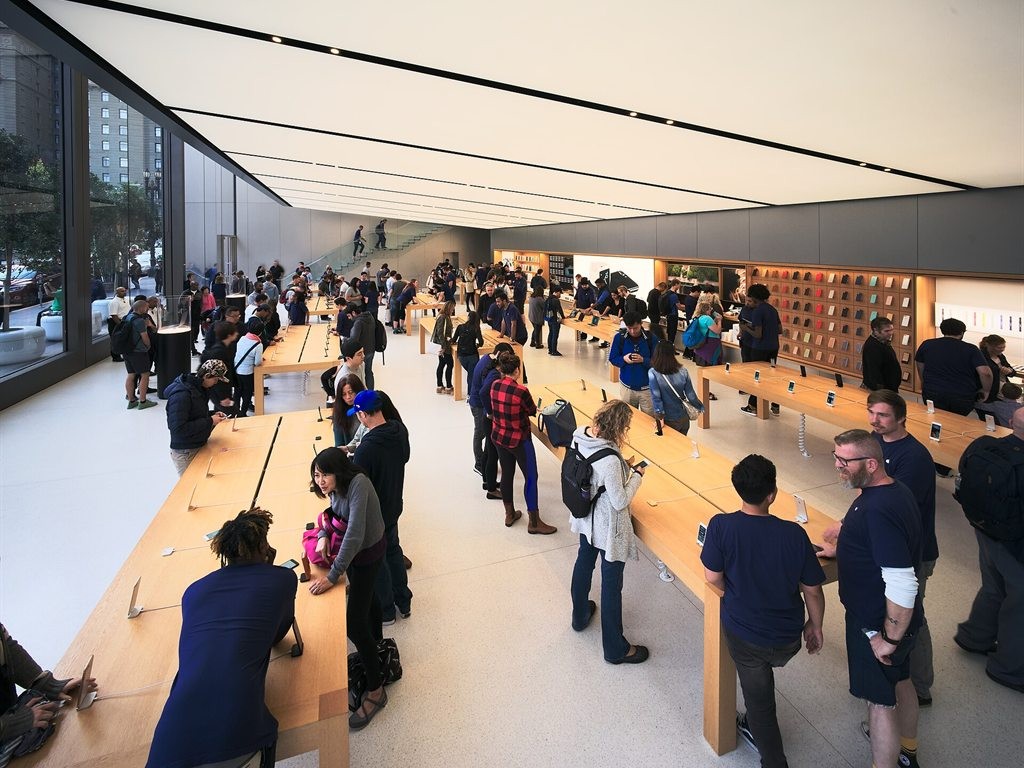
Apple made the same kind of choice for retail. Its stores are floored in pietra serena, a grey sandstone from a family quarry near Florence. When colleagues suggested reproducing the stone in concrete, Steve Jobs insisted on the real material. The tiles were cut and marked so that each one is laid next to the tiles it was cut beside.
In both cases the stone came first and the maintenance was planned around it. The rest of this guide looks at each stone in that light: what it brings to a space, where it works, and what it asks in return.
| Stone | Hardness (Mohs) | Acids | Where it suits in a commercial project |
|---|---|---|---|
| Granite | 6–7 | Largely unaffected | Airports, mall walkways, entrances, office lobbies; borders of marble floors |
| Quartzite | about 7 | Largely unaffected | Lobby floors that take real traffic and want a decorative look; feature walls |
| Marble | 3–4 | Etches | Hotel lobby floors (honed); walls, columns, reception desks (polished) |
| Travertine | 3–4 | Etches | Hotel lobbies and restaurants (filled, honed); terraces and pool surrounds |
| Limestone and sandstone | Softer, porous | Avoid acidic cleaners | Brand stores and contemporary interiors (honed or brushed) |
| Onyx and exotic marbles | — | — | Feature walls and reception desks |
| Sintered stone (manufactured) | Very hard | Resists acids | Projects that repeat one design across rooms or stores |
Marble is the stone most people picture in a grand hotel lobby. Its veining gives a floor depth, and over a large area the veins link up and run across the whole room. Polished, it reflects light back into the space; honed, it turns matte while keeping the pattern.
White marbles make a space brighter and larger to the eye, while deep greys darken it and draw it in. Either way, on a large floor the stone has to read as one surface rather than a patchwork, which is why the whole area is usually taken from one batch. For a high-end hotel in Bhutan, we supplied approximately 2,100 m² of Hermes Grey for bathroom floors, walls and vanity tops, using material from the same batch so that the colour and veining carry from room to room.
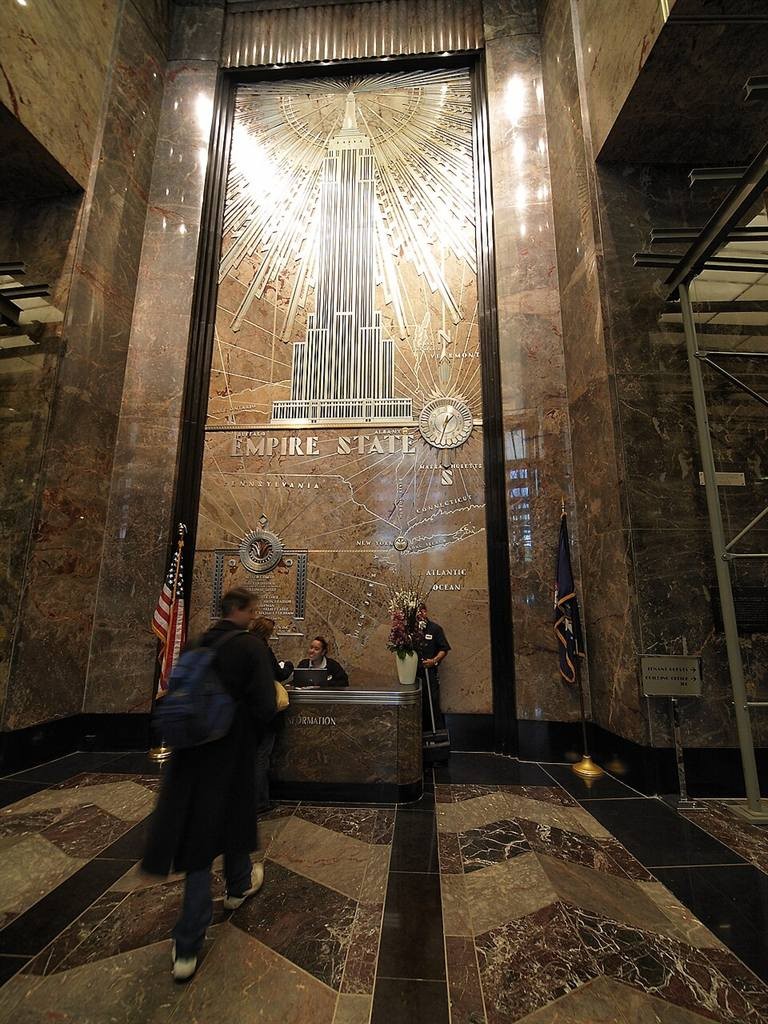
Marble is softer than granite and it etches, so lobby floors usually take a honed or leathered finish, entrance matting and periodic regrinding. We go into finishes and slip resistance in choosing marble for commercial flooring, and into which marbles suit which areas in our marble selection guide for commercial projects. Polished marble comes into its own on walls, columns and reception desks. The Empire State Building's lobby has been lined with marble since 1931; when it was restored, the team removed panels added in the 1960s and sourced matching marble from several countries to put the original walls back.
Granite's look is even and granular, with a regular pattern across the whole floor. A large granite floor keeps that look for decades of heavy use, which is why it is the standard choice for airports and public buildings.
Indoors, granite suits office lobbies, lift lobbies and building entrances, and it is often used as the border or threshold of a marble floor. An even, fine-grained granite in a single tone, honed rather than polished, gives an office lobby a uniform, orderly floor.
Its downsides are about appearance and finish. The colour range is narrower and plainer than marble's, and a polished granite floor becomes slippery when wet, so entrances and wet areas need a honed, flamed or brushed surface.
In hotel lobbies and restaurants, travertine's warm colour and matte, slightly open texture make the space relaxed rather than formal. It works equally well indoors and outdoors, so a floor can run from a terrace through the doors into the lobby without changing material. The Getty Center in Los Angeles is built with about 16,000 tonnes of travertine from Bagni di Tivoli near Rome, the quarry area that supplied the Colosseum, and uses it on walls, plazas and paving alike. Mies van der Rohe's Barcelona Pavilion stands on a travertine floor that extends out over its pool.
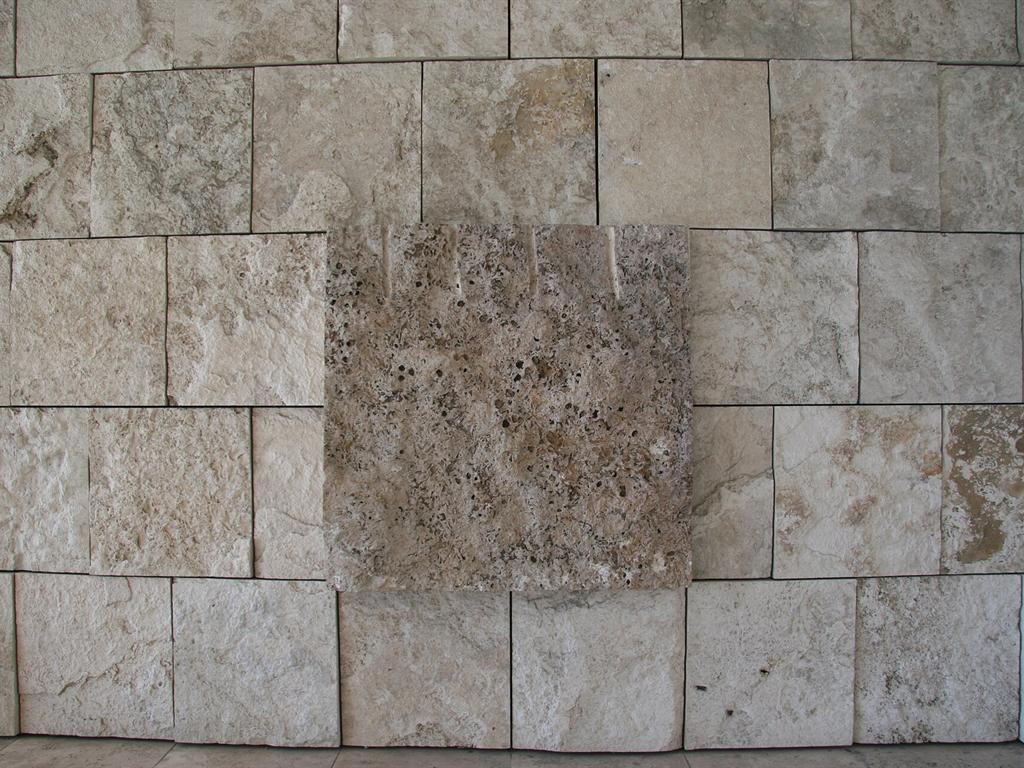
The open texture is also travertine's main weakness. The natural holes are usually filled with a resin or cement filler for interior floors, and under heavy traffic some of that filler wears out over time and has to be topped up. Travertine is calcium-based, so it etches like marble, and it needs a penetrating sealer. Inside, filled and honed travertine is the practical choice; tumbled or unfilled finishes suit terraces and pool surrounds.
In a hotel lobby, travertine gives warmer colour and a more architectural, matte surface, where marble gives more reflected light and a more formal arrival. We recommend filled, honed travertine for a hotel lobby built around warm tones. Our travertine range covers white, beige, silver and red.
Limestone and the fine sandstones have become popular again, and the reason is in how they look. They hardly reflect light. Their surface takes the light in and gives an even, slightly chalky finish that looks close to how the stone came out of the ground. In a lobby or a shop, that plain surface leaves the attention to the light, the products and the people. It suits interiors that want to look natural and unforced rather than polished and formal, which is much of what hotels and brands are asking for now.
Apple's pietra serena floors are the best-known example in retail, and the same idea appears in hotel lobbies, restaurants and galleries. Limestone and sandstone are softer and more porous than the other stones here, so their floors need a honed or brushed finish, a good penetrating sealer, entrance matting and a cleaning routine that avoids acidic products.
Quartzite has veining and colour that can rival marble, with hardness close to granite's. That makes it a strong choice where a lobby wants the look of a decorative stone on a floor that takes real traffic. In the Credit Suisse office lobby, green and gold quartzite tiles were chosen for their hardness and slip resistance, with the architect citing lower maintenance and a longer life.
Many Brazilian quartzites also have colours and movement strong enough to become the feature of a room. The Brazilian blue quartzite display wall and shelves in the next section are from a retail project we supplied.
Some stones are chosen less as a surface and more as a piece of art. Exotic marbles, onyx and the more dramatic quartzites have colour and veining that seem to move across the slab, and a single panel can hold a room's attention the way a painting does.
The onyx wall in the Barcelona Pavilion is the classic example. Four panels cut from the same block are opened out like the pages of a book, so the gold, rust and pink bands mirror each other across the joints and meet in chevrons and a diamond at the centre. It stands on its own in the middle of the building, and the interior is arranged around it.
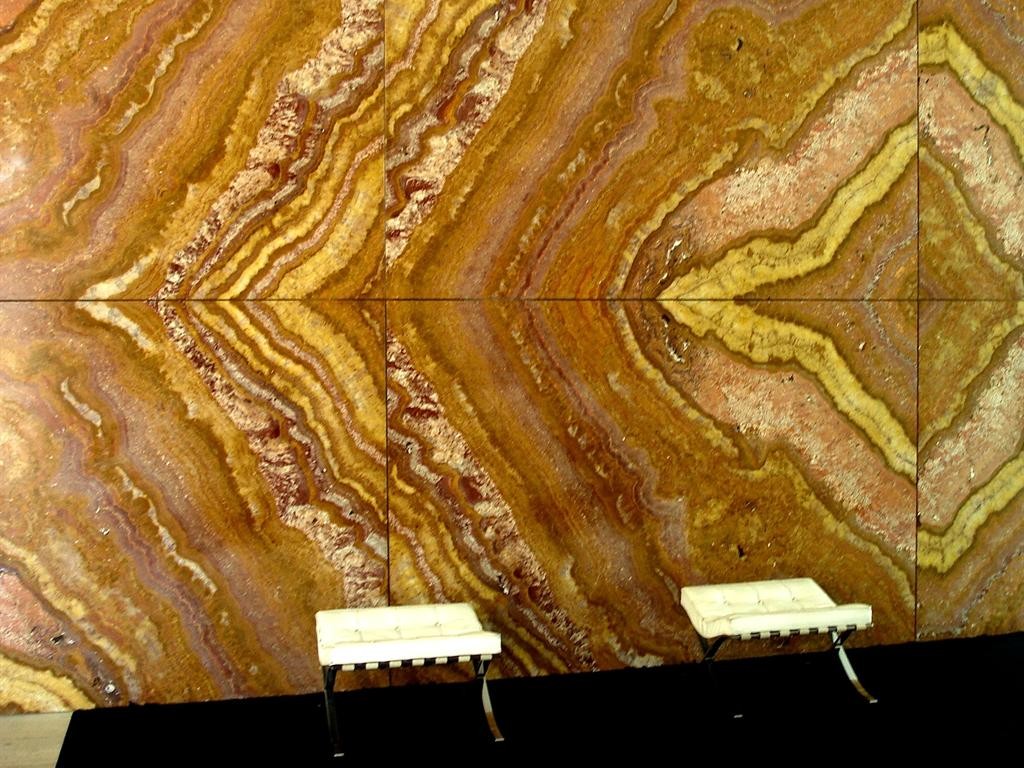
Today the same idea shows up in two places in commercial interiors. Large book-matched or vein-matched panels on lobby walls and floors turn a whole surface into one picture. And reception desks are often faced in a single luxury stone, so the first thing a guest walks up to is the most striking material in the building.
What makes these stones work is the flow of the pattern, and that flow can take very different forms.
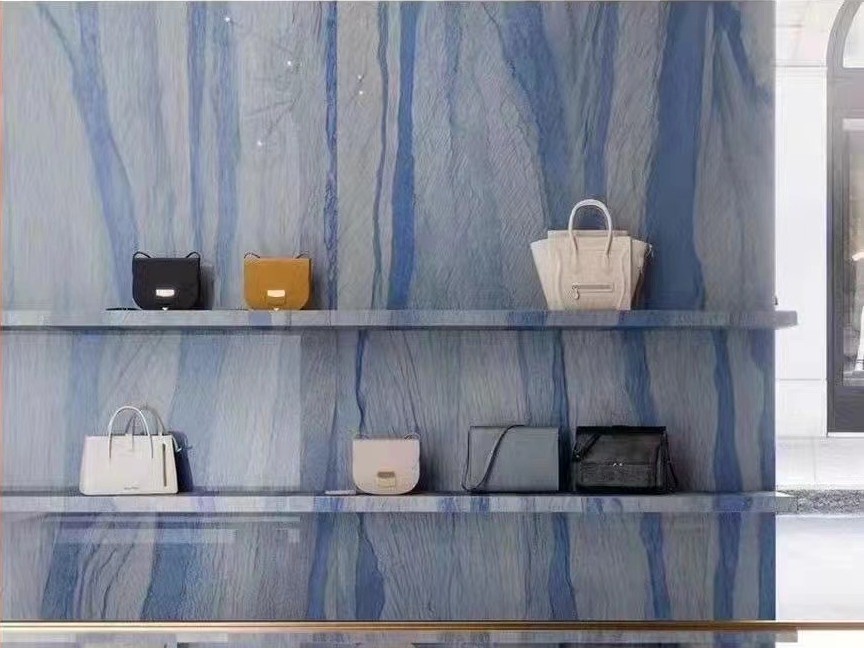
In this retail display, blue bands run down the quartzite wall from top to bottom, like rain running down glass or a stand of blue trees. They vary in width and depth, gathering in places and spreading out in others, so the wall reads as one image rather than a set of panels. The shelves are cut from the same stone, and their edges carry the blue bands on from the wall behind, so wall and shelving look as if they came out of one block. The vertical lines make the wall look taller, and the cool blue sets off the tan and cream leather of the bags on display.
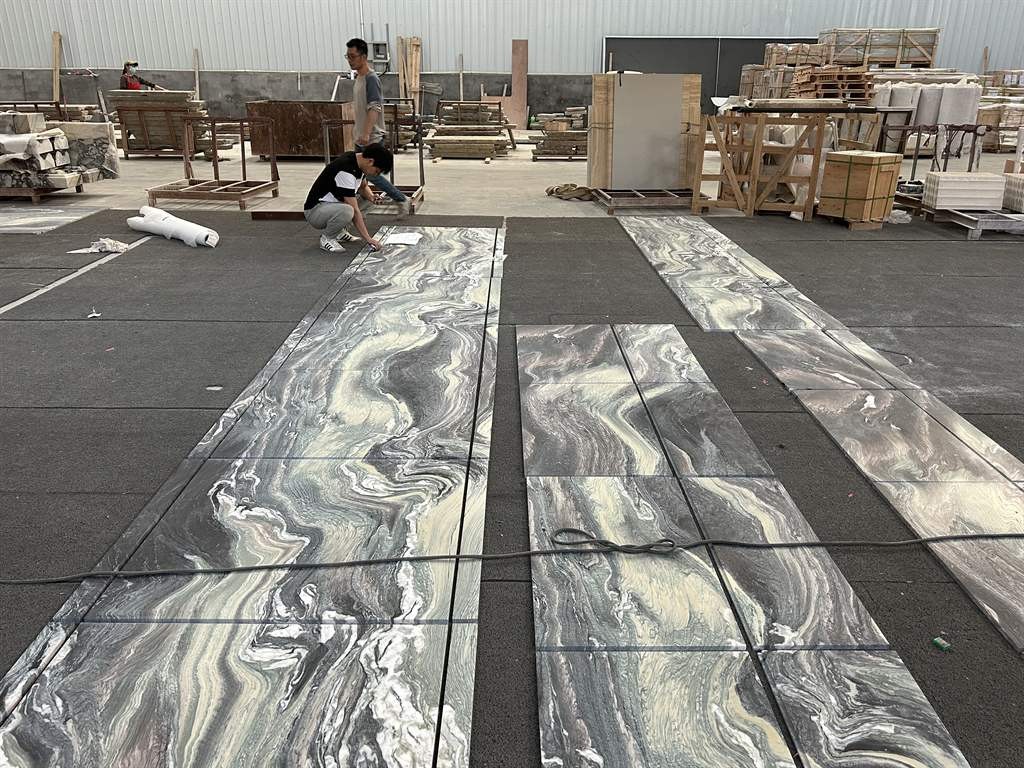
This violet-grey wall moves in a different direction. Its grey, violet, green and pale bands sweep sideways across the panels like hills and running water in an ink landscape. The darker grey and violet sit in front; the green and pale bands recede, so the flat wall gains depth. Matched across the joints, the panels become one long landscape, and that matching is done before the stone leaves us: the photograph shows the panels laid out on our factory floor, their bands brought together against the project drawing.
One pattern falls like rain, the other spreads like a landscape. That difference in direction and rhythm is what a designer is choosing between with luxury stone, and it changes how the whole space looks.
Send us the elevation or rendering for your feature wall, retail display or reception desk, and we'll match the panels against it the way we did for the wall above, so the pattern runs the way you drew it before anything ships.
The first few metres inside the door take more wear than anywhere else, because that is where grit and rainwater come in. This is the place for the hardest surface in the building: granite with a flamed or brushed finish, or a honed stone protected by a recessed entrance mat long enough to catch most of the grit before it reaches the main floor.
In a hotel lobby, the main floor beyond the entrance is where marble and travertine do their work. A white marble makes the arrival bright and open, a deep grey makes it darker and more enclosed, and travertine brings warmer colour. Honed finishes keep the floor looking even under traffic, and the whole area should come from one batch so that it reads as a single surface.
An office lobby usually wants to look established more than warm. Even-toned granite, a deep grey marble or a quartzite all suit it.
Retail floors divide by who uses them. The shared walkways of a shopping centre take traffic from every shop and every visitor, and no single brand is presenting itself there, which points to granite or quartzite. Inside a brand's own store, the sales floor is part of the brand. Some brands choose the stone for its look and plan the care around it, as Apple did with pietra serena. Display walls and feature areas are where an expressive stone, like the blue quartzite above, becomes part of how the goods are presented.
Reception desks and feature walls are the natural home for luxury stones and polished finishes, since they are seen up close and rarely walked on. Stone can also carry the interior's character into furniture; we have supplied designer-specified pieces for five-star hotels.
The finish decides how a stone looks and how it ages. Polished surfaces are the most reflective and show the colour and veining at their richest, but they show wear and become slippery when wet. Honed finishes are matte and smooth, hide wear well and are the usual choice for lobby floors. Leathered finishes have a soft texture that adds grip and hides marks. Flamed and brushed finishes, mostly on granite, give the most grip and suit entrances and outdoor areas.
The same stone can take different finishes in different positions. In the Bhutan hotel bathrooms, the Hermes Grey walls and vanity tops were polished, while the floors, including the showers, had a leathered finish. To keep those surfaces consistent across each room, we planned the layout on the slabs before cutting, numbered the pieces in sequence and preassembled each room before shipment; the installation team laid the pieces by that numbering on site. Thickness is part of the same decision; our guide to stone thickness covers it.
Care follows from the finish. Commercial stone floors need daily dust mopping to keep grit off the surface, a pH-neutral cleaner rather than acidic or bleach-based products, entrance matting, periodic resealing for the more porous stones, and regrinding or re-honing when traffic routes begin to show. These tasks should be agreed with the building's cleaning team before the stone is chosen.
Cost comes from the same pieces: the stone itself, fabrication to the project's sizes, installation and upkeep over the years.
Sintered stone is made by pressing and firing natural minerals into large, dense slabs. It is very hard, absorbs almost no water and resists stains and acids. Its other strength is consistency: the pattern is designed rather than quarried, so one design can be repeated across many rooms or stores, and the slabs come in large formats with few joints.
That makes it a good fit for projects built on repetition: hotel chains rolling out the same rooms, retail brands fitting out many stores to one design, or large areas that must look identical from end to end. At Hotel Llevant on the Costa Brava, a custom textured sintered stone was used for the floors throughout the hotel.
Its main downsides are that edges and corners can chip under impact, and a damaged surface is usually replaced rather than reground. For hotels and retail brands, sintered stone is a high-end surface because of what it does well: large, precise, repeatable slabs in a chosen design. Where a project needs repeated surfaces alongside a few distinctive natural-stone features, the two work well together. We supply both natural stone and sintered stone, so both can be considered within the same commercial project. For floors specifically, see sintered stone wall tiles and flooring.
Large floors and feature walls are only part of commercial stone work. Our hotel work also includes a 70-set Hermes Grey vanity-top order for a US hotel, where the same top had to be repeated across rooms.
Send us your floor plans, wall elevations and renderings, with the areas or quantities involved. We'll suggest a stone for each area by the traffic it takes and what it has to present, plan large floors from one batch, and make repeated pieces match from room to room.
Categories
New Blog
 ROOM 205,NO.45, MIDDLE HAIJING ROAD,XIAMEN,AREA OF PILOT FREE TRADE ZONE(FUJIAN)OF CHINA
For inquiries about our products or pricelist, please leave to us and we will be in touch within 24 hours.



© Copyright: 2026 XIAMEN EXCELLENT STONE CO.,LTD. All Rights Reserved.

IPv6 network supported