English




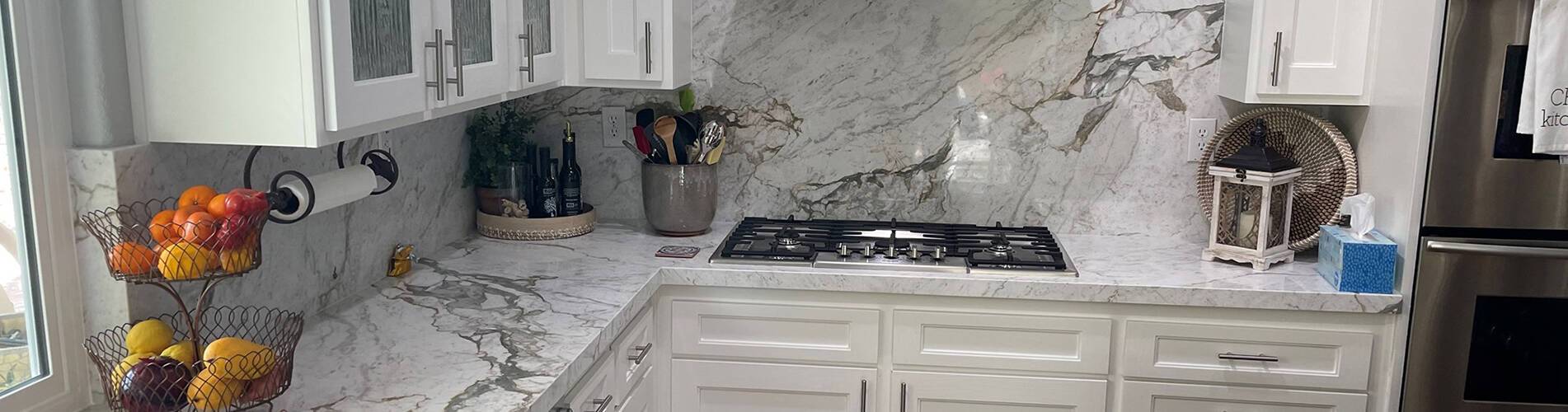
Quick answer: White marble turns yellow for five distinct reasons — iron-bearing accessory minerals oxidizing inside the stone; moisture activating and transporting iron or contaminants; setting materials and substrate showing through translucent stone; wax, coatings or dirt sitting on the surface; and external iron from metal, plumbing or water. Internal iron oxidation is the cause most people name first, and naming it first is the most common diagnostic mistake. Before choosing any treatment, establish whether the color sits on the marble, inside it, or behind it. Water absorption data cannot answer that question. Pattern, location, timing, moisture condition and mineralogy can.
Table of Contents
White marble can turn yellow, orange or warm-brown through several different mechanisms, and they call for completely different responses. The industry default answer — iron oxidation — is a real and important cause, but treating it as the starting assumption sends people toward stain removers when the actual problem is a wax layer, a wet slab bed, or a metal fixture two inches away.
So the first question is not "what cleaner should I use?" It is:
Is the yellow color on the surface, inside the marble, or visually coming through from behind it?
From there, pattern, location, timing, moisture condition and installation history decide what to investigate.

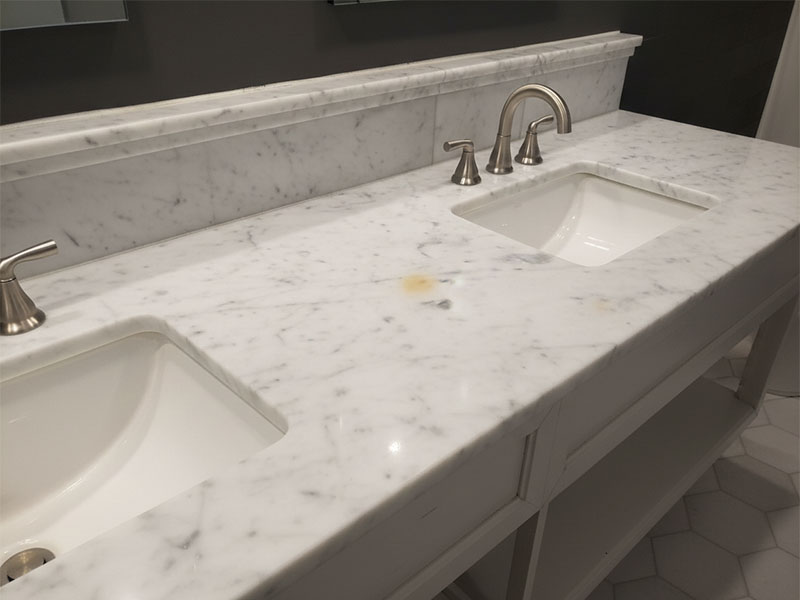
White marble is mainly composed of carbonate minerals, but natural marble also contains accessory minerals, including pyrite, hematite and other iron-bearing minerals. Under suitable moisture and oxygen conditions, these oxidize and produce yellow, orange or brown discoloration.
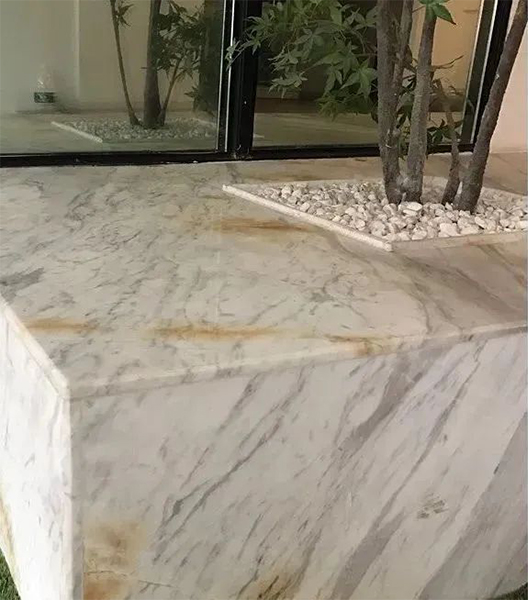
How they are distributed determines how the problem looks. Iron-bearing minerals may sit in an isolated pocket, follow a natural vein, or disperse through a wider area, so mineral-related discoloration appears as an isolated orange-brown spot, as yellowing that tracks a vein, or as broad diffuse yellow-brown coloration.
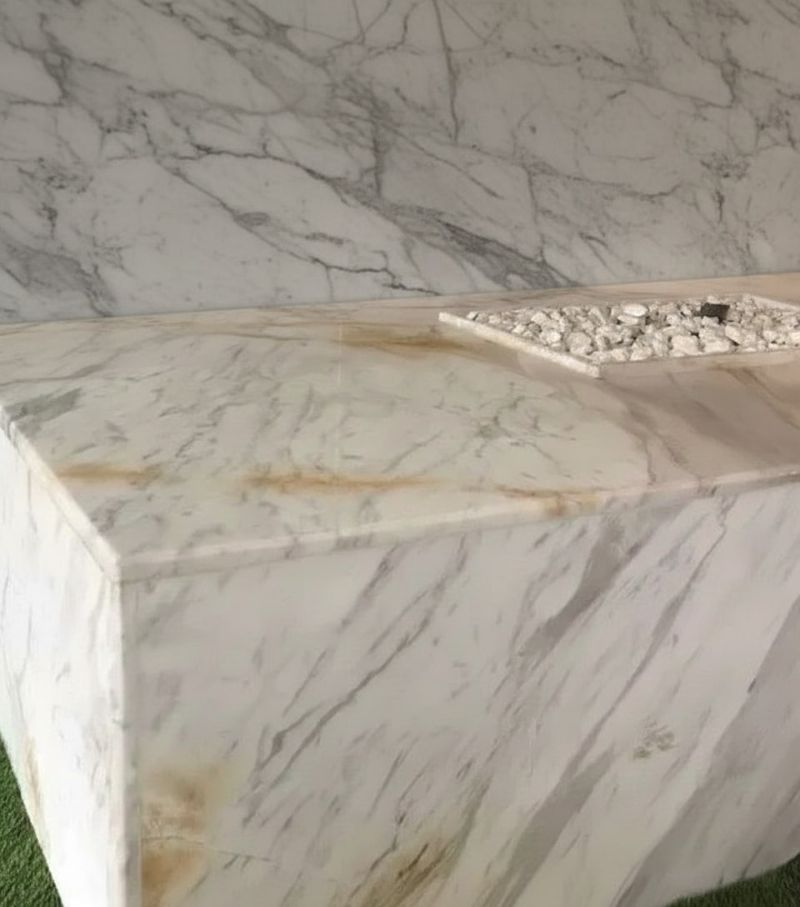
One point is worth stating plainly, because it is widely stated the other way around: calcite and dolomite are not the rust source. Iron-bearing accessory minerals are. White marble does not yellow because it is high in carbonate. It yellows when something in or around it supplies iron and something supplies water.

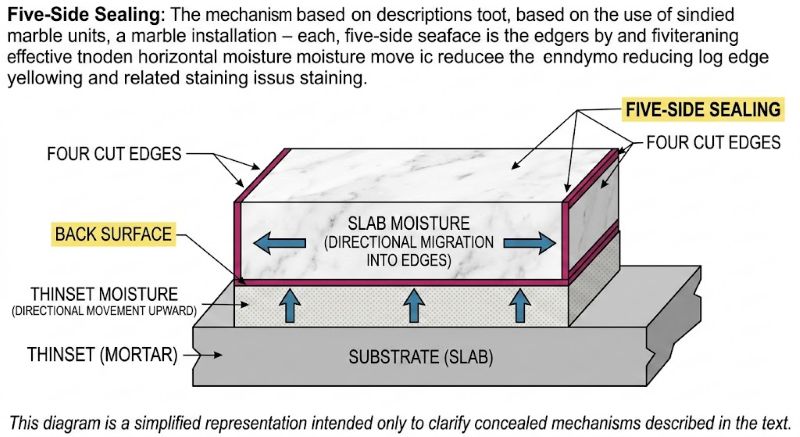
Moisture is routinely described as a cause of yellowing, but water rarely supplies the yellow pigment itself. What it does is promote oxidation of iron-bearing minerals, transport soluble iron compounds through the stone, carry contaminants up from the setting bed or substrate, and keep the assembly wet long enough for discoloration to develop.
That distinction has a practical consequence: drying or sealing the marble surface does nothing to the material or the moisture source underneath it.

Light, translucent white marble reveals what sits beneath it. Gray thinset, a dark substrate, uneven adhesive coverage or a persistently wet bed can all change the visible tone while the marble itself undergoes no iron reaction at all. Setting materials can also create genuine chemical and compatibility problems, particularly with moisture-sensitive or resin-backed stone.
Chemical yellowing and optical show-through therefore have to be separated before anything is treated. The installation variables that drive both are covered in detail further down.
Wax buildup, aging topical coatings, maintenance residue and dirt trapped in a worn finish all make white marble read as amber or yellow. Establish whether the discoloration is sitting on top of the stone before diagnosing anything internal.
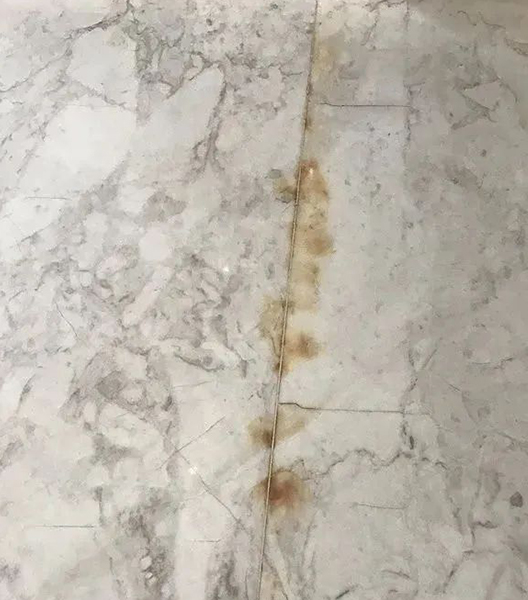
External iron is a separate category again. Metal fasteners, plumbing components, furniture feet and iron-bearing water produce orange-brown staining without the marble being the iron source.
White marble can be predominantly calcitic, predominantly dolomitic, or a mix of both carbonate minerals. The distinction is real, but it does not work as a yellowing rule.
Calcitic versus dolomitic classification alone does not predict rust-like yellowing.
Dolomitic marble still contains pyrite, hematite and other iron-bearing accessory minerals. The useful question is not which carbonate dominates, but whether iron-bearing minerals occur in the actual stone selection.
The same caution applies to absorption figures. A stone can have low water absorption and still contain localized iron-bearing minerals, which is why absorption data and mineralogy should never be treated as interchangeable.
This is the most useful first split, and it is also the cheapest — surface causes can be confirmed or eliminated in an afternoon, while mineralogical investigation is slow and expensive. Rule out the top layer before opening up the stone.
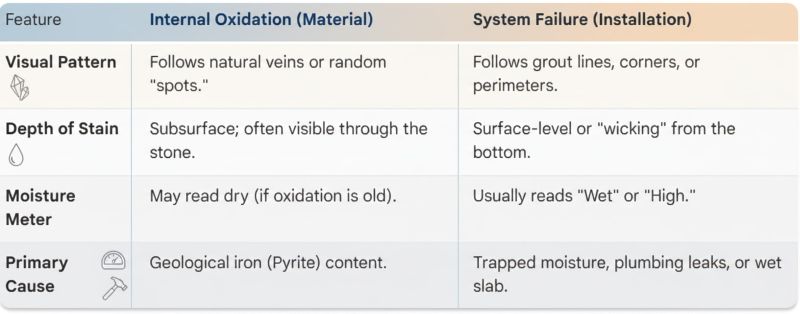
Check the surface first when the discoloration presents as a broad amber or waxy film, concentrates in traffic areas, arrives together with gloss loss, or follows a known history of wax or topical coating.
A controlled professional cleaning or stripping test settles it. If the coating comes off and the expected white stone returns, the discoloration was a surface problem.
Internal mineral discoloration takes priority when you see isolated orange-brown mineral spots, staining that follows natural veins, diffuse yellow-brown coloration with visible depth, or discoloration that survives normal surface cleaning unchanged.
At that point, compare moisture conditions across the installation and, where the project value justifies it, examine the stone mineralogy.
Translucent marble transmits what is underneath it: gray thinset, a dark substrate, mortar voids, differences in adhesive thickness, and wet versus dry zones below the stone. A warm or gray-yellow cast is therefore not automatically chemical yellowing.
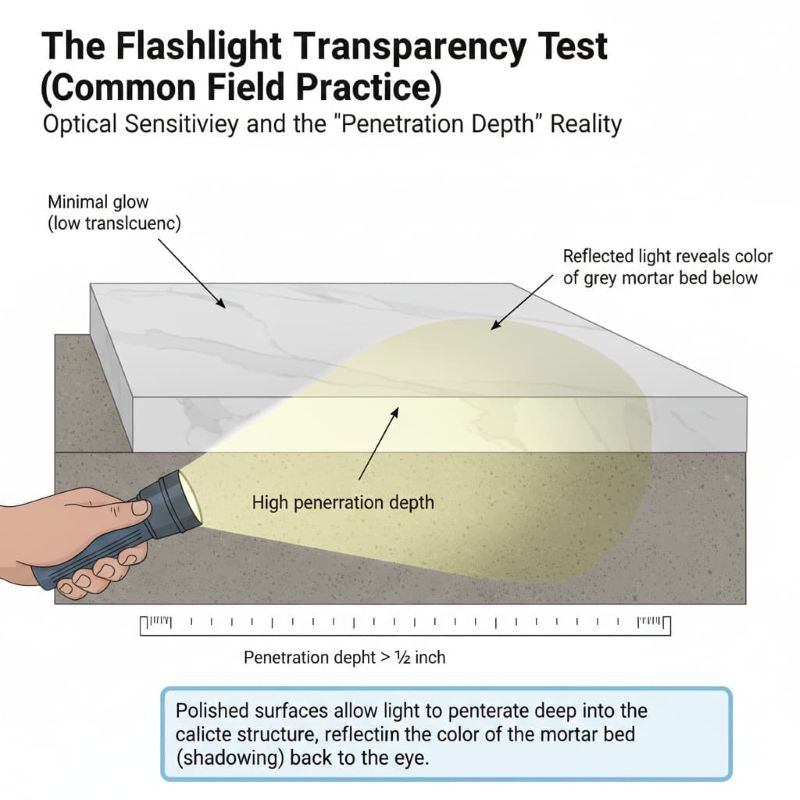
Before treating yellow marble, identify whether the color is on the stone, inside it, or coming through from behind it.
Pattern does not replace testing, but it sets the investigation order — and the underlying logic is simple:
The more regular and repeatable the discoloration geometry, the weaker random natural variation becomes as a first explanation.
Natural stone geology produces irregular mineral distribution. It does not reproduce construction geometry.

| What You See | Investigate First |
|---|---|
| Isolated orange-brown spot, unrelated to joints or mortar | Localized iron-bearing mineral, or external metal in contact |
| Yellowing follows a natural vein rather than a grout line | Mineral concentration within that vein |
| Regular grid pattern | Mesh or resin backing, and the backing adhesive |
| Trowel marks, adhesive dots, mortar coverage geometry | Setting material, coverage and optical show-through |
| Yellow line along a seam | Joint adhesive, exposed edge, local moisture |
| Border around each tile or panel ("picture framing") | Edge uptake, setting-bed moisture, differential drying |
| Yellow ring around a drain, cutout or penetration | Leakage, wet setting bed, cut edge, nearby metal, water quality |
| Only the exposed cut edge changes | Repeated edge wetting, fabrication treatment, edge adhesive |
| Broad amber film | Wax or topical coating |
| Same pattern repeats across many pieces | Processing or installation system, not the individual slab |
| Only one slab changes | Local exposure, fabrication history, or mineral variation |
A yellow ring around a drain tells you to trace the water path first. It does not identify the chemistry of the stain.

Do not label a single affected slab "natural variation" by default. Compare it against its neighbors on moisture exposure, mortar coverage, resin or mesh backing, fabrication repairs, cut edges, and proximity to metal or water sources.
Only when adjacent slabs share the same installation and moisture conditions and just one has changed color does mineralogy and fabrication history become the leading explanation.
Timing shifts the investigation order. It does not identify the cause on its own.
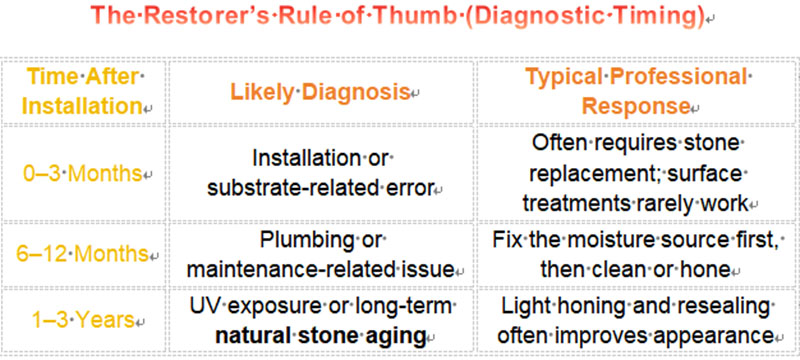
Discoloration appearing shortly after installation points to the installation system: installation moisture, substrate condition, mortar color, moisture-sensitive stone, adhesive compatibility and optical show-through.
"Natural aging" explains nothing about discoloration that appears within weeks of installation.
Mineral-related discoloration does not have to appear quickly. Diffuse yellow-brown staining associated with iron-bearing minerals is documented developing well after installation, on stone that looked entirely correct through its first months of service.
The consequence is that passing visual inspection at handover clears nothing. A quiet first year is not evidence that the minerals are inert; it may only mean the moisture path has not yet done enough work. When delayed discoloration is diffuse or vein-related and the installation carries a continuing moisture history, investigate the minerals and the moisture path together.
Flooding makes moisture and iron the immediate priorities, but it does not establish where the iron came from. It may originate in the stone, in plumbing, in groundwater, or in the flood water itself. Check the marble and the water source.
Once installed, marble stops being an isolated slab.
It becomes one layer in a moisture-transport and drying assembly.
That assembly can include concrete or screed, waterproofing, mortar or thinset, adhesive, the marble, grout, seams, backing materials and surface treatments. Four decisions inside it drive most early yellowing.

White setting material. White thinset is the safer visual choice for white and translucent marble, because the stone reveals the tone of the bed. Gray mortar or a dark substrate creates warm or shadowed areas with no internal iron reaction involved.
Rapid-setting mortar. This addresses a different problem. White mortar solves color compatibility; rapid-setting mortar limits exposure to installation water for stone that reacts poorly to prolonged moisture. For more sensitive materials, a reaction-resin system may be appropriate where the stone and adhesive manufacturers both support it. These are not interchangeable decisions, and choosing white mortar does not address moisture at all.
Resin and mesh backing. Some slabs and tiles are reinforced with resin and fiber mesh, which adds another material interface. Certain mesh adhesives are moisture-sensitive, and the weak point is often the bond between backing and stone rather than between mortar and backing. A regular mesh-like grid in the discoloration points at the backing system before it points at random mineral oxidation.
Backing condition is a supplier-side fact, not something an installer should have to discover on site. We identify whether the marble we supply carries resin or mesh backing so the setting system can be chosen around it rather than against it.
Substrate moisture. Concrete and screed are not dry because a certain number of days have passed. Verify the actual moisture condition and compare it against the requirements of the selected mortar, membrane and installation system.
Each test answers one question. Most disputes about yellowing come from using a test to answer a question it was never designed for.
| Test or Check | What It Tells You | What It Does Not Tell You |
|---|---|---|
| ASTM C97 | Water absorption and bulk specific gravity | Whether the stone contains pyrite or will yellow |
| ASTM C503 | Physical requirements for marble dimension stone | A proven yellowing threshold |
| ASTM C1721 | Petrographic and mineralogical information relevant to staining and color change | Guaranteed future field performance |
| ASTM F2170 | Internal relative humidity of concrete | Which mineral caused a yellow stain |
| ASTM F1869 | Concrete moisture vapor emission, reported as lb/1,000 ft²/24 h | Whether the marble contains iron |
| Comparative moisture reading | Whether the affected area is wetter than a control area | The chemistry of the stain |
| Full-system mockup | Visual and installation compatibility | Every possible long-term field condition |
ASTM C503 sets a maximum water absorption of 0.20% for calcitic and dolomitic dimension marble.
That is a physical-property requirement, not a yellowing threshold.
Meeting it proves nothing about pyrite, hematite or other localized iron-bearing minerals in the batch.
ASTM C97 measures how much water the stone absorbs under the test method. Petrographic examination such as ASTM C1721 investigates which minerals and constituents are actually present.
Where the concern is internal iron-related discoloration, mineralogical information is directly relevant and a low absorption number is not. Absorption and mineralogy are simply not the same property.
ASTM F2170 and F1869 establish whether the concrete substrate is an active moisture variable. They say nothing about whether the yellow pigment came from pyrite, external iron, an adhesive or another source. A higher moisture reading in a yellow area supports moisture involvement, not a specific chemical diagnosis.
A project-specific 72-hour soak test is a reasonable screening step: it can expose fast-reacting material before that material reaches the job. What it cannot do is clear a stone for long-term service. Mineral-related staining develops over months, and installation conditions include variables a short water test does not reproduce.
Restoration potential depends entirely on which layer changed color, and the range runs from routine to unrecoverable.
| Diagnosis | Restoration Outlook | What Has To Happen First |
|---|---|---|
| Wax, coating, maintenance residue or trapped dirt | Usually reversible | Controlled cleaning or stripping test |
| External iron source | Reversible once the source is gone | Remove or isolate the metal or water source |
| Optical show-through from the setting bed | Not a stain at all | Address as an installation issue, not a stone issue |
| Active moisture or leak | Recurs until the source is closed | Trace and stop the water path |
| Deep internal iron oxidation | Partially reversible at best | Mineralogical assessment before treatment |
Two of those rows deserve emphasis. If yellowing returns shortly after cleaning, stop repeating the same surface treatment — the source is active and below the finish. And deeply seated rust-like staining from internal minerals may improve under repeated professional treatment without ever fully clearing.
Marble is an acid-sensitive carbonate stone, and a chemical strong enough to lift iron staining is usually strong enough to etch the surface.
Removing the stain and preserving the finish are two separate problems.
Do not treat a rust-colored stain as a straightforward cleaning task before the stain type and the stone's response are understood.
No. Annual sealing is widely recommended as yellowing prevention, and it does not work that way.
A compatible impregnating sealer reduces certain liquid exposures and improves stain resistance. It cannot remove iron already present in the marble, correct an active leak, dry a wet substrate, fix incompatible setting materials, or prevent oxidation.
Where backside or edge moisture is a known project risk, specify a treatment designed for that interface and confirm it is compatible with the bonding system. A blanket "seal all five sides" rule is not a substitute for that decision.
Commercial stone names do not guarantee identical accessory-mineral distribution between slabs, so specifying by name alone leaves the main variable uncontrolled. Review the actual slabs or batch for calcitic or dolomitic mineralogy where relevant, visible mineral spots, vein characteristics, translucency, resin or mesh backing, and any known moisture sensitivity.
This is the point where a supplier either helps or gets in the way. As a marble factory, we work from the specific batch rather than the commercial name: we show the actual slabs reserved for a project, point out visible mineral spots and how the veining behaves across the pieces, and state the backing condition of the material as supplied. None of that predicts field performance by itself. It does move the decision from a name to a material.
Questions worth putting to any white marble supplier before an order is confirmed:
A supplier who cannot answer the first two is describing a name rather than a shipment.
Specify the stone together with the substrate, mortar or adhesive, waterproofing, grout, backside or edge treatment, and surface treatment. For resin-backed or moisture-sensitive marble, confirm compatibility before full installation rather than after.
For large commercial, hospitality and other high-value white marble projects, the mockup should include the actual marble, substrate, setting material, backing condition, grout and any relevant surface or backside treatment.
A full-system mockup exposes show-through, coverage differences, moisture marks and material incompatibility while the problem is still limited to one panel instead of an entire floor.
Check concrete or screed moisture, drainage, waterproofing, leaks, exposed cut edges and drying conditions. Calendar age is not a moisture test.
When white marble starts turning yellow, work through it in this order:
The evidence only works in combination:
Pattern + location + timing + moisture + installation history + mineralogy
No single moisture reading, absorption value or visual pattern replaces that sequence.
White marble yellowing should be diagnosed before it is treated, and the diagnosis starts with where the color sits rather than with what caused it. Establish the layer first, then use geometry, location, timing and moisture conditions to decide whether the investigation belongs with the stone, the surface or the installation system. For unresolved internal yellow-brown staining, mineralogical evidence carries more weight than any absorption figure.
Yellowing problems usually trace back to a decision made well upstream of the job site: a selection confirmed from a commercial name and one sample photograph, with the batch, the backing and the intended installation system all left open.
We supply white marble as a factory rather than a catalogue, in slab and cut-to-size form. The batch a project is drawing from, the backing condition of the material, and the finish it ships with are all things we can identify and document before loading, and all things better settled in the quotation stage than in a claim.

If you are specifying white marble for a project where moisture exposure, translucency or backing condition matters, tell us the application and the installation system you are working with and we will work from the material actually available. You can also see our white marble slabs, tiles and cut-to-size range for what is currently available.
Categories
New Blog
 ROOM 205,NO.45, MIDDLE HAIJING ROAD,XIAMEN,AREA OF PILOT FREE TRADE ZONE(FUJIAN)OF CHINA
For inquiries about our products or pricelist, please leave to us and we will be in touch within 24 hours.



© Copyright: 2026 XIAMEN EXCELLENT STONE CO.,LTD. All Rights Reserved.

IPv6 network supported