English




Quick answer
White marble is classified three ways, and most commercial names belong to more than one group at once.
The most widely traded types of white marble are Carrara, Calacatta Gold, Statuario, Arabescato, Thassos, Sivec, Volakas, Marmara, Afyon, Bianco Dolomiti, Blanco Macael, Estremoz, Makrana, Vermont Danby, Guangxi White, Vietnam Crystal White, White Wooden Marble, Panda White, Oriental White and Calacatta Viola.
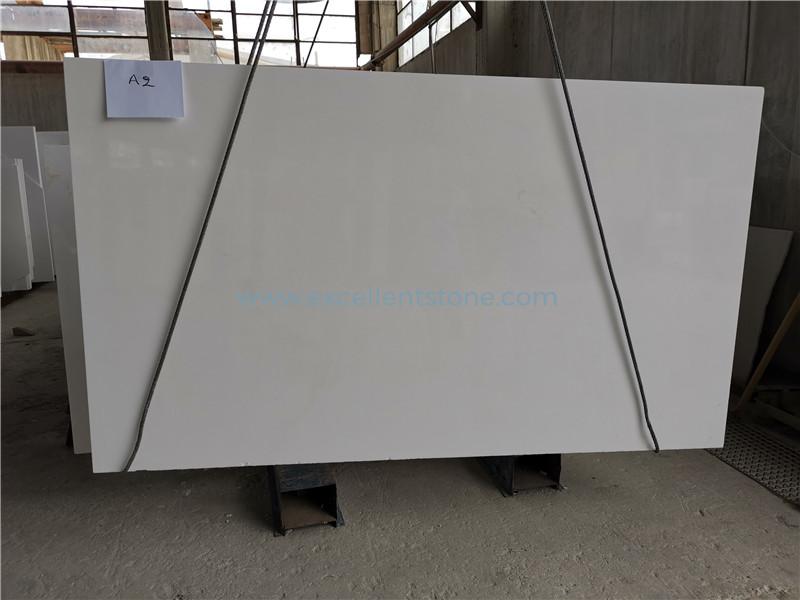
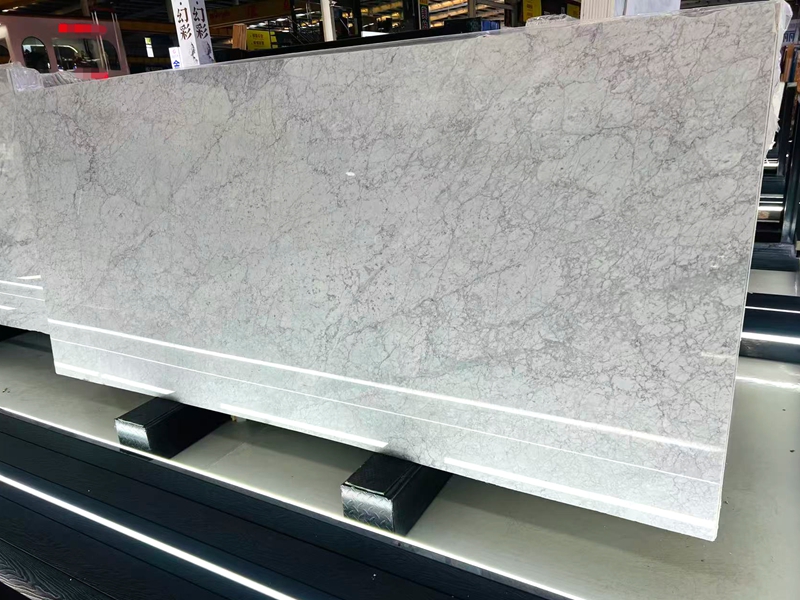
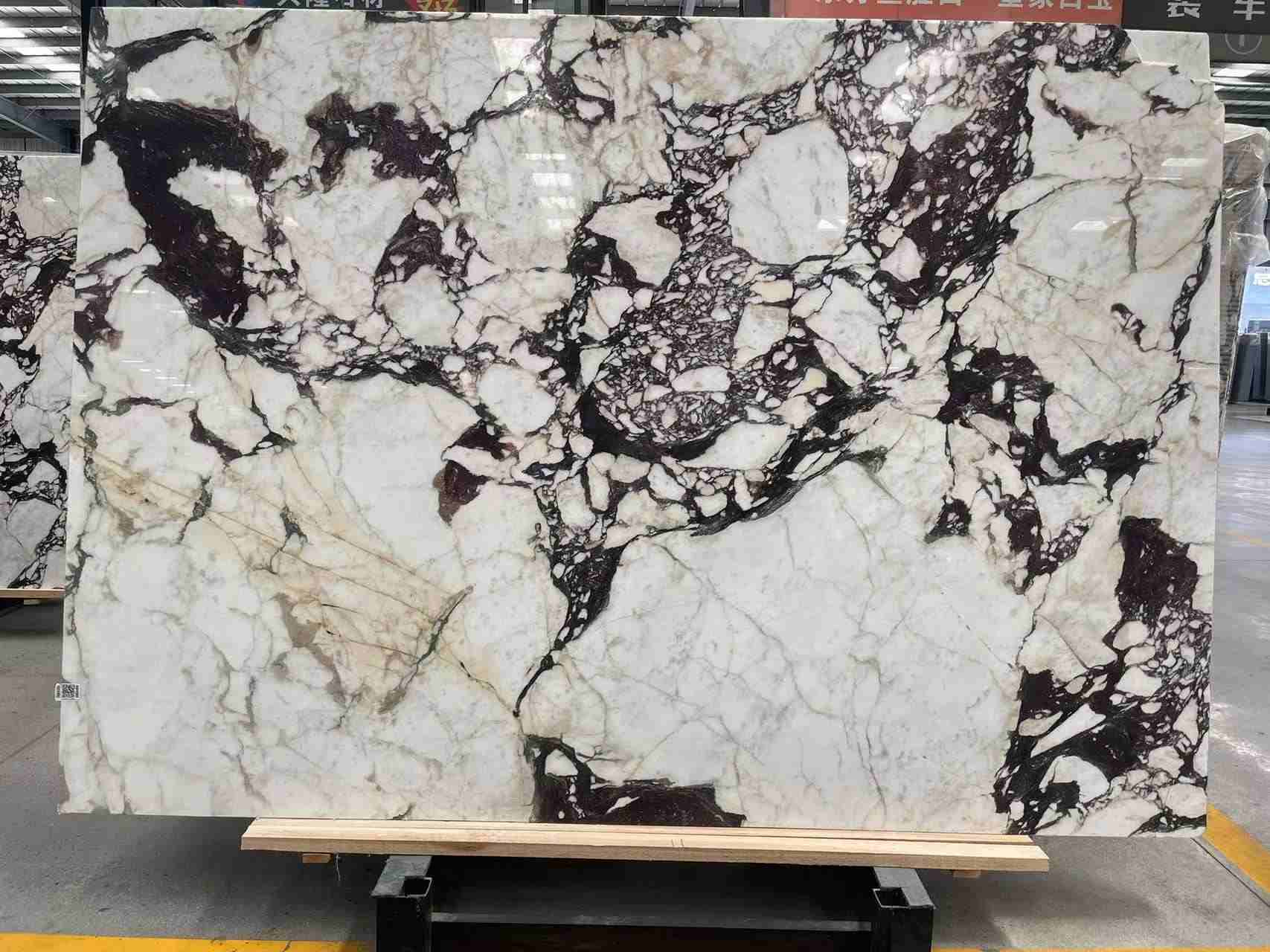
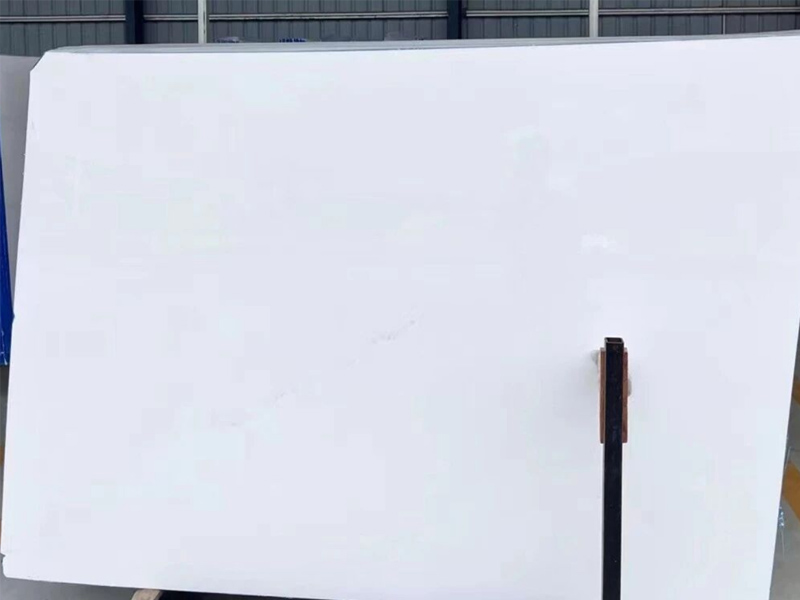
Put a Thassos slab, a Carrara slab and a Panda White slab side by side and you have three materials sharing one name. The first is a flat, cold, almost sugar-like white. The second is a soft grey haze. The third is a black-and-white composition that belongs on a wall by itself.
So "white marble" describes a colour family, not a look. Once you're actually choosing, the question shifts: what background tone sits behind the veins, how much movement can the space take, and what should the stone be doing once it's installed?
The same stone often lands in more than one group, because natural marble varies by quarry area, block and slab. Names get you to a shortlist. Slabs decide the rest.
Twenty commercial names from Europe, Asia and North America. Read the "visual role" column as the stone's usual job in a room — what it does without being pushed.
| White marble type | Typical origin | Dominant background | Typical veining or movement | Usual visual role |
|---|---|---|---|---|
| Carrara White | Italy | Cool grey-white | Fine to medium grey veins and soft clouding | Atmospheric or background |
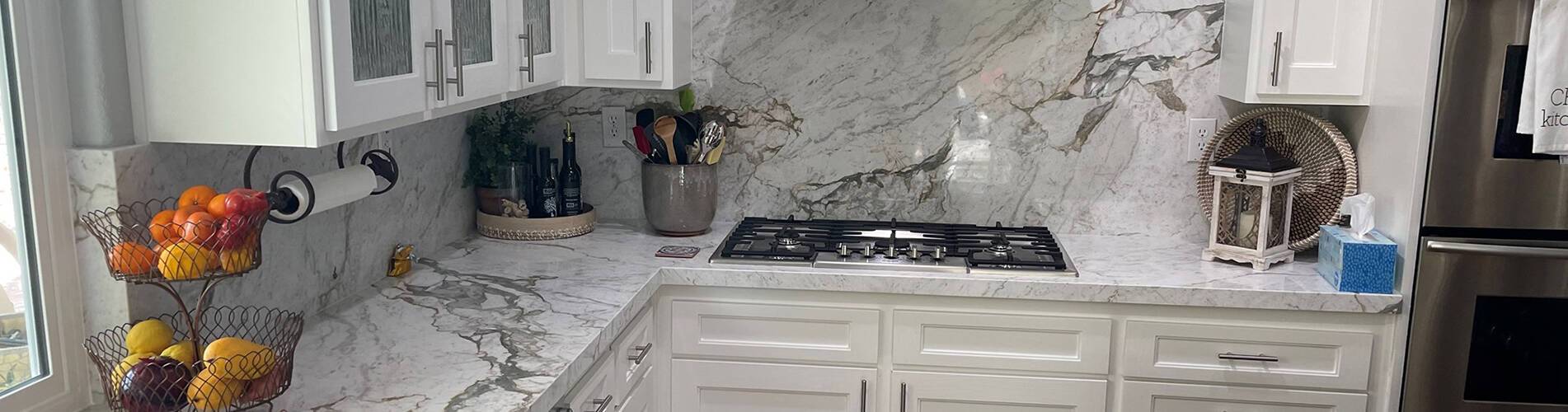
| Calacatta Gold | Italy | Bright to warm white | Broad grey veins, often with gold or beige accents | Statement |
| Statuario | Italy | Clean, luminous white | Defined grey veins with comparatively open white space | Refined statement |
| Arabescato | Italy | Soft white to light ivory | Dense, flowing and interlaced grey veining | Statement |
| Thassos White | Greece | Bright, cool crystalline white | Minimal visible veining | Background |
| Sivec White | North Macedonia | Bright neutral white | Fine, light grey lines or subtle crystalline movement | Background or refined architectural |
| Volakas | Greece | White, sometimes slightly cool or warm | Diagonal grey, taupe or brown-grey veins | Atmospheric or statement |
| Marmara White | Turkey | White to lightly creamy white | Parallel grey stripes | Architectural |
| Afyon White | Turkey | Bright neutral to lightly warm white | Quiet crystalline movement or faint veining | Background |
| Bianco Dolomiti | Turkey | White to pale grey-white | Fine linear or softly dispersed grey veins | Atmospheric |
| Blanco Macael | Spain | White to light grey-white | Fine grey marks, occasional directional veins | Background or architectural |
| Estremoz White | Portugal | Warm white to cream | Soft grey, beige, brown or occasional pink movement | Atmospheric |
| Makrana White | India | Clean to neutral white | Usually restrained movement; some selections show grey or pinkish lines | Background |
| Vermont Danby | United States | Bright white | Grey diagonal movement, sometimes with warmer accents | Atmospheric or refined statement |
| Guangxi White | China | Bright to milky white | Light grey clouding or soft shadow-like movement | Background or atmospheric |
| Vietnam Crystal White | Vietnam | Bright cool-to-neutral crystalline white | Very little veining or faint crystalline texture | Background |
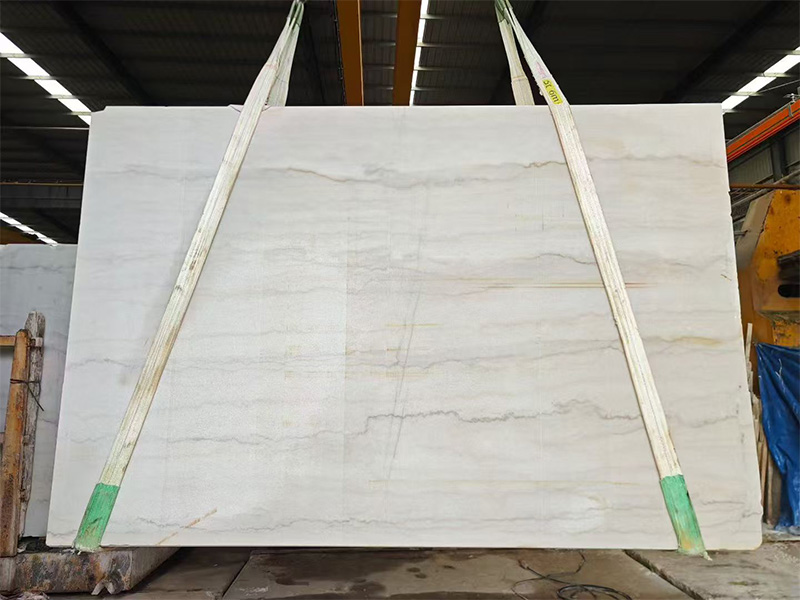
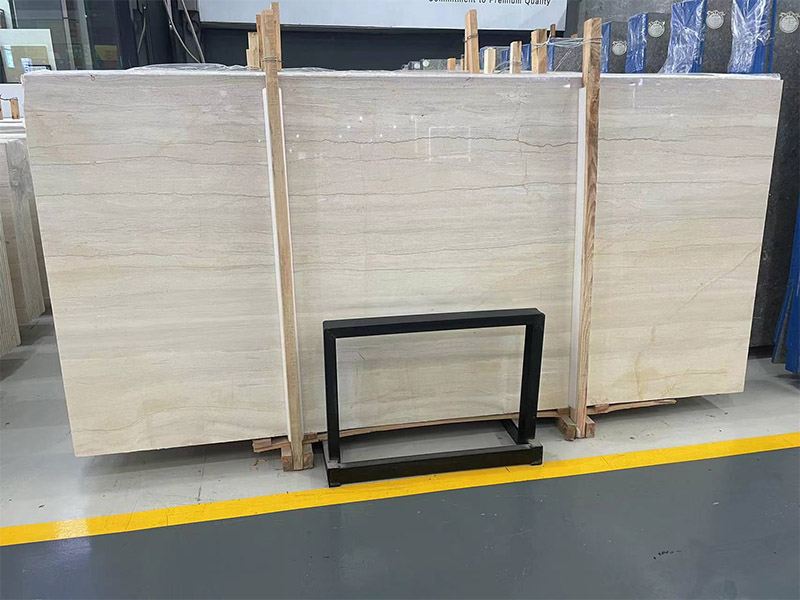
| White Wooden Marble | China | White to grey-white | Parallel wood-grain lines and bands | Architectural |
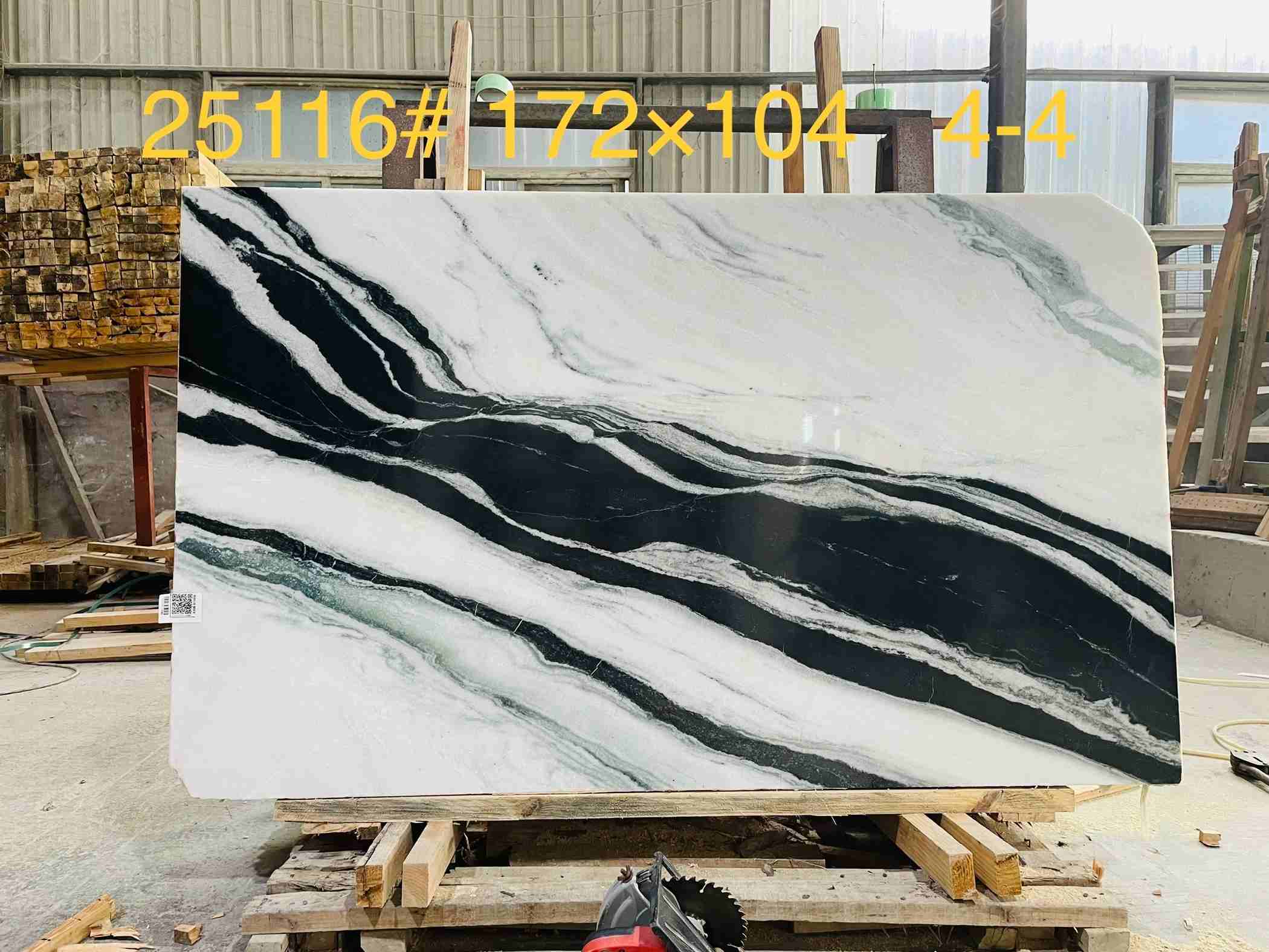
| Panda White | China | Clear white | Large black or dark grey bands with strong contrast | Statement |
| Oriental White | China | White | Flowing grey to dark grey movement, varying by selection | Atmospheric or statement |
| Calacatta Viola | Italy | Creamy white | Burgundy, violet and grey veining | Decorative statement |
Four Italian names cause most of the confusion, so it helps to separate them early. Carrara is the grey one — quieter field, finer movement. Calacatta runs cleaner and brighter behind veins that are simply bigger. Statuario keeps a lot of open white and draws its grey in deliberate strokes. Arabescato fills the slab, veins branching into each other until little empty space is left.
Commercial names stretch, too. "Vietnam White" can cover several stones and several grades; Vietnam Crystal White points at one specific thing — the bright, low-vein crystalline material described below.
Background tone is the field you see behind the veins: the colour a slab settles into once you stop looking at the drawing on top of it.
Step back a few metres to read it. Up close the eye goes straight to the veins and reports their colour instead of the field's. A Panda White slab with heavy black banding still has a clean white background. A near-vein-free slab can sit on a distinctly grey or creamy one.
Bright white marble reads almost flat — a continuous field with nothing competing for attention.
Thassos White is the far end of it. Greek, dolomitic, closer to a sugar cube than to most stone: dense, cold, faintly sparkling, essentially no vein. Put it beside anything else on this page and the neighbours turn slightly grey or slightly yellow.
Vietnam Crystal White sits a step warmer and a step coarser. Individual crystals catch the light, giving the surface a faint grain instead of Thassos's flat brightness. At two metres they look like the same stone. At arm's length they don't.
Clean selections of Sivec, Makrana White and Afyon White land here as well. Sivec is the Macedonian bright neutral, tight and even. Makrana is the milky one — dense, non-sparkling, taking light in where Thassos throws it back, and the stone most people recognise from the Taj Mahal.
Bright still leaves room for detail. Faint shadows, mineral points and the occasional vein survive in all of these; they just don't take over the field. Repetition is what changes the reading — an isolated grey area or a yellowish spot that nobody noticed on one slab becomes a pattern across forty.
Neutral white pulls the room in no particular direction. It won't cool a space toward blue-grey or warm it toward beige, which makes it the easy partner for joinery, paint and metalwork that are already decided.
Sivec, selected Makrana White, Afyon White, Blanco Macael and quieter Statuario blocks all sit here. Afyon is the clearest case — white with a soft haze moving through it, committed to nothing.
Neutrality behaves more like a batch property than a slab property. One slab reads neutral, the next leans cool, a third comes through more translucent, and the average is what ends up on the floor.
Cool or grey-white marble carries grey before a single vein is counted. The field itself is cool.
Carrara White is the reference — the grey-white everyone has already seen, softened further by fine clouding that spreads through the field rather than sitting on top of it. Bianco Dolomiti, Blanco Macael, and some Volakas and White Wooden Marble selections belong to the same group.
Grey veins are a separate matter. Calacatta carries plenty of grey over a bright or warm field and still reads warm overall; Carrara's clouding is what makes Carrara read grey. The field decides, the drawing doesn't.
Warm white marble sits on cream, beige or ivory. In isolation the warmth can be hard to see. Set the slab against a wall painted pure white and it appears immediately.
Estremoz White is the Portuguese version, soft and cream-toned, occasionally carrying a pink drift. Warmer Calacatta Gold and Arabescato belong here, along with Calacatta Viola and some Marmara, Volakas and Danby selections.
Field and vein warm up independently. A bright white field can carry gold veins; a creamy field can carry grey ones. Both get called "warm white," and they behave very differently in a room.
Veining is the drawing on top of the field: its scale, direction, density and contrast. Once several slabs are installed, this usually matters more than background tone.
Most of these families produce quiet, medium and heavily figured selections. The groups below describe how slabs behave, and a single name can appear in two of them.
Clean or minimal white marble puts almost nothing on the surface. The background and the crystalline grain carry the whole slab — Thassos White, Vietnam Crystal White, Afyon White, Makrana White and selected Sivec.
The result is controlled, bright and low in visual noise.
It's also the hardest end of the catalogue to keep consistent. On a heavily veined slab, a grey shadow or a fill mark disappears into the movement. On plain white it sits there on its own — and so does a half-degree shift in temperature between one slab and the next.
Carrara White is the soft, cloudy white marble most people know: grey wisps, pale shadows and low-contrast clouds that fade into the field instead of crossing it. Guangxi White, Bianco Dolomiti, softer Volakas, Blanco Macael and some Oriental White move the same way.
This style gives a surface depth while keeping it continuous, which is why it covers so much floor.
Distribution is where it goes wrong. Gentle clouding concentrated into three or four slabs stops reading as atmosphere and starts reading as a dark patch. Mix light and dark selections across a floor and the room looks like it was laid from two different batches, because it was.
Linear white marble runs repeated parallel lines one direction across the slab.
Marmara White is the clearest example: grey stripes crossing a white to lightly creamy field with real regularity. Certain cuts of White Wooden Marble, Blanco Macael and other directional stones read linear too.
Direction becomes part of the design once this material is on site. Lines can stretch a corridor or set the order of a wall, and a few rotated panels or an inconsistent gap will undo either one. Orientation belongs in the selection conversation alongside colour and size.
White Wooden Marble is the main wood-grain white marble in commercial supply: closely spaced layers stacked like timber grain or sedimentary bedding. Depending on the cut, its bands run straight, gently wavy or tightly compressed.
More active than a simple stripe, still firmly directional.
Band density is what shifts the effect. Fine continuous grain and broad broken banding come out of the same family and look like different materials once installed — a bigger jump, usually, than a moderate change in background tone.
Bold white marble draws large vein paths you can follow across a room: Calacatta Gold, Statuario, Arabescato, stronger Volakas, Vermont Danby and selected Oriental White.
The movement takes different forms. Calacatta sweeps in broad open strokes. Statuario draws its grey deliberately and leaves white around it. Arabescato branches and interlaces until the slab is nearly full. Danby runs diagonal, sometimes with a warmer accent riding along.
These stones stay legible at a distance, which is what makes them work on feature walls and focal islands. It's also what makes cutting decisive: a composition that reads beautifully across a full slab can lose its logic once divided into panels.
High-contrast white marble sets a graphic relationship between white ground and dark movement.
Panda White is the plainest case — black and dark grey bands across clear white, closer to a print than to most marble. Calacatta Viola brings burgundy and violet. Paonazzo and the more expressive Calacatta selections mix grey, black, gold and amber. Some Oriental White slabs drift toward an ink-wash effect, grey pooling and thinning across the surface.
Material like this gets chosen as a composition. Where the dark bands fall, how much open white stays around them, whether two panels balance each other — those decide whether the wall looks deliberate or busy. The name matters less to the outcome than the sequence and the cut.
Background and veining describe the slab. Role describes what happens after installation, and it's usually the shortest path from "which marble is this" to "which marble do I want."
| Visual role | What the stone does | Typical characteristics | Representative white marbles |
|---|---|---|---|
| Background | Creates light and continuity while allowing furniture, objects or architecture to lead | Clean or quiet field, low contrast, repeatable movement | Thassos, Vietnam Crystal, Sivec, Afyon, Makrana |
| Atmospheric | Gives the room softness, depth or natural variation without becoming a single focal image | Clouding, fine veins, gradual tonal shifts | Carrara, Guangxi, Bianco Dolomiti, soft Volakas, Estremoz |
| Architectural | Reinforces direction, proportion, symmetry or structural order | Parallel lines, bands, consistent directional movement | Marmara, White Wooden Marble, selected Blanco Macael |
| Statement | Becomes a focal surface or a recognizable stone composition | Large-scale veins, strong contrast, distinctive color or bookmatch potential | Calacatta Gold, Arabescato, Statuario, Panda White, Calacatta Viola |
Role moves with selection and layout. Quiet Calacatta panels can behave atmospherically. A strongly veined Volakas slab can carry a wall on its own. Marmara cut into small tiles and rotated at random loses the architectural order that made it Marmara in the first place.
The grouping exists to name the result a project needs, before anyone starts choosing a batch.
Selection gets easier from the other direction: start with the installed result and work back to the stone.
A project rarely needs "a good white marble." It needs a white surface that holds together across four hundred square metres, or a calm continuous wall, or a disciplined run of lines, or a bookmatch that actually meets, or one slab doing all the talking. Each of those asks for different evidence.
Big floors, wall fields and repeated modular panels want one continuous white impression. Individually beautiful slabs are beside the point if they don't agree with each other.
That calls for a stable bright or neutral background, low contrast, and movement that stays balanced through repetition: Thassos White, Vietnam Crystal White, Sivec, Makrana White, Afyon White and selected Guangxi White.
Range matters more than any single sample here. On minimal stone, black points, yellowish minerals, grey patches and resin areas have nowhere to hide, and the question becomes whether they read as natural variation or as a break in the surface.
Panel size changes the answer. Small tiles spread variation around; large panels put local clouding and inclusions on display. The white field has to survive at the quantity actually available, not only in the best-photographed slabs.
Some rooms want continuity without the flatness of an almost vein-free white.
The stone for that has fine-to-medium low-contrast veins, softly spread clouding and gradual transitions between lighter and greyer areas: Carrara White, Bianco Dolomiti, Guangxi White, softer Volakas, Blanco Macael and quiet Oriental White.
These get judged as a population. A set of attractive slabs can still patch up when grey clouds bunch together or the background steps instead of fading. On a floor, stronger and quieter pieces want distributing; on a wall, the question is whether clouding crosses the joints naturally or leaves one panel sitting darker than its neighbours.
Soft variation is the character of these stones. The line worth watching is where a dark area or a temperature shift starts creating a focal point nobody asked for.
Corridors, lobbies, stair walls, long counters, ordered elevations — places where veining can do structural work.
Marmara White and White Wooden Marble lead here, with directional Blanco Macael offering a quieter version of the same idea. What they need in common: clear grain, consistent line orientation, and enough usable length to carry that direction across the planned pieces.
The lines need a job first — extending a floor, lifting a height, aligning with joinery, forming bands — because the job determines the cutting orientation. Rotation, uneven spacing and bands that stop at an important joint turn a disciplined material restless.
Line spacing and module width also have to agree. Broad bands can vanish inside a narrow strip; dense grain can start to vibrate across a large field.
A vein-match works when the drawing continues from panel to panel. A bookmatch also has to mirror into something balanced.
Strong, readable movement helps — Calacatta Gold, Arabescato, Panda White, Statuario and expressive Oriental White — though dramatic veining on its own guarantees nothing. The wall needs consecutive slabs, usable panel sizes, and vein paths that arrive at the joints where they're supposed to.
Elevation comes first: panel dimensions, joints, openings, visual centre. A strong central vein can look perfect on the slab and break apart once trimming and cutouts are drawn over it.
The matching zones carry most of the risk — cracks, heavy repairs, weak areas, colour changes. Visual weight has to balance across the mirror as well. A dense panel beside open white can meet perfectly at the joint and still look wrong.
An island, a reception desk, a fireplace, a panel treated as art. The stone leads and everything else follows.
Panda White, Calacatta Viola, Paonazzo, Calacatta Gold, Arabescato and the more expressive Calacatta selections do this — large readable movement, a clear hierarchy between field and vein colours, enough intact surface to keep the composition after cutting.
They're chosen as images, framed by the room. Strong black, grey, gold, violet or burgundy movement wants placing deliberately, with enough open white left around it to register. Uniform activity across a whole slab can read as texture and lose its focus, while a single concentrated vein, positioned well, carries much further.
Most of what goes wrong here is compositional. The movement lands to one side, two colours compete, or a cutout removes the exact area that made the slab worth buying. Repairs and fissures matter most when they run through a focal or a thin structural zone. The right slab is the one whose drama survives fabrication in the position it's meant to occupy.
Three things run through all five effects. Full slabs and the actual batch tell you more than a sample ever will. Natural variation and a genuine mismatch are different problems and want treating differently. And the quantity on hand has to produce the panel sizes and the sequence the design assumes.
Thassos White and Vietnam Crystal White, with selected Sivec, Afyon White and Makrana White close behind. Worth knowing that "minimal" describes the veining, not the surface — crystalline variation, mineral points and faint shadows are all still in play.
No single white marble is best for large-area flooring; the choice follows the effect. Carrara and Guangxi White give a soft continuous floor; Sivec, Afyon and Makrana hold a quieter neutral; Marmara brings direction; Thassos gets closest to pure white. What they all need is a repeatable background, evenly distributed movement, and enough batch behind the quantity. Finish and performance are a separate conversation.
Carrara sits on a cooler grey-white field with finer, softer movement. Calacatta runs brighter or warmer behind broader grey veins, sometimes with gold or beige alongside. Both names cover a wide natural range, so two slabs sold under the same name can look further apart than a Carrara and a Calacatta chosen side by side.
Bookmatching works with any white marble that has continuous, legible veins and consecutive slabs available. Calacatta, Arabescato, Panda White, Statuario and strong Oriental White come up most often. The sequence has to mirror into a balanced composition inside the panel dimensions the wall actually allows.
Yes, with one thing understood up front: most traditional white marbles are calcitic and etch where acid touches them. Lemon, wine and vinegar leave dull marks. Plenty of clients read that as patina and like it. If an unchanged polished surface is the requirement, a different material category is the easier answer.
White marble gets easier to compare once the name is treated as an opening question. Decide the background tone, identify the veining behaviour, settle the role the stone has to play, then look at real slabs against that.
The variation is what makes the material worth using. The classification is just there to keep it in hand.
Categories
New Blog
 ROOM 205,NO.45, MIDDLE HAIJING ROAD,XIAMEN,AREA OF PILOT FREE TRADE ZONE(FUJIAN)OF CHINA
For inquiries about our products or pricelist, please leave to us and we will be in touch within 24 hours.



© Copyright: 2026 XIAMEN EXCELLENT STONE CO.,LTD. All Rights Reserved.

IPv6 network supported