English




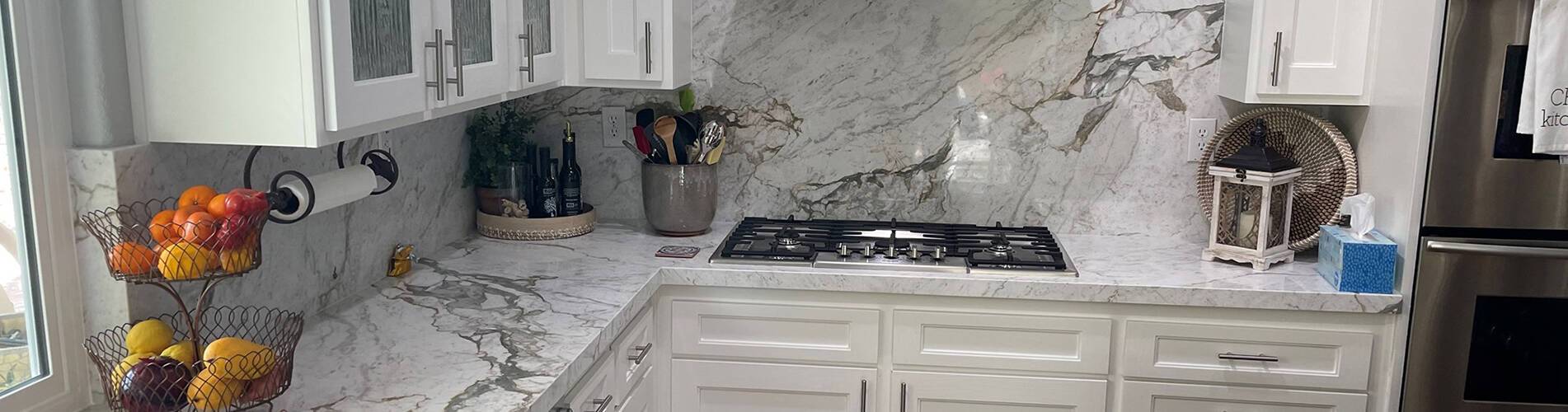
Quick answer: To choose white marble slabs, match three things — the look you need, the environment the stone has to survive, and your supplier's ability to keep a whole order consistent. Pick the variety by the effect you want. Choose calcite or dolomite marble based on how wet the space is, because calcite marbles yellow. Then put the grade criteria, slab size, thickness and finish in writing, confirm the trade name against a quarry, and work backwards from your site date: wholesale white marble runs 7 to 14 weeks from order to delivery.
Everything else is detail — but the detail is where orders go wrong. A slab that looked perfect in a photo arrives with a grey cast. The second container doesn't match the first. The stone starts to yellow a year after the building opens.
Those three things break down into ten decisions. Here they are in the order you face them.
Plus frequently asked questions and about this guide.
Most guides sort white marble by country. That doesn't help you choose. You start with a look in mind, so here they are grouped by what they look like.
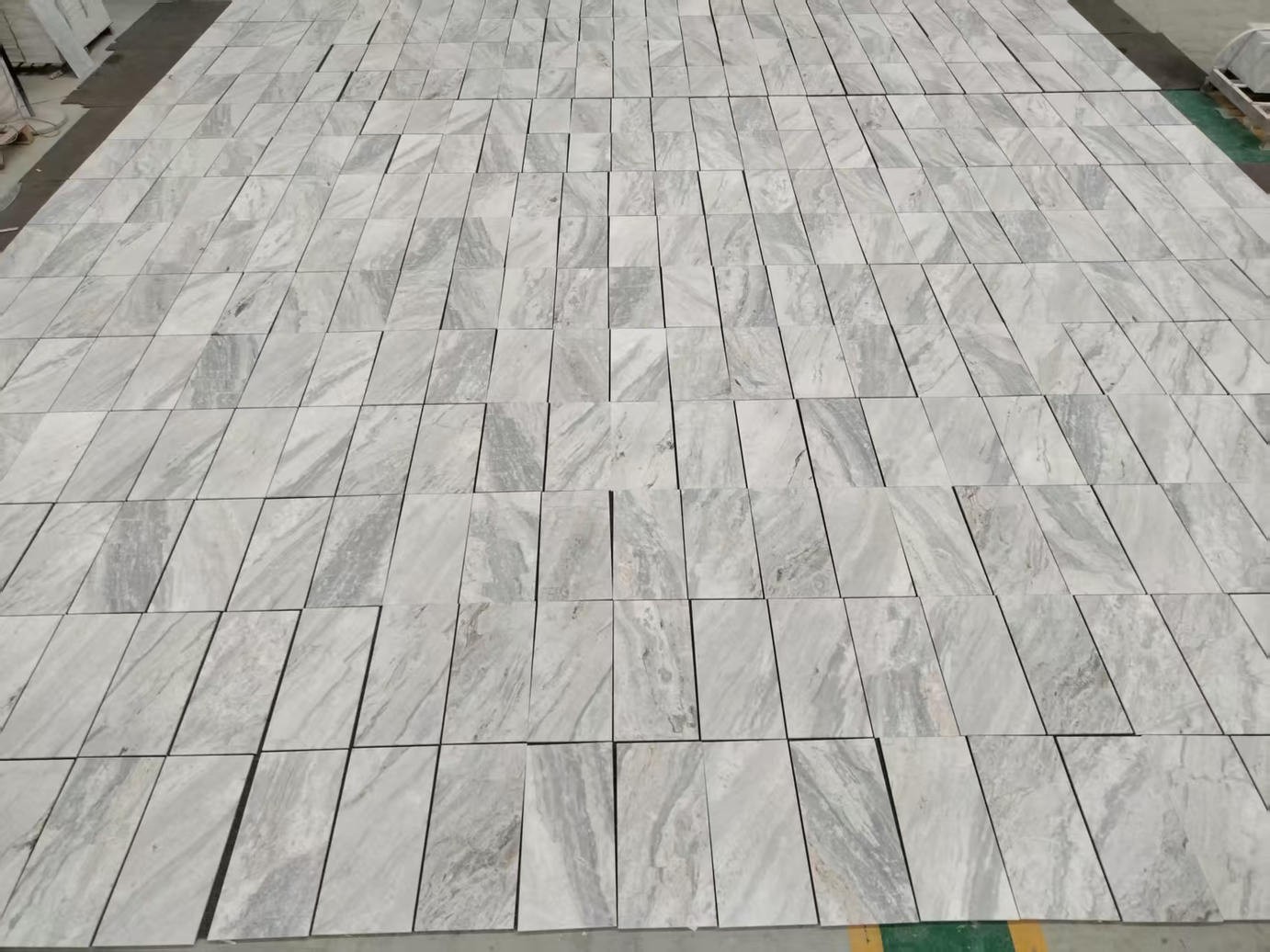
This is the shortlist — the stones that come up most often and what each one is good for. For the full classification of every variety we carry, sorted by colour, veining and visual role, see our companion guide to types of white marble.
This is what most people picture when they hear "white marble." A soft white background with fine grey veins running through it.
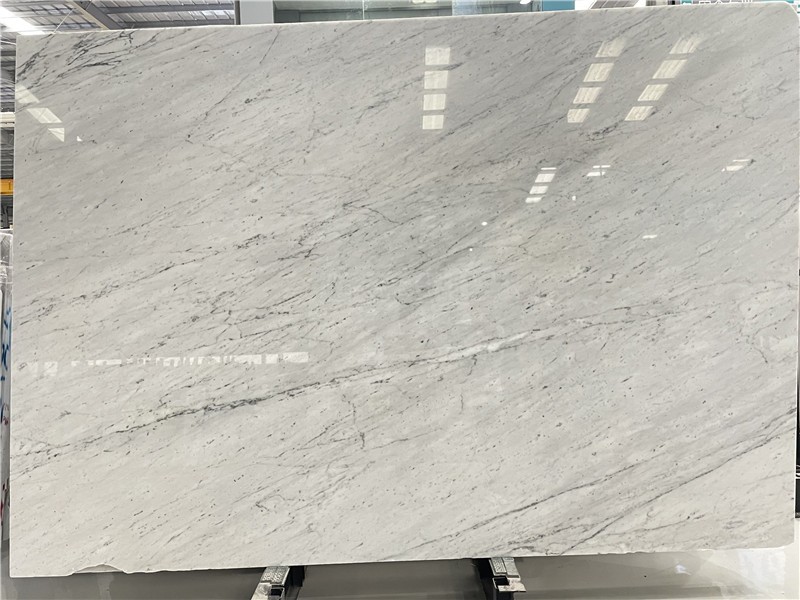
Carrara comes from the Apuan Alps in Italy and is the most recognized white marble in the world. The background is a soft grey-white, and the veins are fine and feathery. It is the workhorse of the group — widely available, and the reference point everyone else gets compared to.
Oriental White comes from Sichuan, China. In the Chinese trade it is called the country's marble calling card. Clean white background, clear grey veining.
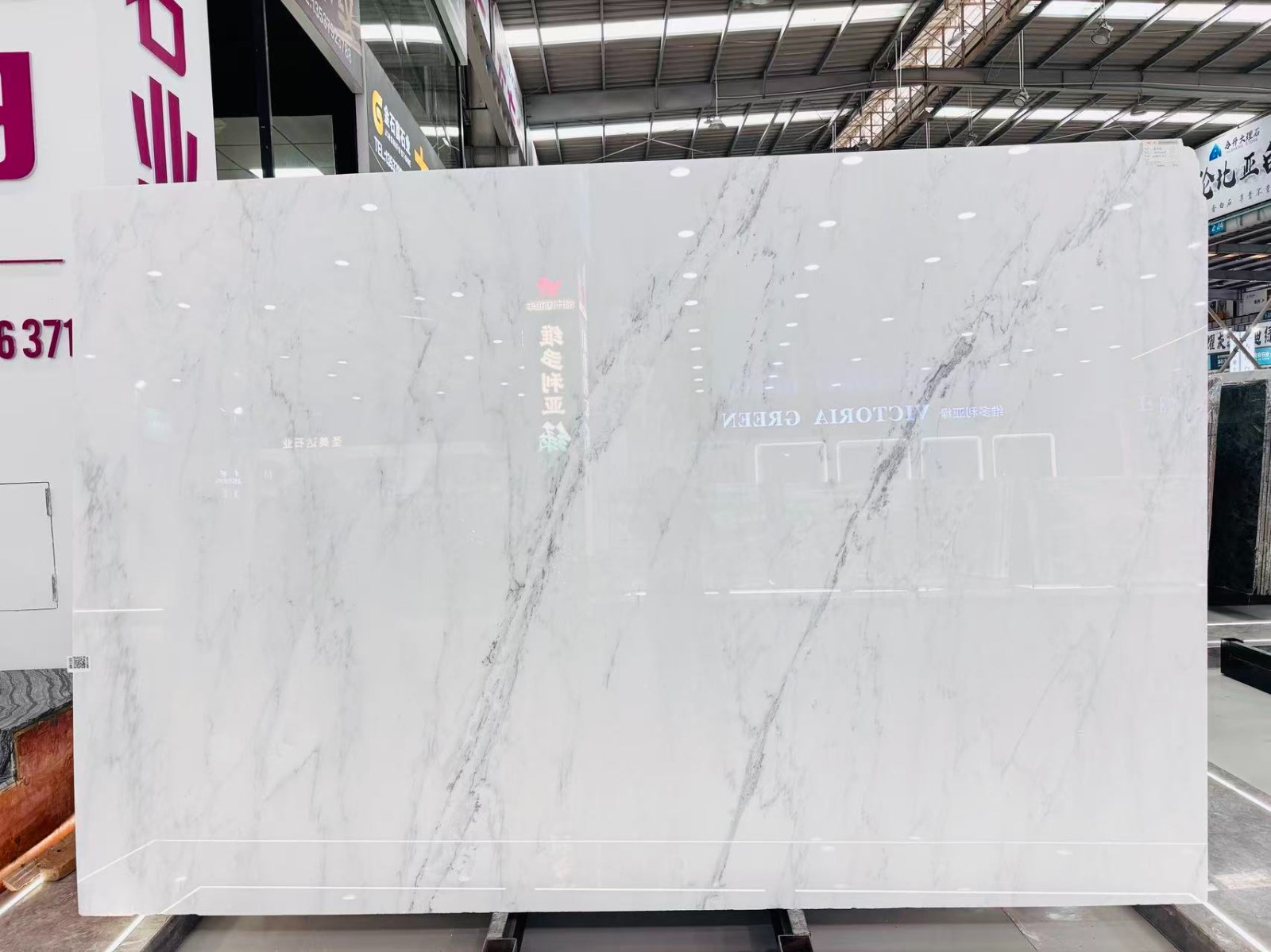
Oriental Fish Belly White is a separate stone from Sichuan, not another name for Oriental White. The two get confused constantly, and the shared "Oriental" is the reason. It runs whiter than Oriental White and the veining is finer.
 |
 |
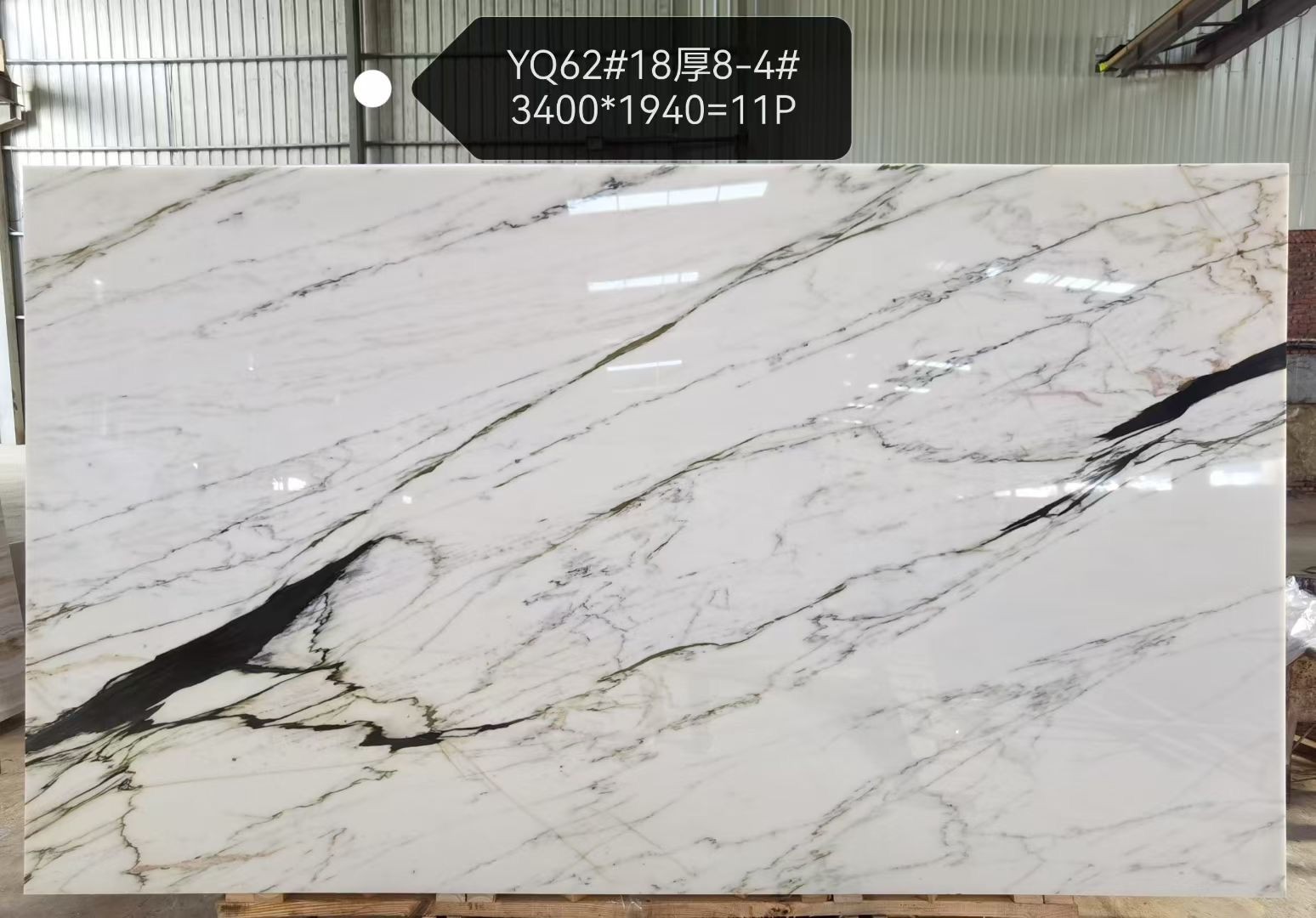 |
Calacatta has a crisp white background and thick, dramatic veins that run from gold to dark grey. It is rarer than Carrara and priced accordingly. Designers pick it for bookmatched feature walls, where two slabs are cut from the same block and opened like a book so the veins mirror each other.
Statuario sits between the two. It has the bright white base of Calacatta with more structured, flowing grey veins. Vein width ranges from a few millimetres to several centimetres. It cuts well, which is why sculptors have used it for centuries.
Volakas comes from northern Greece. The background is a slightly grey white and the veins run on a diagonal, which gives it a cloud-like look — softer than the Italian stones. It shows up often in hotel lobbies.
Guangxi White comes from Hezhou in Guangxi, China. Snow-white background with soft flowing veins in warm grey and light gold. The veining ranges from thin lines to broad misty clouds, so two slabs from different blocks can look quite different. Keep it indoors — it is not a good choice for exterior cladding.
These read as artwork rather than background. Chinese buyers call the style shuimo, after traditional ink-wash painting.
Panda White is a Sichuan stone — white with strong black veining and a fine, tight grain. Large clean slabs are genuinely scarce, which is the main thing to know before you specify it for a big wall.
Ink Jiangnan has white and soft black veins woven together, like ink splashed onto paper. It gives a similar effect to Panda White at a lower price.
Landscape Painting marble has veining that reads like rivers and mountains. The best panels are sold by the piece, not by the square metre, because each one is treated as a single composition.
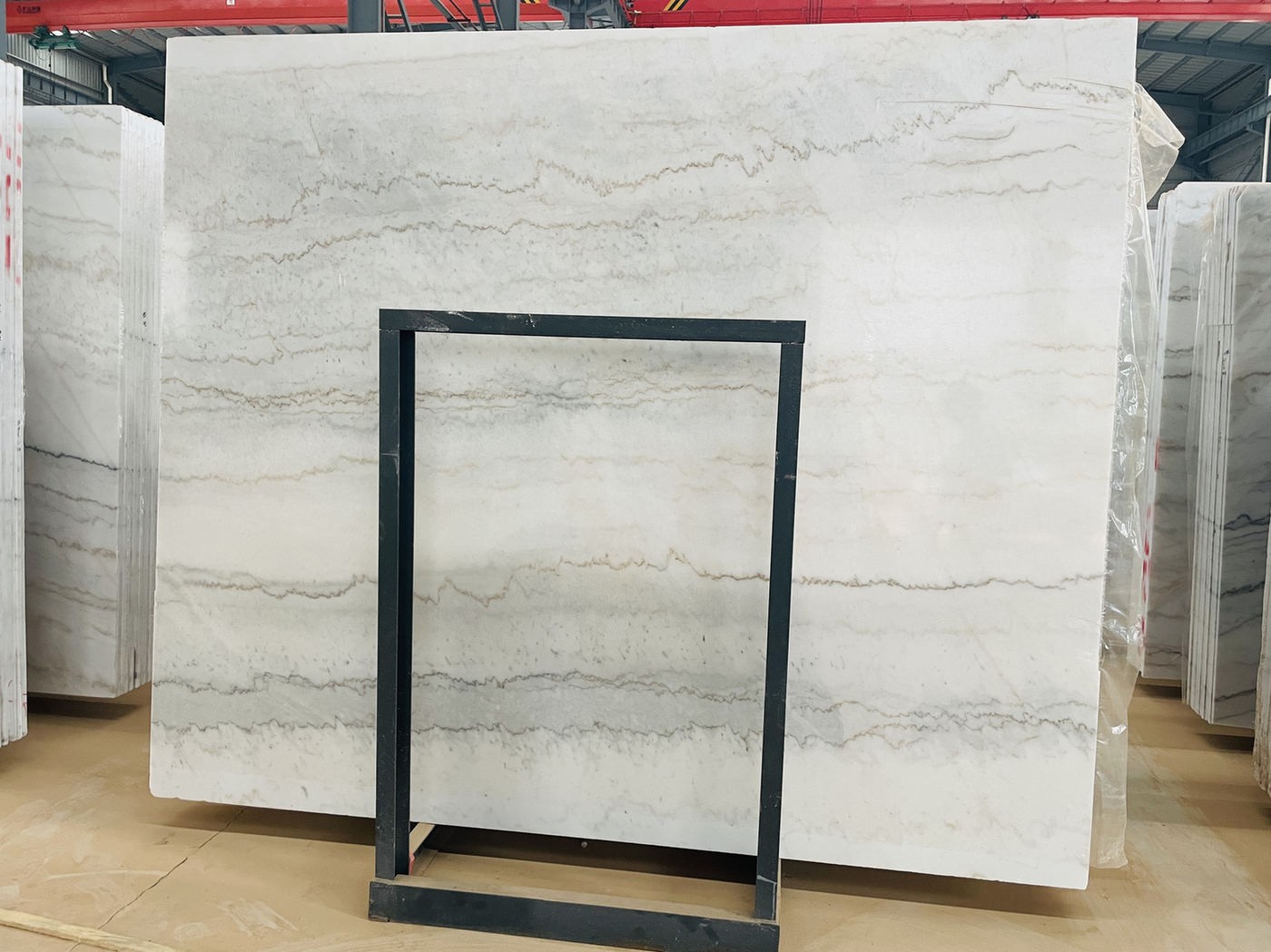 |
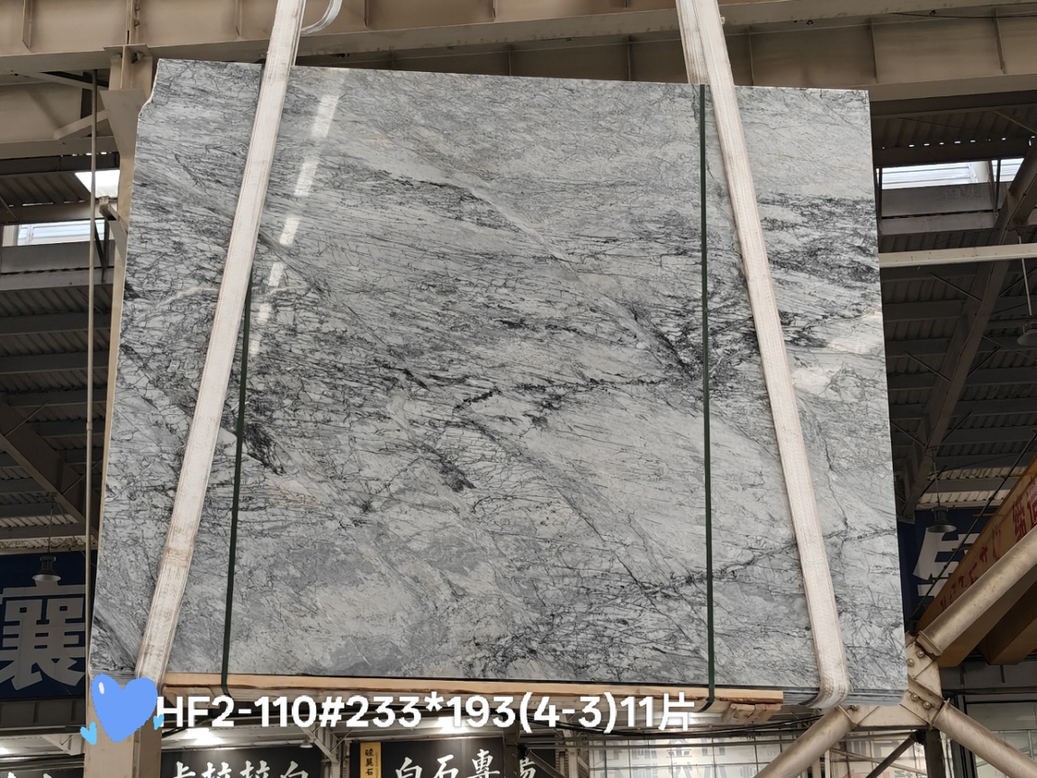 |
Greek crystal whites — Thassos from Thassos Island and Sivec from Prilep in North Macedonia — are the whitest stones in commercial use. Both are dolomitic marble with a very fine grain and almost no veining. Sivec is the harder of the two.
Yunnan Crystal White is the Chinese stone in this category, and it costs less than the Greek crystal whites.
White Wooden comes from Guizhou. The veins run in straight parallel bands that look like wood grain. Note that it is classified as a semi-white marble, not a pure white — the background carries grey and silver tones. You will also see it sold as White Serpeggiante, Striato Bianco, Silk Georgette and Chenille White. Same stone.
Jazz White is another Chinese white with a cleaner, more even field.
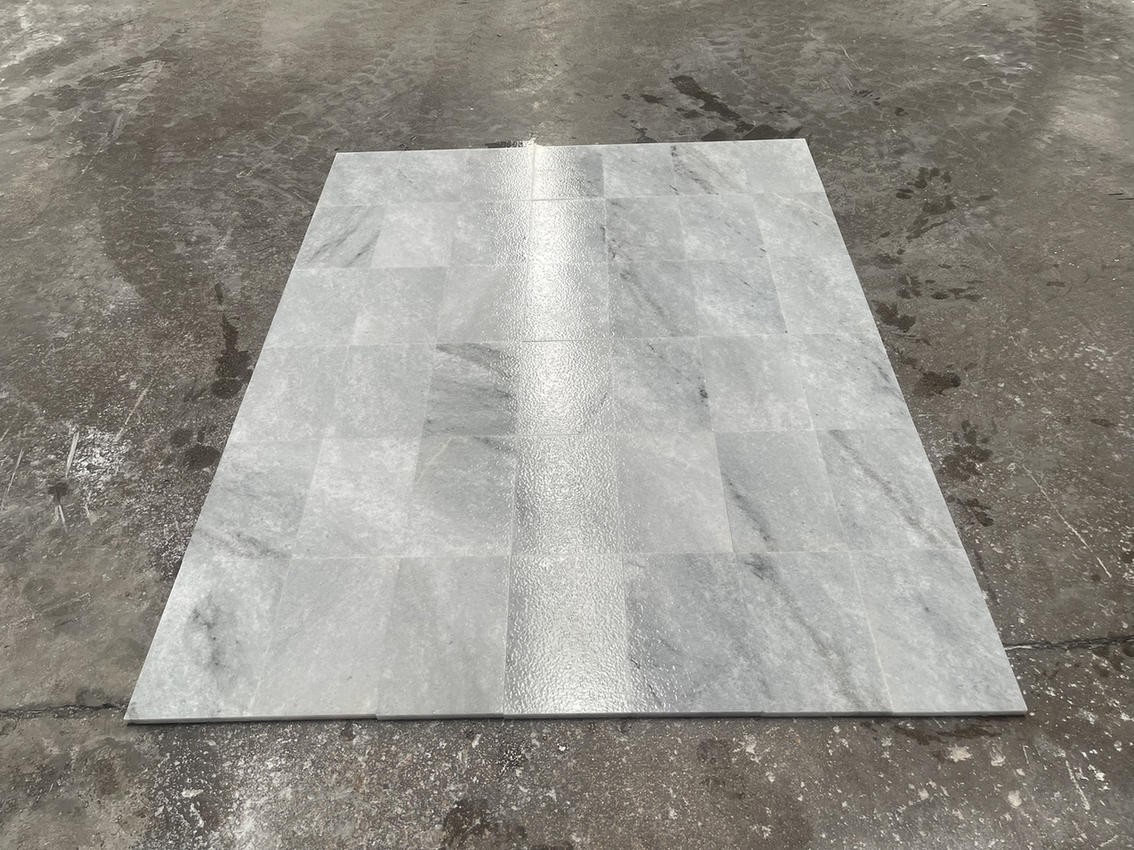 |
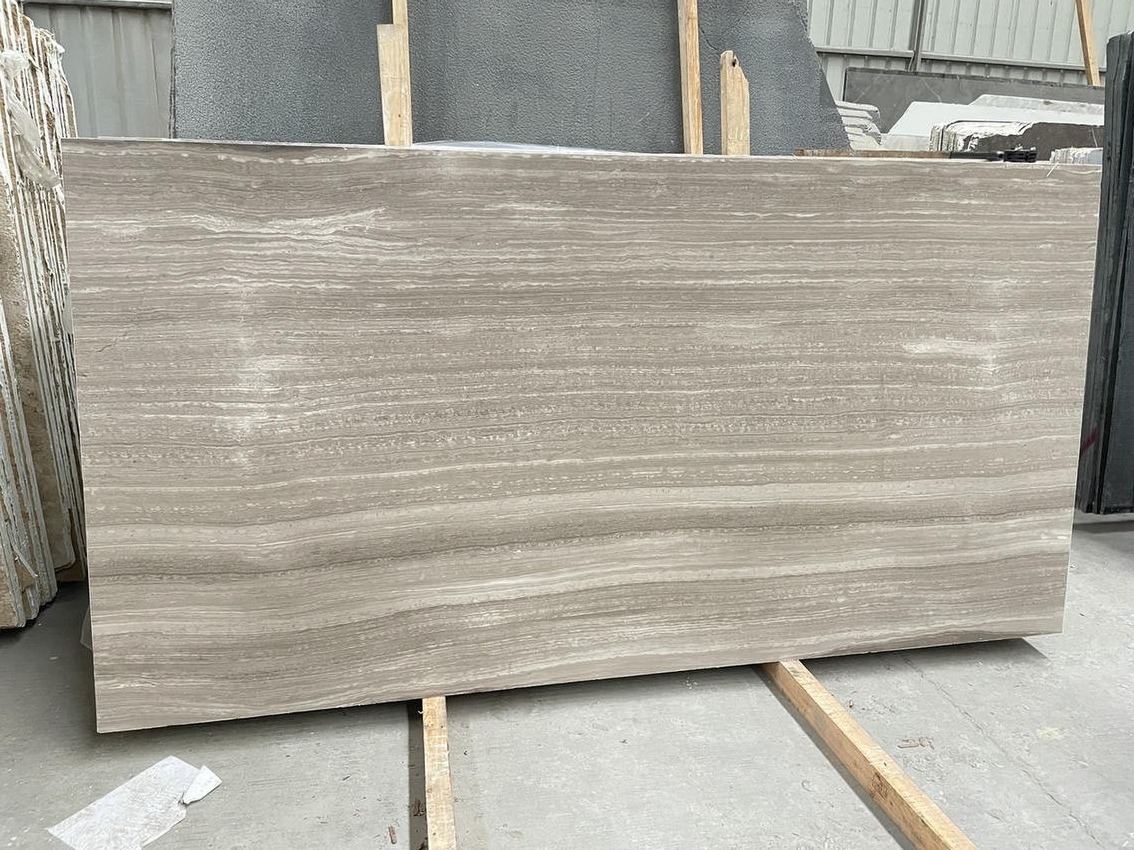 |
 |
| Stone | Origin | Background | Veining | Type | Best for |
|---|---|---|---|---|---|
| Carrara | Italy | Soft grey-white | Fine, feathery | Calcite | Floors, walls, general use |
| Calacatta | Italy | Crisp white | Bold, gold to dark grey | Calcite | Feature walls, bookmatch |
| Statuario | Italy | Bright white | Structured, flowing | Calcite | Focal points, carving |
| Volakas | Greece | Grey-white | Diagonal, cloudy | Calcite | Lobbies, interior cladding |
| Thassos / Sivec | Greece / N. Macedonia | Near pure white | Almost none | Dolomite | Wet areas, high traffic |
| Oriental White | China | Clean white | Clear grey | Calcite | Floors, walls |
| Oriental Fish Belly White | China | White | Fine | Calcite | Interior feature work |
| Guangxi White | China | Snow white | Soft, misty | Calcite | Interior floors, lobbies |
| Panda White | China | White | Strong black | Calcite | Feature walls |
| Ink Jiangnan | China | White | Soft black, ink-like | Calcite | Feature walls |
| Landscape Painting | China | Multi-tone | Landscape patterns | Calcite | Single-panel art walls |
| Yunnan Crystal White | China | Near pure white | Minimal | Dolomite | Wet areas, minimal designs |
| Jazz White | China | Even white | Light | Calcite | Large floor areas |
| White Wooden | China | Semi-white | Straight, wood-like | Calcite | Cladding, accent walls |
Narrowing between two or three of these? The full white marble classification takes each variety further — colour family, veining character, and the visual role it plays in a space.
White marble yellows. This is the single most common complaint on finished projects, and it is preventable.
Here is what happens. White marble contains iron minerals — iron sulfide, iron carbonate, magnesium iron silicate. When water and air reach them, the iron oxidises. It turns into what is effectively rust, and the rust shows through the surface as a yellow or brown stain.
Without back-sealing, yellowing typically appears 8 to 12 months after installation. That timing catches people out, because the job looked perfect at handover.
There is a second cause. Some white marble holds water-soluble organic matter. During wet-set installation, the alkaline water in cement grout reacts with it and pushes a brown-yellow discolouration up to the face.
White marble splits into two mineral families, and the difference matters more than any grade label.
Calcite marbles include Carrara, Calacatta, Statuario and most Chinese whites. They sit around 3 on the Mohs hardness scale. Their iron content is higher, so they yellow and rust more readily. Carrara is the worst offender of the group.
Dolomite marbles include Thassos, Sivec and Yunnan Crystal White. They run 3.5 to 4 on the Mohs scale, they are denser, and they resist yellowing and rust far better.
Match the stone to the room, not to a preference:
Back-sealing the underside of the slab before installation is the most important protective step there is. Penetrating sealers based on silane or siloxane work, but they lose strength over time and need reapplying.
For the full mechanism and the repair options once yellowing has started, see our detailed article on why white marble turns yellow.
The same stone can reach you under half a dozen different names. This is not fraud — it is how the trade evolved — but it costs buyers money when they compare quotes that are not actually for the same material.
Oriental White, Eastern White and China Carrara are the same marble.
Oriental White is the established trade name. Eastern White came from a direct translation of the Chinese name. China Carrara came from marketing — it tells a buyer what shelf the stone sits on.
That marketing origin is worth understanding, not dismissing. The stone stands on its own. It has been quarried and used for decades, and the name simply signals where it fits in the market.
Despite the shared "Oriental," this is a separate variety with its own quarry and its own character. If a quote says one and the sample shows the other, that is a real substitution, not a naming variation.
White Wooden also trades as White Wood Grain, Wooden White, White Serpeggiante, China Serpeggiante, Striato Bianco, Silk Georgette and Chenille White.
Name inflation is not a Chinese practice — it is a stone industry practice. One American distributor lists nine separate white marble product names. Two major suppliers write the same Italian stone as "Statuario" and "Statuary White" on their own websites. Buyers searching for "fake Carrara" are running into the same problem from the other direction.
Buyers are often told one stone "looks like" another. That is the wrong frame, and it sets up disappointment when the slabs arrive.
The right frame is application. Two stones substitute for each other when they achieve the same white effect in the same setting — not when their veining patterns match under a magnifying glass.
Three pairs work this way:
| Stone | Substitutes for | What it delivers |
|---|---|---|
| Oriental White / China Carrara | Italian Carrara | Same soft grey-veined white in the same interior settings |
| Yunnan Crystal White | Greek crystal whites | Same near-pure white field, lower cost |
| Ink Jiangnan | Panda White | Same ink-wash effect, better availability in large slabs |
Notice the third pair is one Chinese stone substituting for another. Sourcing to effect and budget is standard practice everywhere in this industry, in every direction.
What to do: stop working from the trade name alone. Ask for the quarry location, the local Chinese or Greek name, and a photo of the actual block. A supplier who knows their material answers all three straight away.
Five things decide whether a slab is worth buying.
| What to check | Good | Poor | Why it matters on site |
|---|---|---|---|
| Background purity | Even white across the whole slab | Grey, yellow or green cast in patches | Patchy background is obvious on large wall runs |
| Vein distribution | Balanced across the face | Clustered at one edge, bare elsewhere | Hard to lay out; waste goes up |
| Cracks and weak seams | None visible | Visible fractures, glass-like lines | Breakage during fabrication and transport |
| Pits and filling | Minimal, cleanly filled | Heavy filling, dull patches | Filler shows up later and catches dirt |
| Finish quality | Even gloss, square edges, consistent thickness | Wavy surface, chipped edges | Visible seams and lippage after installation |
Run your fingernail across the line. If your nail catches, it is a crack. If it glides over, it is a natural seam in the stone. Cracks are a defect. Seams usually are not.
Tap the slab. A dense, sound slab rings clear. A dull or gritty sound means internal fractures.
Hold it to the light. Real marble lets some light through. Complete opacity in a thin sample is a warning sign.
Look at it in daylight. Showroom lighting hides a great deal. Ask your supplier for photographs shot in natural light on the factory floor, not styled product shots from a lightbox.
Check the slabs together, not one by one. When you order multiple slabs, look at how the veins meet at the joints. Veins that fight each other across a seam look wrong no matter how good each slab is on its own.
One caution: acid and ink tests do damage the surface. Run them on an offcut, never on a slab you intend to install.
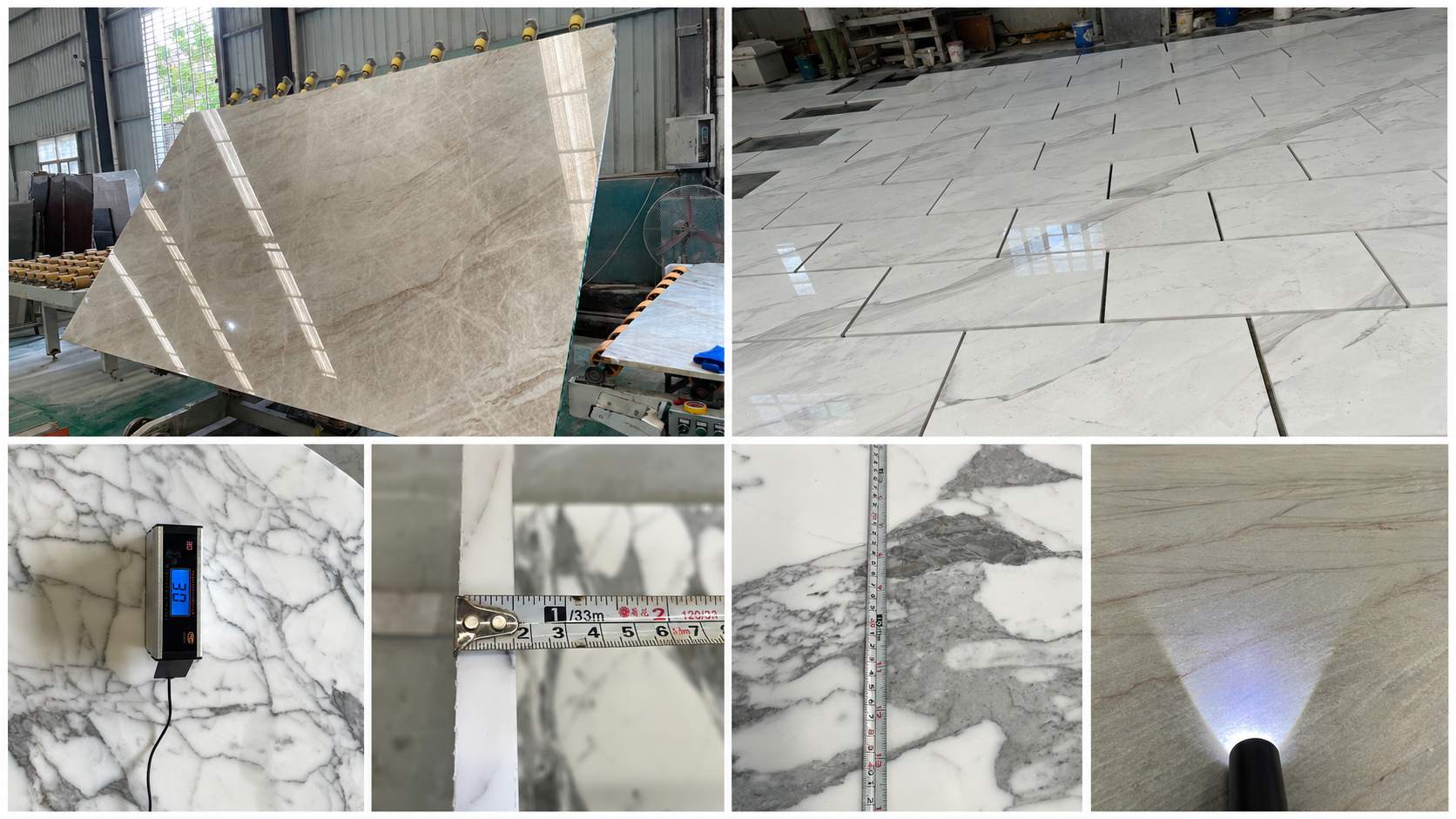
Before grades, understand where the stone comes from — because that explains why grading exists at all.
The figures in this section come from the manager of our processing plant, who has spent fifteen years cutting white marble and works on slab layout and yield for a living.
Marble yield is measured in two stages.
Quarry yield is how much of the rock cut from the mountain comes out as usable blocks. It runs 15% to 40%. Well-formed deposits with few fractures reach 30–40%. Heavily fractured or weathered deposits deliver 15–25%.
Processing yield is how much of a block survives cutting into finished slab. It runs 60% to 75%. Marble cuts easily, but the losses come from protecting the veining and avoiding breakage. Stones with complex, fragile veining sit at the bottom of that range.
Multiply the two and you get overall yield:
| Deposit and process | Quarry yield | Processing yield | Overall |
|---|---|---|---|
| Sound deposit, modern equipment | 40% | 75% | 30% |
| Typical | 35% | 70% | 24.5% |
| Fractured deposit, standard equipment | 15% | 60% | 9% |
That one number explains most of what confuses buyers. It is why white marble costs what it does. It is why large slabs cost disproportionately more — a block clean enough to yield a 3-metre slab is genuinely rare. It is why two quotes from the same quarry differ. And it is why no supplier can promise you a full container of top-grade slabs from one block. If someone does, they are planning to mix blocks, and your colour consistency is gone.
Quarry yield is set by geology. Processing yield is not — it is the half of the equation a factory actually controls, and the gap between a good plant and an average one is wide.
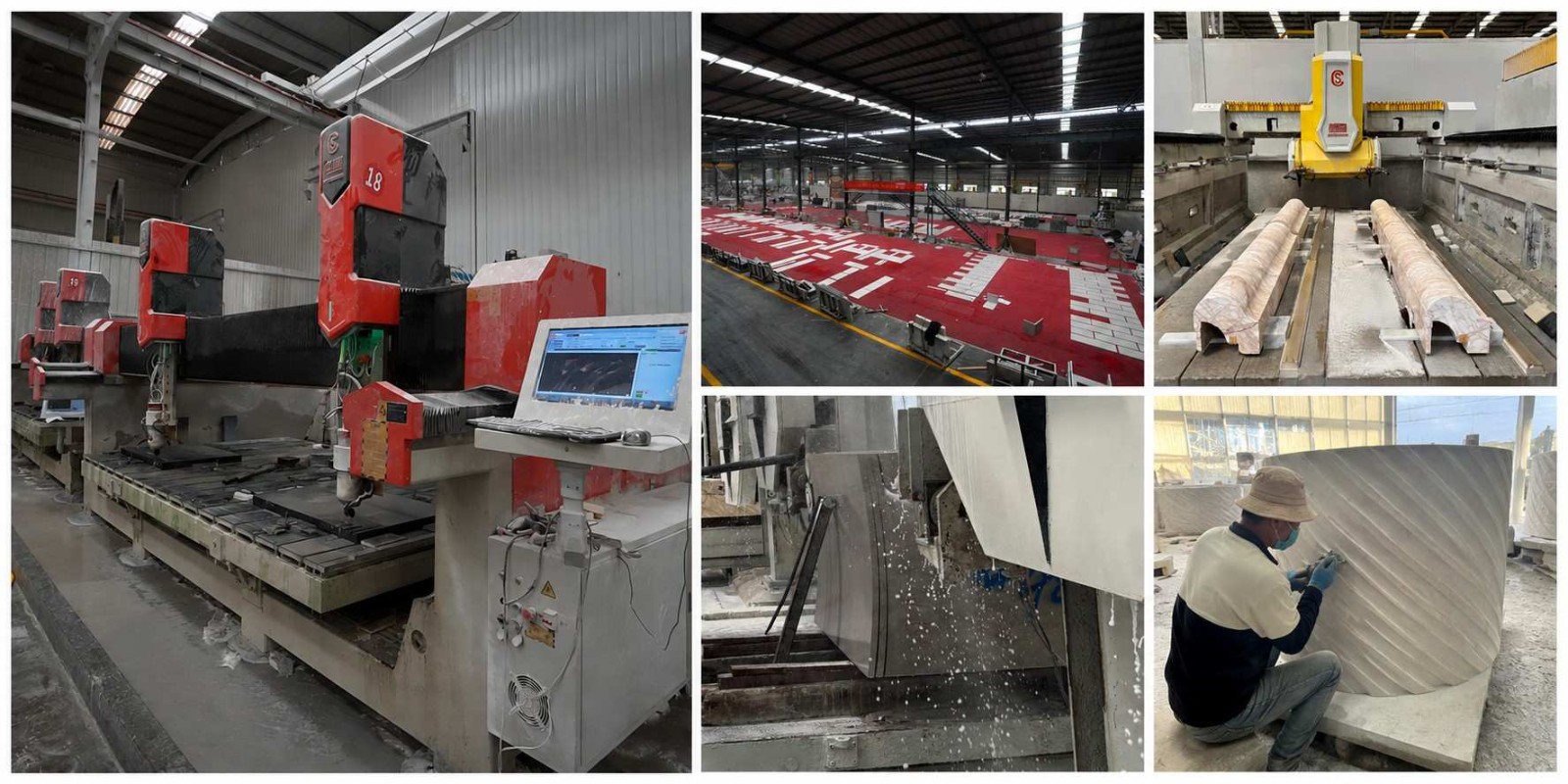
Three things move it. Multi-wire saws cut thinner kerfs and waste less stone than older gangsaws. Proper resin treatment holds fragile veining together so slabs survive the line instead of breaking on it. And layout — deciding how a block gets sliced before the saw starts — decides how much of it lands inside your order rather than in the offcut pile.
Ask a supplier what their processing yield is. If they know the number, they measure it. If they measure it, they work on it.
There is no industry-wide standard for grading the appearance of marble. Each supplier runs their own system, and the systems contradict each other.
| Supplier system | Top | Middle | Bottom |
|---|---|---|---|
| A / B / C | Grade A | Grade B | Grade C |
| Premium / Commercial / Economy | Premium | Commercial | Economy |
| Carrara trade grades | Extra | C | CD |
Look at what happens to the word "commercial." In the first system it is the bottom tier. In the second it is the middle. A buyer who accepts "commercial grade" from two suppliers is buying two different things.
Premium grade typically runs 30–50% above commercial, and economy sits 20–40% below it. Those spreads are the industry's rough working numbers — they tell you the scale of the gap, not what your specific stone will cost.
Stop asking what grade it is. Ask what the grade is based on. A supplier who grades seriously will answer in specifics: background variation across the batch, vein density, whether the slabs are filled, how much filling. Get that in writing and attached to your order, and the label stops mattering.
ASTM C503/C503M, published by ASTM International, is the standard specification for marble dimension stone. Suppliers cite it constantly. Here is what it actually requires.
| Property | ASTM C503 requirement | Commonly published values for white marble |
|---|---|---|
| Water absorption | ≤ 0.20% | around 0.10% |
| Density | ≥ 2560 kg/m³ | 2700–2830 kg/m³ |
| Compressive strength | ≥ 52 MPa | 118–162 MPa |
| Flexural strength | ≥ 7.0 MPa | 10–17 MPa |
Look at compressive strength. The standard sets the floor at 52 MPa. Normal white marble on the market tests two to three times higher.
"Meets ASTM C503" is not a quality claim. It is a minimum entry requirement. It tells you the stone is not the worst material on the market. It tells you nothing about whether it is good.
The related test methods are worth knowing by number, because you will specify them:
What to do instead of accepting a generic certificate: ask for test data on the batch you are buying, not a report on the stone type in general. Agree the testing lab, the cost and the turnaround before you place the order, not after. We arrange third-party testing on request — tell us which standards your specification calls for and we will book it into the production schedule.
| Standard | Maximum | |
|---|---|---|
| Length | 2800–3000 mm | 3200 mm |
| Height | 1800–2000 mm | 2100 mm |
| Thickness | 20–30 mm | 50 mm and up for special work |
Slabs longer than 3000 mm are rare. Three things cap the size: the gangsaw, warehouse handling, and — the real constraint — finding a block sound enough to cut that long without a fracture running through it. The first two are equipment problems. The third is the yield problem from the previous section, and it is why the price curve for large slabs is steeper than the area alone would suggest.
Common sizes are 600×600, 600×900 and 900×900 mm. The practical maximum for standard production is 1200×1200 mm. Beyond that, both the block requirement and the equipment requirement climb steeply, and so does the price.
For flooring, 18–20 mm is standard. For countertops and heavy-traffic work, 20–30 mm. You will see 20 mm described as the international standard, and for most projects it is the right default.
Two figures belong in your contract: thickness tolerance of ±0.5 mm, and polished gloss of 90 degrees or above. Both are measurable on arrival, which makes them enforceable.
Polished is buffed to a high shine with progressively finer abrasives. It brings out colour and veining. It is slippery when wet and it etches when acid touches it.
Honed stops the buffing early and leaves a matte surface. It hides scratches and etch marks far better than polished.
Leathered is brushed with diamond-tipped brushes to leave a soft texture. It is slip-resistant and hides fingerprints.
The working rule: matte or textured finishes on floors, polished on vertical surfaces. Floors take abuse and need grip. Walls are seen but not touched, so they can carry the shine.
White shows everything. A batch variation that disappears in a dark stone reads as an obvious mistake across a white floor or a white lobby wall. This is the single biggest execution risk in a white marble order, and it is a supply chain problem, not an inspection problem.
Four things control it:
Sequential block reservation. Slabs are held from consecutive blocks in the same quarry face, so the tone runs consistently across the whole order — including later phases.
Batch polishing. The whole order is polished together, so the surface finish matches.
Dry-lay before shipping. The factory lays the full order out on the floor. Slabs get sorted into tone groups, veins get matched at the joints, and every piece is numbered to a grid position. The design team approves the layout before anything is packed.
Crate mapping. Crate labels reference rooms and elevations, with vein direction arrows on each piece. Installers work to the approved layout instead of guessing.
Colour consistency comes from how material is allocated at the quarry, not from sorting slabs at the end. By the time slabs are cut, the tone range is fixed. A supplier who offers to "pick the good ones for you" is telling you they did not reserve the blocks.
If your project runs in phases, say so at the quotation stage. Reserving blocks for a phase two that is eight months out is straightforward. Matching a phase two after the blocks are gone is not.
Plan on 7 to 14 weeks from order to delivery. Here is where the time goes.
| Stage | Time | What happens |
|---|---|---|
| Block to slab | ~15 days | Mesh backing, cutting, grinding, drying, resin treatment |
| Slab to finished pieces | ~7 days | Layout, infrared cutting, grinding, sealing |
| Packing and delivery to port | 7–15 days | Crating, loading, inland transport |
| Destination | Transit |
|---|---|
| US West Coast, fast vessel | 12–18 days |
| US West Coast, slow vessel | 25–35 days |
| US East Coast, sea + rail | 20–28 days |
| US East Coast, all-water | 35–45 days |
| Vancouver | ~25 days |
| Toronto / Montreal | 35–40 days |
| West Europe base ports, direct | 28–35 days |
| Mediterranean ports, direct | 35–45 days |
| North Europe ports, direct | 35–45 days |
Transshipment adds 7–15 days over a direct sailing. Customs clearance and final delivery add another 7–15 days.
| Destination | Total | Weeks |
|---|---|---|
| US West Coast, fast vessel | 48–70 days | 7–10 |
| US East Coast, sea + rail | 56–80 days | 8–12 |
| Vancouver | 61–77 days | 9–11 |
| West Europe, direct | 64–87 days | 10–13 |
| US East Coast all-water, Mediterranean, North Europe | 71–97 days | 11–14 |
Production is 4 to 5 weeks of that, and it is the only part anyone can compress. Sailing time and customs are fixed. If your site date is tight, tell your supplier early — production can be prioritised in the schedule. Asking after the order is placed rarely helps.
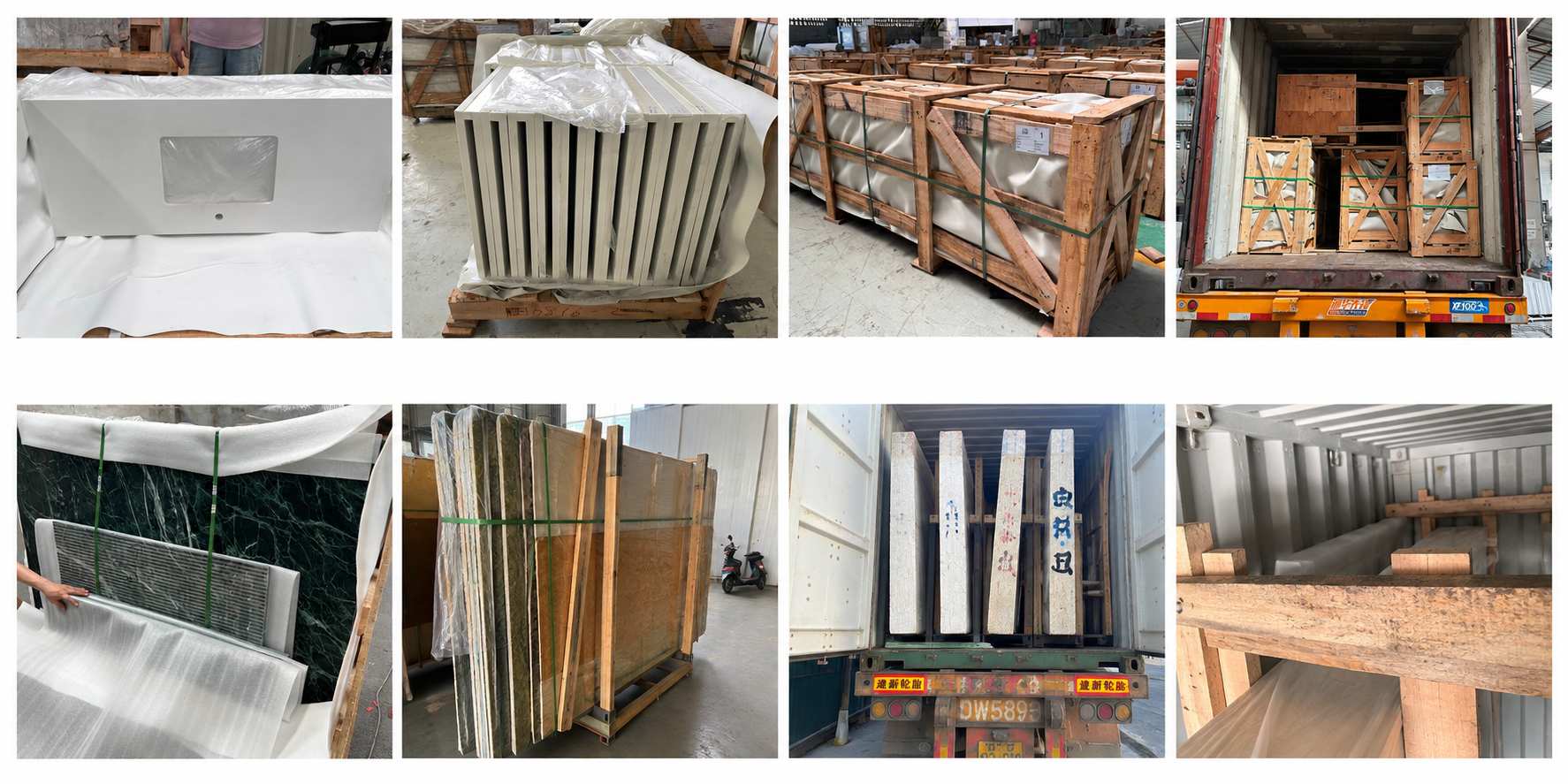
Packing is not a detail. Slabs travel for weeks in a steel box that moves constantly.
Proper packing means heat-treated or fumigated timber frames carrying the IPPC stamp required for customs, high-density foam between polished faces, slabs paired face to face on reinforced A-frames, steel banding, and the frames braced to the container walls so nothing shifts at sea. Slabs must be completely dry before they are wrapped — moisture sealed into a crate for six weeks is how staining starts.
Fibreglass mesh backing is standard on fragile slabs and on thin material. The industry figure for the improvement in break resistance is around 40%. It is not a sign of poor stone; it is a sign the stone needs support during handling, which is true of most large-format thin slab.
Five questions separate a supplier who controls their material from one who resells it.
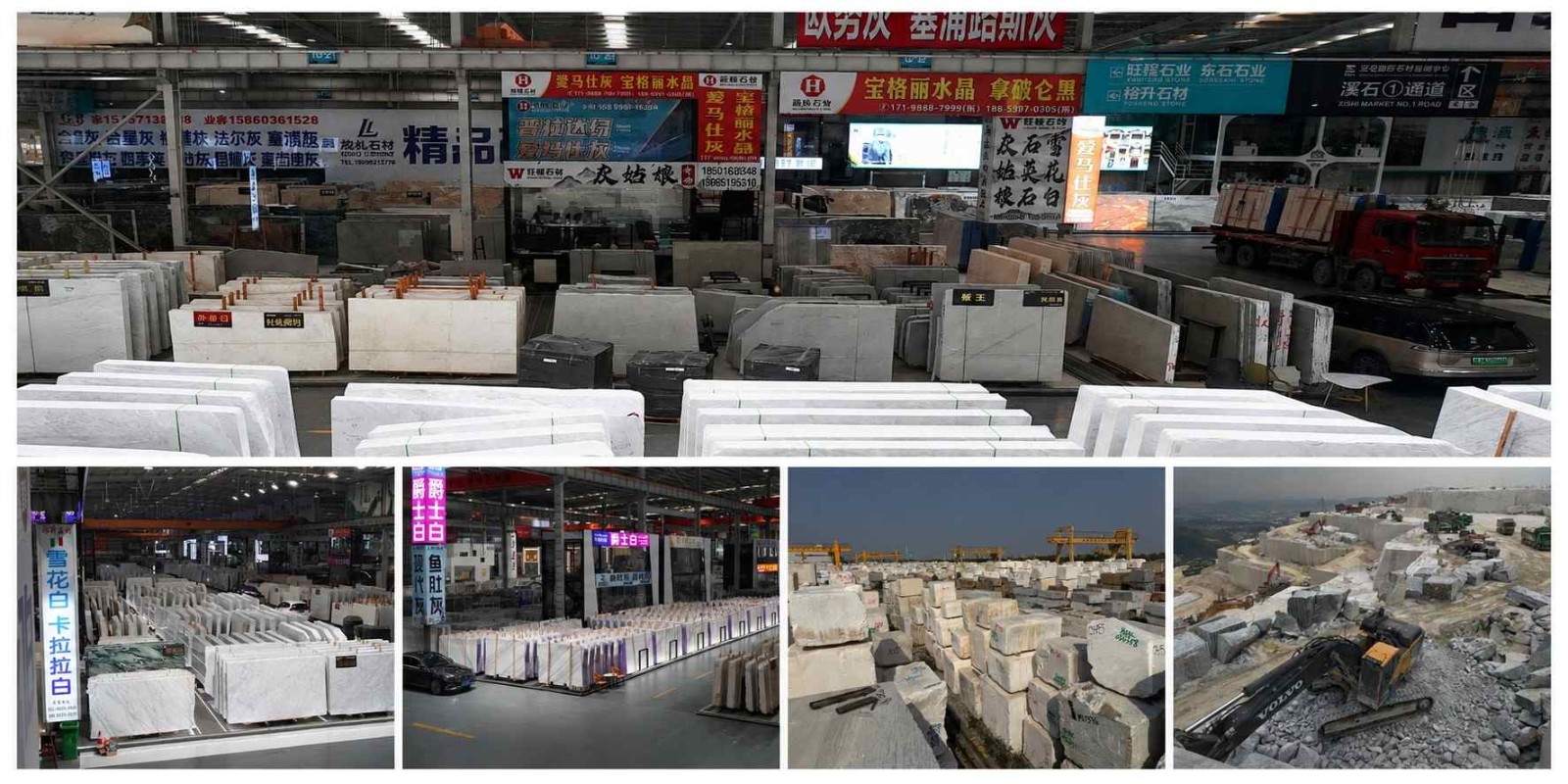
Do you own quarries and processing? Which ones, and where? A supplier who owns block supply can reserve sequential blocks for your order. One who buys on the open market cannot, whatever they promise about consistency.
What do you test before you sell? The answer tells you whether quality control is a process or a sales line.
Can you send me a sample from the batch I will actually receive? This is the question that separates real suppliers from the rest. Anyone can send a hand-picked sample. A batch-representative sample is a commitment.
What is in your lead time, and when does the clock start? Honest suppliers break it down by stage. A flat "four weeks" for a container of white marble is not a real number.
Do they ask about your application? A supplier who hears "hotel lobby floor" and immediately asks about traffic, finish and slip resistance is thinking about your project. One who just quotes a price is selling stone by the square metre.
 |
 |
Three separate things drive the spread.
The material differs. Different grade, different block, different yield — the subjects of the last few sections.
The commercial terms differ. An FOB quote and a CIF quote are not comparable numbers. Neither are quotes with different MOQs, packing standards or thicknesses.
The seller differs. A factory quotes its own cost. A trading company adds a margin on top of a factory's price. Neither is wrong — a good trading company earns its margin — but you should know which one you are talking to.
Background and veining. Carrara has a soft grey-white background with fine, feathery veins. Calacatta has a crisp white background with bold veins in gold and dark grey, and it is rarer and more expensive. Statuario has Calacatta's bright white base with more structured, flowing grey veining. All three come from the same region of Italy.
Check five things: even background colour across the whole slab, balanced vein distribution, no cracks, minimal and cleanly done filling, and consistent finish and thickness. Run your fingernail across any line — if it catches, it is a crack rather than a natural seam. Inspect in daylight, not showroom lighting.
For flooring, 18–20 mm. For countertops and heavy traffic, 20–30 mm. 20 mm is the widely used international standard and the right default for most projects. Below 18 mm, breakage during handling and installation rises sharply.
No. Quality varies by quarry and by grade, in China exactly as it does in Italy, Greece and Turkey. Chinese quarries produce material across the full range, from commercial grade to premium. Judge the specific stone and the specific batch: ask for quarry location, batch test data and a batch-representative sample. Those answers tell you more than the country of origin ever will.
Real marble has irregular, non-repeating veining — no two slabs are identical. It lets some light through in thin sections and rings clear when tapped. Artificial stone shows repeating patterns, is fully opaque, and often has colours that look too vivid or too uniform.
Yes, if it is not protected. Iron minerals in the stone oxidise when they meet water and air, and the result shows through as yellow or brown staining — typically 8 to 12 months after installation. Back-sealing the underside before installation is the most effective prevention. Dolomitic marbles such as Thassos, Sivec and Yunnan Crystal White resist it considerably better than calcite marbles like Carrara.
Yes. Oriental White, Eastern White and China Carrara are three trade names for the same stone. Oriental Fish Belly White, despite the similar name, is a different variety with its own quarry.
Not by itself. Fibreglass mesh backing supports fragile and thin slabs during cutting, transport and installation, and it is standard practice on large-format thin material. What it does tell you is that the stone needs support — so ask why. On a delicate, heavily veined stone that is normal. On a thick slab of a sound material, ask more questions.
Between roughly 10% and 30% of the rock cut from a quarry ends up as sellable slab. Quarry yield runs 15–40% depending on how fractured the deposit is, and processing yield runs 60–75%. That is the main reason white marble is priced the way it is, and why large slabs cost disproportionately more.
7 to 14 weeks door to door, depending on destination. Production takes 29–37 days. Sea freight runs from 12–18 days to the US West Coast on a fast vessel up to 35–45 days to Mediterranean and North European ports. Customs and delivery add 7–15 days.
Choosing the stone is the first half. Browse our white marble range to see what we hold and what we can reserve, go deeper on the varieties in our guide to types of white marble, or read our step-by-step guide to importing marble slabs from China for the ordering, inspection and shipping side.
If you have a project with a date on it, send us the specification. We will tell you what is available, what the real lead time looks like for your port, and what we would need to reserve to keep phase two matching phase one.
Written by Max Wang, who runs Excellent Stone and this site.
The production figures here — yield rates, slab sizes, processing and packing times — are not gathered from other websites. They come from interviews with the manager of our own processing plant, who has fifteen years in white marble and spends his working life on block layout and yield. Where this guide describes what happens on a factory floor, that is the floor it describes.
Shipping transit times are our own routing data. Standards figures come from the published specifications of ASTM International and ANSI. Where a number is an industry rule of thumb rather than a measured value — the grade price spreads, the mesh-backing figure — the text says so.
Last updated: August 2026. Lead times and sailing schedules move. Contact us for current figures on your route.
Categories
New Blog
 ROOM 205,NO.45, MIDDLE HAIJING ROAD,XIAMEN,AREA OF PILOT FREE TRADE ZONE(FUJIAN)OF CHINA
For inquiries about our products or pricelist, please leave to us and we will be in touch within 24 hours.



© Copyright: 2026 XIAMEN EXCELLENT STONE CO.,LTD. All Rights Reserved.

IPv6 network supported