English




Author:Max Wang
Most buyers start with a simple question:
- How is durability defined for granite?
- What does durability include in granite performance?
At first, it seems like durability should be a single property—something you can check in a data sheet, compare, and use to make a decision.
But when you look at real technical specifications, you will notice something different:
There is no single “durability value.”
Instead, you see separate numbers—strength, absorption, abrasion, test results—each reported independently.
This leads to a more practical question:
- How do these numbers actually describe long-term performance?
- Why are multiple factors needed to describe durability?
To answer this, durability must be understood not as one number, but as a way of reading how different types of data relate to each other over time.
In standards such as ASTM C615, granite is defined through separate properties:
- compressive strength
- water absorption
- density
- abrasion resistance
Each property is tested independently and reported separately.
This reflects an important condition:
No single property represents durability on its own.
Durability only becomes visible when these different properties are read together in the right way.
This is why many misunderstand durability:
They try to read it directly from values that were never designed to represent it.
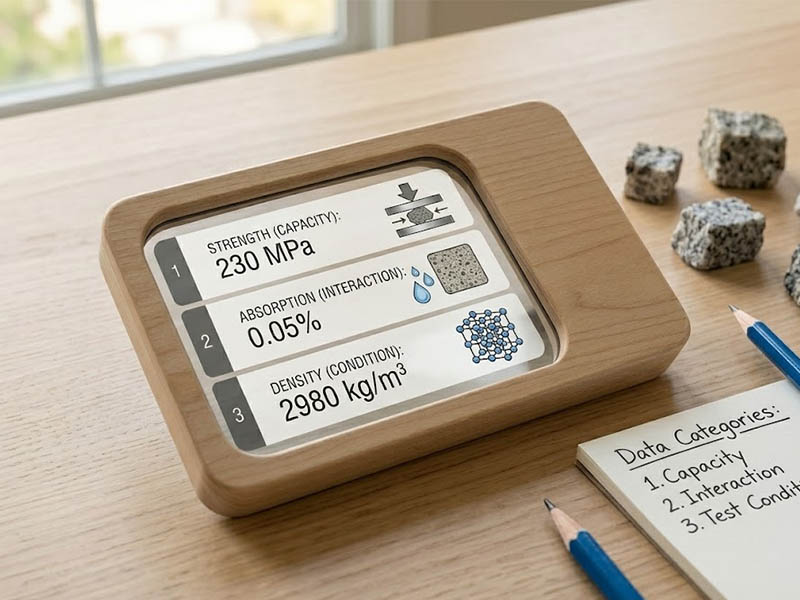
Before asking what durability “is,” the first step is to recognize what each type of data represents:
- some values describe capacity (how much load the material can take),
- some describe interaction (how the material responds to water or environment),
- others describe test conditions (how performance is measured).
These categories must remain separate.
If they are mixed too early, the interpretation becomes unreliable.

Compressive and flexural strength are usually the first values reviewed.
Many granites show high strength values, often above 150–250 MPa.
It is easy to assume that higher strength means better durability.
However, projects show that materials with similar strength can behave differently over time, especially in wet or outdoor conditions.
This tells us something important:
Strength does not describe long-term behavior.
It answers a different question:
- Can the material remain intact under load?
If the answer is no, the material fails immediately.
If the answer is yes, the question of durability begins—but is not yet answered.
Strength should be used only to confirm structural feasibility.
It should not be used to predict long-term performance.
Water absorption is often treated as a key durability indicator.
But materials with similar absorption values can perform very differently in real conditions.
This is because absorption does not tell you what will happen.
It tells you how interaction can happen.
A single value does not describe how water behaves inside the material.
Different patterns may exist:
- water may enter and leave quickly,
- water may enter and remain,
- water may repeatedly enter and exit over time.
These patterns lead to different long-term effects, even if the numbers are similar.
Instead of reading absorption as a score, it must be understood as a pathway:
- how water enters,
- whether it stays,
- whether it cycles.
Without identifying these behaviors, the number alone cannot support any conclusion about durability.
At this point, you may have strength and absorption data.
It is common to assume that similar values mean similar results.
However, real projects show otherwise.
Materials with similar data can show:
- stable performance
- uneven surface change
- localized deterioration
This happens because the data does not include all the conditions that affect performance.
Differences come from:
- exposure patterns (continuous vs intermittent moisture),
- environmental factors (temperature, salts),
- how these factors interact over time.
Data alone does not define performance.
It must be read together with the conditions under which it operates.
Without those conditions, the same dataset can support more than one interpretation.
Standards such as ASTM C97, C170, and others define how granite is tested.
Each test isolates one condition:
- strength under load
- absorption under controlled conditions
- resistance after specific cycles
These tests are reliable—but limited.
They do not represent how all conditions act together in real use.
- Which tests are related to granite durability?
- How do lab tests relate to granite durability?
Each test provides one piece of information.
To understand durability, you must ask:
- what condition does this test represent?
- does that condition exist in the project?
Without this link, test results cannot indicate long-term performance.
By now, you have:
- strength (capacity),
- absorption (interaction pathway),
- environmental context (conditions).
These do not automatically produce a conclusion.
A valid interpretation only exists when all three are considered together.
If one is missing:
- the picture is incomplete,
- the interpretation may be misleading.
To interpret durability, the data must be read in this sequence:
1. confirm the material can remain intact (strength),
2. understand how the environment can interact (absorption and pathways),
3. identify whether those interactions will actually occur (conditions).
Only when these are aligned can the data support a consistent understanding of long-term behavior.
Each value in a data sheet has meaning only within its context:
- strength matters when load is relevant,
- absorption matters when moisture is present,
- environmental factors matter when interaction is possible.
If values are read independently, they can lead to incorrect conclusions.
Durability is not a separate property.
It is the result of how physical properties are interpreted together under real conditions.
At this stage, durability can be understood clearly:
It is not a number, and not a single test result.
It is a way of organizing how material data is read over time.
It answers the question:
- What influences long-term performance of granite?
But it does not answer:
- whether a material is suitable,
- which option is better,
- or what should be selected.
Those questions require additional factors beyond durability.
Durability helps you understand how a material may behave over time.
But a complete technical evaluation requires:
- other performance dimensions,
- project-specific requirements,
- and practical constraints.
Durability is one part of that process—not the final answer.
Granite durability is not defined by a single value.
It is revealed only when data is read in structure:
- capacity
- interaction
- conditions
Without this structure, technical data remains a list of numbers.
With it, those numbers begin to describe how a material may perform over time.
However, this interpretation applies only to one performance dimension.
Used in isolation, it can lead to decisions that appear valid but fail under real conditions.
To understand how durability relates to other performance requirements, it must be placed within the broader framework of granite technical evaluation—where multiple performance dimensions are interpreted together to support consistent decisions.
For a complete view of this structure in practice, see how granite technical specifications are organized for decision-making.
Categories
New Blog
 ROOM 205,NO.45, MIDDLE HAIJING ROAD,XIAMEN,AREA OF PILOT FREE TRADE ZONE(FUJIAN)OF CHINA
For inquiries about our products or pricelist, please leave to us and we will be in touch within 24 hours.



© Copyright: 2026 XIAMEN EXCELLENT STONE CO.,LTD. All Rights Reserved.

IPv6 network supported