English




Quick Answer
Is sintered stone better than porcelain? Neither name is better. They're the same material, pressed and fired the same way. What separates a top slab from an ordinary one is the production line behind it, and in China most top-grade slabs come off lines imported from Italy. Between the two ends sits a middle grade with no name of its own, so one supplier sells it as sintered stone and the next as porcelain. That middle grade is why the same name can come with two very different prices.
Two quotes for the same 1600 × 3200 slab can arrive with two different names. One supplier calls it sintered stone, the other calls it porcelain slab, and the prices are not the same. The natural question is whether you are being sold the same material under a better name.
Sometimes you are, and the name won't tell you. Both names cover slabs made the same way, from ordinary to top grade. And where the dearer slab really is better, that still doesn't mean every project should pay for it. Pay for the part of the difference your project will actually use.
Contents
By how it is made, yes. Sintered stone is made the way porcelain is made: mineral powders pressed into a slab and fired until they fuse. The tile standards define porcelain by a test result, not a recipe. ISO 13006, the international standard for ceramic tiles, puts dry-pressed tiles with water absorption of 0.5% or less in the porcelain group, BIa. ANSI A137.1 draws the same line for ceramic tile in the US.
The best-known makers use different names, and their data sheets cite different standards:
| Who | What they call it | What standard they test to |
|---|---|---|
| Laminam (Italy) | "a porcelain stoneware surface" made from "clay, feldspar, sand and kaolin" | Its technical sheet lists the slabs under ISO 13006:2018, "Dry Pressed Porcelain Tiles", group BIa |
| Dekton by Cosentino (Spain) | "an ultra-compact surface", made from "a blend of raw materials such as glass, latest generation porcelain materials and quartz" | Its technical data sheet is issued "according to EN 14411, ANSI A137.1, ISO 13006", the European, American and international ceramic tile standards |
| Neolith (Spain) | "the world leader of sintered stone", "created with natural raw materials" | Its introduction page doesn't say |
| Lapitec (Italy) | Sintered stone | Its technical data sheet tests to EN 14617, the European standard for engineered (agglomerated) stone |
| China, national standard GB/T 44309-2024 | 陶瓷岩板, literally "ceramic rock slab" | A national standard of its own, in force since March 2025, kept within the ceramic family |
Buyers and sellers argue over whether sintered stone is "really" porcelain, and the table shows why there is no single label to settle it. Laminam calls its slabs porcelain. Neolith calls them sintered stone. Dekton calls them ultra-compact. China gave the material its own standard and still put "ceramic" in the name.
What settles it for a buyer is this: porcelain is not a lower grade, and sintered stone is not a quality grade. Both names cover slabs made by the same process. What separates a better slab from an ordinary one is how far the maker took that process: refined raw materials, more powerful presses, higher firing temperatures and larger formats. The name doesn't record any of that.
Each of the brands that made these slabs well known chose its own word for them, as the table shows. As the slabs reached China and Chinese factories began making their own, 岩板 ("rock slab") and its English twin, sintered stone, became the trade name for the whole category. Today it is used for slabs from the newest lines and from older ones alike. The name tells you the category, not the grade.
You will meet other names too. In Singapore and India, buyers compare sintered stone with "full body tiles" and "vitrified tiles". These are local names for porcelain tiles that are coloured through the body or fully vitrified. They are the same family. What differs is mainly size and thickness, and so where they can be used. "Sintered porcelain", "ultra-compact surface" and "large format porcelain slab" are more names for the same family.
Both names are used across three rough grades of slab, and the name doesn't tell you which one you have.
| Ordinary large-format slab | Upgraded-line slab | Top-grade slab | |
|---|---|---|---|
| How it is made | Standard large-format tile lines | Porcelain-slab lines improved with better raw materials, more pressure and higher firing | The highest pressures and firing temperatures; in China, mostly on lines imported from Italy |
| What sellers call it | Usually porcelain slab, sometimes sintered stone | Either. There is no agreed term for this grade | Sintered stone, porcelain, ultra-compact, or the maker's brand name |
| Look and feel | Convincing in photos, less depth up close | Closer to natural stone | The most convincing depth and texture |
| Price | Lowest | Middle | Highest |
Most of the confusion between sintered stone and porcelain comes from the middle grade. It is better than an ordinary large-format slab, it looks and performs closer to the top grade, and one supplier will sell it as sintered stone while another sells it as porcelain. Neither name is wrong. Neither tells you where the slab sits.
China makes both the top grade and the middle grade. Top grade is not made only in Europe.
The grades explain why two slabs with the same name can be priced apart. Whether that gap is worth paying is decided on the slabs and their test reports.
Start with the baseline. Ask for the test report of the exact product. It gives a result for each property tested, such as water absorption, breaking strength, stain resistance, chemical resistance and lead and cadmium release, so you can check them against what your application needs. For what the report means for food contact and silica, see is sintered stone safe.
Above that baseline, a higher grade can give you two things.
Performance. If the dearer slab is sold as stronger or denser, compare the two test reports on the same test at the same thickness, for example breaking strength at 12 mm or 20 mm. If the reports follow different standards, or one of them leaves the test out, ask for figures on the same standard and thickness. Until you have them, "stronger" is a claim, not a difference you can weigh.
The finished look. The pattern across a full slab, how neighbouring slabs match, how a cut edge looks and the surface up close. They are worth paying for where people will see them, and not where nobody will. None of this shows in a rendering: product images can be made to look like any grade. It shows on a real slab, or in an unretouched photo of one.
Decide where to upgrade by what matters most in each part of the project:
| What the area needs most | What to compare |
|---|---|
| A feature wall, reception counter or island that people look at first | Full-slab photos, how neighbouring slabs match, the surface up close |
| Countertops with undermount sinks or exposed straight edges | A fabricated edge sample of the same series |
| Many identical units, such as apartment kitchens or hotel bathrooms | Price once the specification is met, slab size and fabrication support |
| Floors, especially wet areas | The slip rating of the actual finish |
On countertops, look closely at the edges. Most slabs carry their design on the surface. A mitered front edge can hide the body, but an undermount sink cutout or an exposed straight edge shows the cut slab. If those details are in your design, look at a fabricated edge sample of the same series before you order. Some series carry the design through the body; that is a property of the series, so confirm it on the sample, not from the words "full body" in a catalog. See sintered stone countertops.
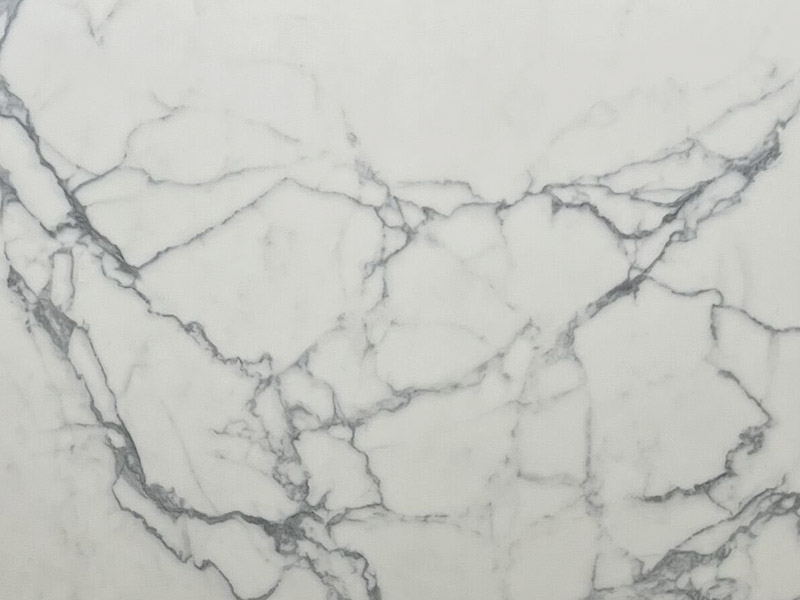
On wall panels, the grade shows where the wall is a focal point: in the pattern across each slab and in whether the veins carry on across the joints. Before you order, judge the series on full-slab photos. Once your slabs are produced, ask for photos of your own batch, laid out side by side, before they ship. Keep one project to one production batch, because shade and pattern can shift between batches; if you will need more later, note the batch number. For large areas of plain cladding in corridors, rooms and repeated units, a slab that meets the specification is usually enough, and price decides. For panel thickness, backing and installation, see sintered stone wall panels.
At every grade, these slabs are hard but brittle. Cutting, drilling and moving them call for tools and handling made for this material. See how sintered stone is cut and fabricated.
On wet floors, do not use a polished surface unless the supplier confirms that finish is rated for it.
Before comparing two quotes, line them up: same thickness, same finish, same slab size, and the same scope, either both for raw slabs or both including the same fabrication.
Then compare what you actually get. Pay more when the dearer slab shows a difference your project will use: a pattern or surface you prefer where it will be seen, an edge that works with your design, or better results on the tests that matter for your application. Don't pay more for a name when the cheaper slab already does the job. A name doesn't justify a premium, and a shared name doesn't rule one out either.
For what goes into a slab price and what a quote should include, see our sintered stone price guide.
For a wider checklist, see how to choose a sintered stone supplier.
For what sintered stone is and how it is made, see what is sintered stone. For how it compares with natural stone, see sintered stone vs granite vs quartzite. For branded alternatives, see Dekton, Neolith and Lapitec alternatives.
We supply sintered stone at different grades. Tell us the application and the budget, and we will tell you which grade each option is and what separates them. On request, we send unretouched slab photos, samples, fabricated edge samples and test reports, and once your order is produced, photos of your own batch before it ships.
They are made the same way, and most leading makers test their slabs as porcelain tile. Lapitec tests to the engineered stone standard instead, and China gave the material its own ceramic standard. In the market, both names cover slabs from ordinary large-format to top grade. Ask what separates two options, then check it on the slabs and their reports, not on the name.
It can be. Porcelain covers everything from basic floor tile to the top slab brands. Laminam, one of the best-known names in the category, describes its slabs as porcelain stoneware. Whether a porcelain slab is high end depends on its grade, not on the word porcelain.
A top-grade slab costs more than an ordinary large-format one. But the price follows the grade and the specification, not the name, so a slab called sintered stone is not always the more expensive one. See our price guide.
The best-known brands are European: Laminam and Lapitec from Italy, Neolith and Dekton from Spain. China also makes top-grade sintered stone, mostly on lines imported from Italy. Chinese factories make the middle grade too.
It won't name the grade, but it lets you compare two offers on the same test at the same thickness, such as breaking strength or water absorption. If the two reports use different standards, ask for figures on the same one. What a report doesn't show is the look: the pattern across a full slab, the match between slabs and the cut edge. For those, use full-slab photos, an edge sample and a sample in hand.
 ROOM 205,NO.45, MIDDLE HAIJING ROAD,XIAMEN,AREA OF PILOT FREE TRADE ZONE(FUJIAN)OF CHINA
For inquiries about our products or pricelist, please leave to us and we will be in touch within 24 hours.



© Copyright: 2026 XIAMEN EXCELLENT STONE CO.,LTD. All Rights Reserved.

IPv6 network supported